Spare a thought for France. This week France 24 asked why the country has become such a ready target for cyberattacks, pointing to analysts who rank it as the most heavily breached large jurisdiction in Europe. Dennis-Kenji Kipker, research director at the cyberintelligence institute in Frankfurt, told the broadcaster that France was a "high-value target with too many unlocked side doors".
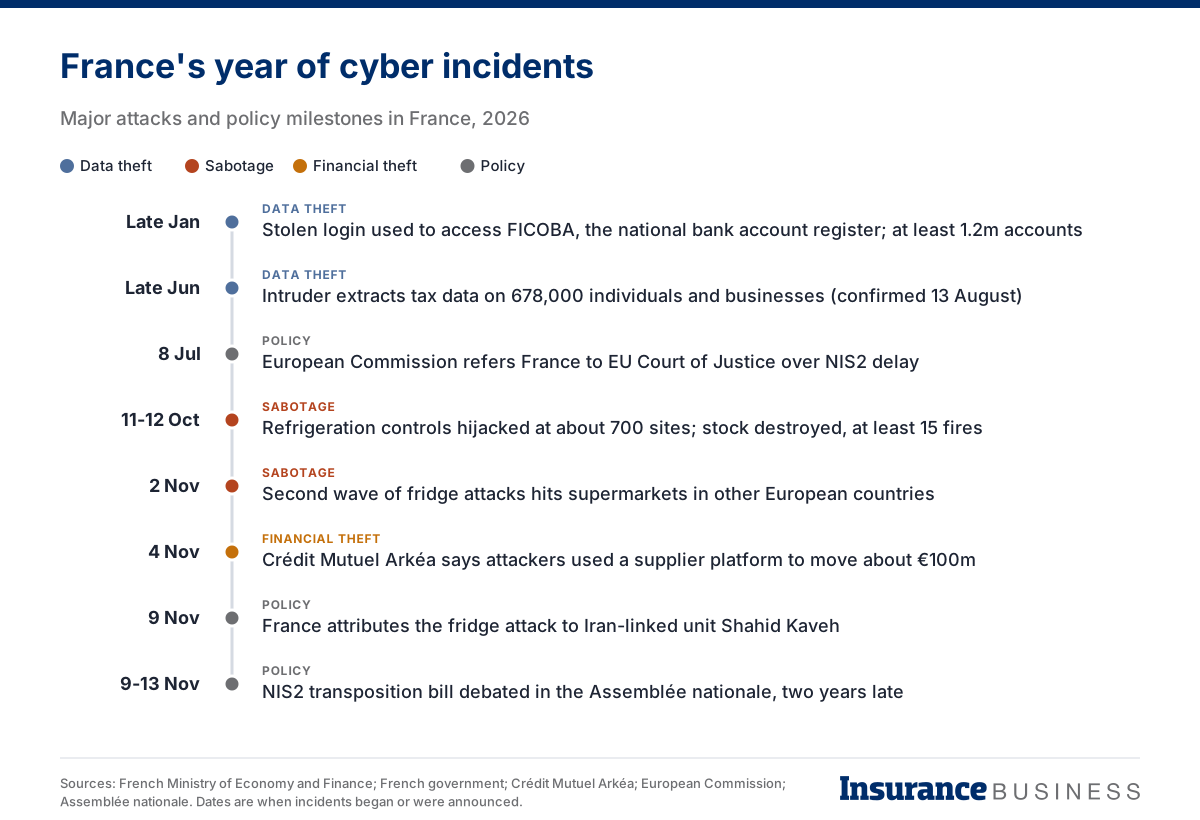
The case for the prosecution is strong. On the night of October 11-12, attackers took control of internet-connected refrigeration systems at around 700 commercial sites, mostly supermarkets, and turned the chiller cabinets into something closer to ovens. Stock was ruined and at least 15 fires broke out, according to French officials. Paris has since pinned the attack on Shahid Kaveh, a cyber unit linked to Iran's Revolutionary Guards.
It was the most memorable incident of the year, but hardly a one-off. In August, the finance ministry confirmed that an intruder had used a stolen login to extract data on 678,000 individual and business taxpayers from the tax authority's systems, including income and property details. Earlier in the year it disclosed unauthorised access to FICOBA, the national register of bank accounts, covering at least 1.2 million accounts.
And then, on 4 November, Brittany-based lender Crédit Mutuel Arkéa said attackers had got in through a platform run by one of its service providers and made fraudulent transfers from the bank's own account. It put the loss at about €100m, though part has since been recovered. Paris prosecutors are investigating.
Read next: French fridges hacked, food destroyed - and the cyber policies almost certainly won't pay
Part of the answer is that France is worth the effort. It is a nuclear power, a permanent member of the UN Security Council and one of Ukraine's main European backers, which makes it a natural target for state-linked groups. It is also a highly centralised state, so a single breach at a national agency or a shared software supplier can expose millions of records in one go.
It has also left a few doors unlocked. EU member states had until 17 October 2024 to bring the NIS2 Directive into national law. France missed that deadline, and on 8 July 2026 the European Commission referred it, along with Spain, Ireland and the Netherlands, to the EU Court of Justice. The French bill that would transpose NIS2, known as the loi Résilience, only reached the floor of the Assemblée nationale this week, more than two years late.
When it passes, the number of sectors covered will rise from six to 18, and around 15,000 French organisations will face new security and incident reporting duties. Until then, none of the NIS2 obligations apply in French law. France's national cybersecurity agency, ANSSI, has been publishing preparatory guidance in the meantime.
Read next: Fridge hackers reach the UK - and the coverage gap comes with them
Whatever the hackers' feelings about France, the bills are real, and each incident lands on a different part of the insurance market.
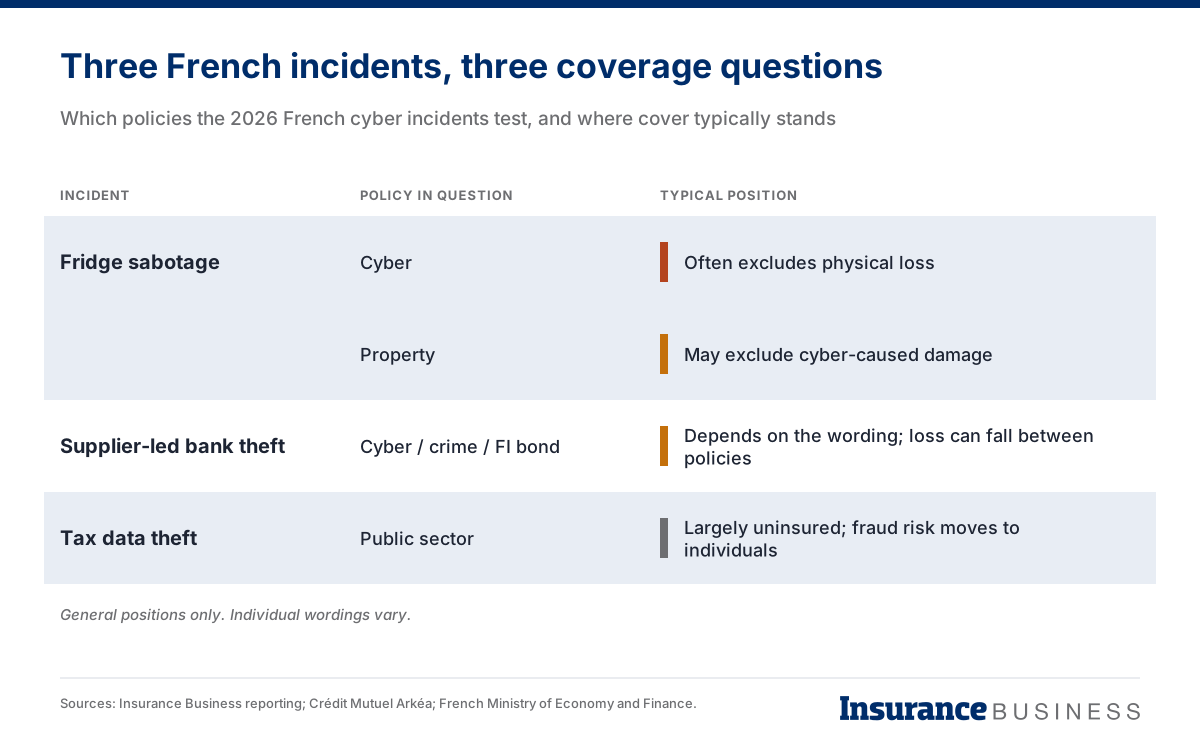
The fridge attack is the clearest case of cyber-physical loss. A hacker changes a setting and the yoghurt is ruined, but nothing is stolen and no data is held to ransom. Brokers said at the time that cyber policies typically do not cover physical losses of this kind, and Intermarché confirmed its own insurance did not respond, as Insurance Business reported in October. Property policies may not fill the gap either if their wordings exclude losses caused by a cyber event.
The weak point was also familiar. Danfoss, the Danish group whose controllers were targeted, said the incidents affected systems running outdated firmware, and researchers had published details of flaws in those controllers in August. For underwriters, that puts connected operational technology, and how quickly clients patch it, firmly on the proposal form.
The Arkéa theft raises a different question: who pays when an attacker comes in through a supplier and moves money out of the client's own account? Depending on the wording, that loss could sit with cyber, crime or financial institutions cover, or fall between them. Brokers with financial services clients will want to know which policy responds to funds stolen through a third party's platform.
The tax breach, by contrast, is mostly uninsured public-sector loss. Its knock-on effect for insurers is downstream, in identity fraud and phishing aimed at the people whose details were taken.
Read next: Fires reported as hundreds of French supermarkets hacked
Probably not. The same France 24 report quoted Rafe Pilling, senior director of threat research at Sophos, who said ransomware groups had listed more victims in Germany and Italy than in France over the past year. France gets the headlines because its attacks have been unusually visible: state-linked sabotage, a raid on a bank, a breach at the tax office. The everyday ransomware and data theft are spread far more evenly.
Nor has France kept the fridge hackers to itself. A second wave of fridge attacks in early November hit supermarkets in several other European countries, and UK food businesses were among the victims, as Insurance Business has reported.
On 10 November, Juhan Lepassaar, executive director of the EU's cybersecurity agency ENISA, warned that routers and household appliances could be next, and urged manufacturers to build security into products from the start. That is a personal lines question as much as a commercial one, as more home insurance customers fill their houses with connected devices.
Read next: UK officially unveils cyber security and resilience bill to counter rising threats
The UK is updating its own rules. The Cyber Security and Resilience Bill, introduced in November 2025, would bring more organisations into the scope of the NIS regulations, require more incidents to be reported and give regulators higher fines.
UK clients with French operations or suppliers have the most direct exposure. But the methods used in France, from hijacked controllers to compromised service providers, can be reused anywhere, and the wording questions they raise apply just as much to policies written in London. Hackers may not hate the French most, but they do seem to enjoy the trip, and the next one could easily be across the Channel.