.jpg)
California's doctors and its health insurers don't often end up on the same side of a lawsuit. This week, they filed one together.
The California Association of Health Plans and the California Medical Association have asked the California Supreme Court to stop the state from putting its restructured managed care organization (MCO) tax into effect.
Their petition for a writ of mandate, filed late Thursday and made public Friday, argues that the Legislature and Gov. Gavin Newsom's administration rewrote Proposition 35, the 2024 ballot measure that capped the tax on commercial health plans, without going back to voters.
The named respondents are the Department of Health Care Services and its director, Michelle Baass; the Department of Finance and its director, Joe Stephenshaw; and state Controller Malia Cohen. Two individuals joined the groups as petitioners: Dustin Corcoran, the medical association's chief executive and an official proponent of Proposition 35, and Charles Bacchi, president and CEO of the health plans association.
Health plans have said plainly that the tax will flow straight into premiums – on top of renewal increases that are already running hot.
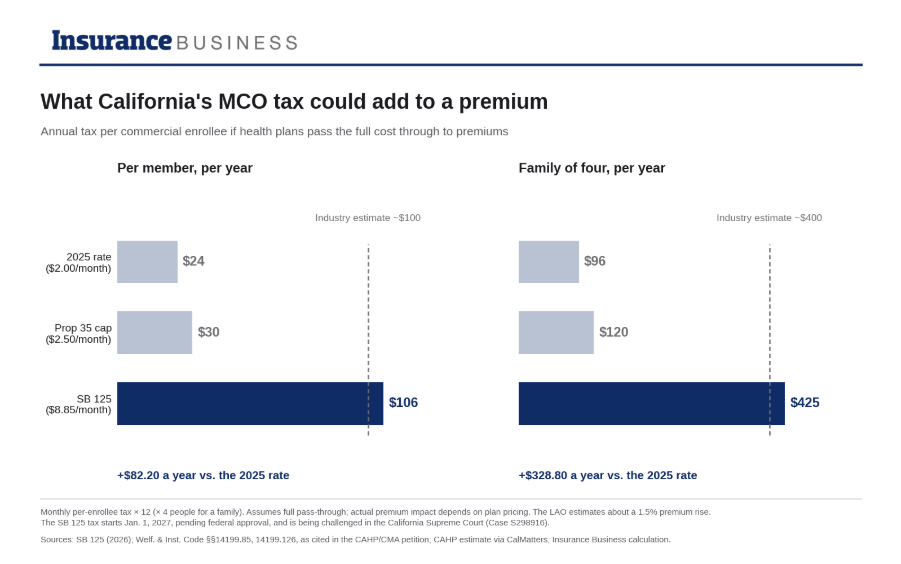
The new levy, created by Senate Bill 125 and signed by Newsom on June 29, charges every health plan in the state the same $8.85 per enrollee per month for 2027 through 2029, whether the member is on Medi-Cal or commercial coverage.
That is a sharp break from the old design. For 2025, according to the petition, the state taxed Medi-Cal enrollment at $274 per member per month and commercial enrollment at just $2. Under SB 125, private plans would pay roughly $1.5 billion a year out of about $2.3 billion in total.
The state's Legislative Analyst's Office estimated that if plans pass the full cost along, monthly premiums would rise about 1.5%. The health plans association puts it in dollars: roughly $100 per member per year, or about $400 for a family of four. Bacchi has described folding taxes into premiums as "just actuarial science."
Read next: Small businesses absorb 31% premium surge rather than cut health coverage
The redesign didn't start in California. H.R. 1, the federal tax-and-spending law enacted in July 2025, tightened the rules on provider taxes. The Centers for Medicare & Medicaid Services followed in February with a final rule barring states from taxing Medicaid enrollment more heavily than commercial enrollment. When CMS announced the rule, it singled out California's structure as an example of the loophole it meant to close.
California is one of seven states with MCO tax waivers that must come into compliance, according to an analysis by McDermott+. The petition says the state has until December 31 to submit a compliant tax to CMS, to take effect January 1, 2027.
The old structure was lucrative, generating between $7 billion and $8 billion in net revenue a year, according to the Legislative Analyst's Office as cited in the petition. The Department of Finance has said it chose $8.85 because that rate raises about $2.3 billion – roughly what the tax brought in before 2023 – with about $2 billion supporting existing Medi-Cal services and about $300 million funding provider rate increases already promised for primary, maternal and mental health care.
That is where the courtroom fight begins. Proposition 35, which voters approved with about 68% support, made the MCO tax permanent but capped the tax on commercial enrollment at $2.50 per member per month and $36 million a year in total. It also locked the revenue into a dedicated fund for Medi-Cal improvements, chiefly higher provider pay, and barred the state from using it to plug holes in the general fund.
The measure lets lawmakers amend it, but only with a three-fourths vote in each house and only in ways that further its purpose. The petition says SB 125 cleared neither bar: it passed without a supermajority, sets a commercial rate more than triple the cap, and routes the money into a new Medi-Cal Stability Fund that can relieve pressure on the general fund.
The state's workaround is to send federal regulators two versions of the tax. According to the petition, the Department of Health Care Services told health plans in August that one version would follow Proposition 35's structure, taxing Medi-Cal enrollment at $192.50 and commercial enrollment at $1.79 – a gap the department concedes CMS will reject. The other is the flat $8.85 tax under SB 125, which the department expects to be approved.
The plaintiffs call that a built-to-fail strategy. Corcoran said the state cannot ignore the law voters passed simply because following it is inconvenient. Bacchi accused California of blowing through a limit voters adopted to protect people and businesses from higher health costs.
The governor's office isn't budging. Tara Gallegos, a Newsom spokesperson, said in an email that the state disagrees with the claims, adding: "we believe the courts will too."
Read next: Employer health plan costs won't fall until brokers change too
The petitioners are asking the state's highest court to take the case directly, skipping the lower courts, and to rule before the December 31 federal deadline. They warn that if SB 125 is struck down after January 1, California could be left without a valid tax and, because H.R. 1 bars new MCO taxes, lose those federal matching funds for good.
They also point to a second deadline. California's next governor must submit a budget by January 10, 2027, and the state's spending plans for 2027 through 2029 count on revenue from the SB 125 tax.
They are asking the court to order the state to drop SB 125, submit a tax that satisfies both Proposition 35 and federal rules, and spend every dollar as the initiative requires.
The medical association was one of the main architects of Proposition 35. It joined the California Hospital Association and Global Medical Response as the campaign's biggest donors, contributing a combined $38 million. Newsom did not formally oppose the measure but warned at the time it would "hamstring" the budget.
The health plans' role is more nuanced. During the 2024 campaign, the plans association said it had not asked for the cap on commercial taxes, and it has historically supported the MCO tax as a way to fund Medi-Cal. Its objection now is the size of the commercial bill.
Consumer advocates are focused less on the tax than on where the money lands. Kiran Savage-Sangwan of the California Pan-Ethnic Health Network told CalMatters in June that it would be unacceptable for consumers to pay higher premiums only for the revenue to backfill the state's general fund.
For benefits advisers with California clients, the timing is awkward. The tax is slated to begin January 1, 2027, or whenever federal approval arrives, which puts it squarely in the middle of next year's renewal cycle.
Employers are already absorbing steep increases. More than a third of U.S. employers saw renewals of 10% or more even after changing plan designs, according to a Gallagher survey data on employer health premiums, and WTW has warned of an 11.1% jump in employer healthcare costs for 2027 for plans that take no corrective action.
Three things will decide what California groups actually pay: whether the Supreme Court agrees to hear the case, how it rules, and whether CMS approves either version of the tax. Until then, brokers may want to build a possible MCO surcharge into 2027 renewal conversations rather than wait for it to show up in a rate filing.