Self-funded employers are losing a growing share of No Surprises Act arbitration cases in which the plan side never made its case. More than one in five federal arbitration decisions in the first half of 2025 were settled by default, according to a white paper the ERISA Industry Committee released September 17, 2026, and providers have gained the most ground in those cases.
In a self-funded plan, a third-party administrator or an administrative-services-only carrier usually handles the dispute and chooses the offer submitted for the plan. The award is still paid from plan assets. KFF's 2025 Employer Health Benefits Survey, cited in the paper, found 67 percent of workers with employer coverage are in self-funded plans, rising to 80 percent at firms with 200 or more workers.
When a plan and an out-of-network provider fail to agree on payment during a 30-business-day open negotiation period, either one can file for the federal independent dispute resolution (IDR) process, where a certified arbitrator picks one of two final offers. If one party doesn't submit the evidence needed to contest the case, the other wins by default. Citing a March 2026 Health Affairs Forefront analysis, the paper said defaults made up 22 percent of determinations in the first half of 2025, a share that has barely moved in several years.
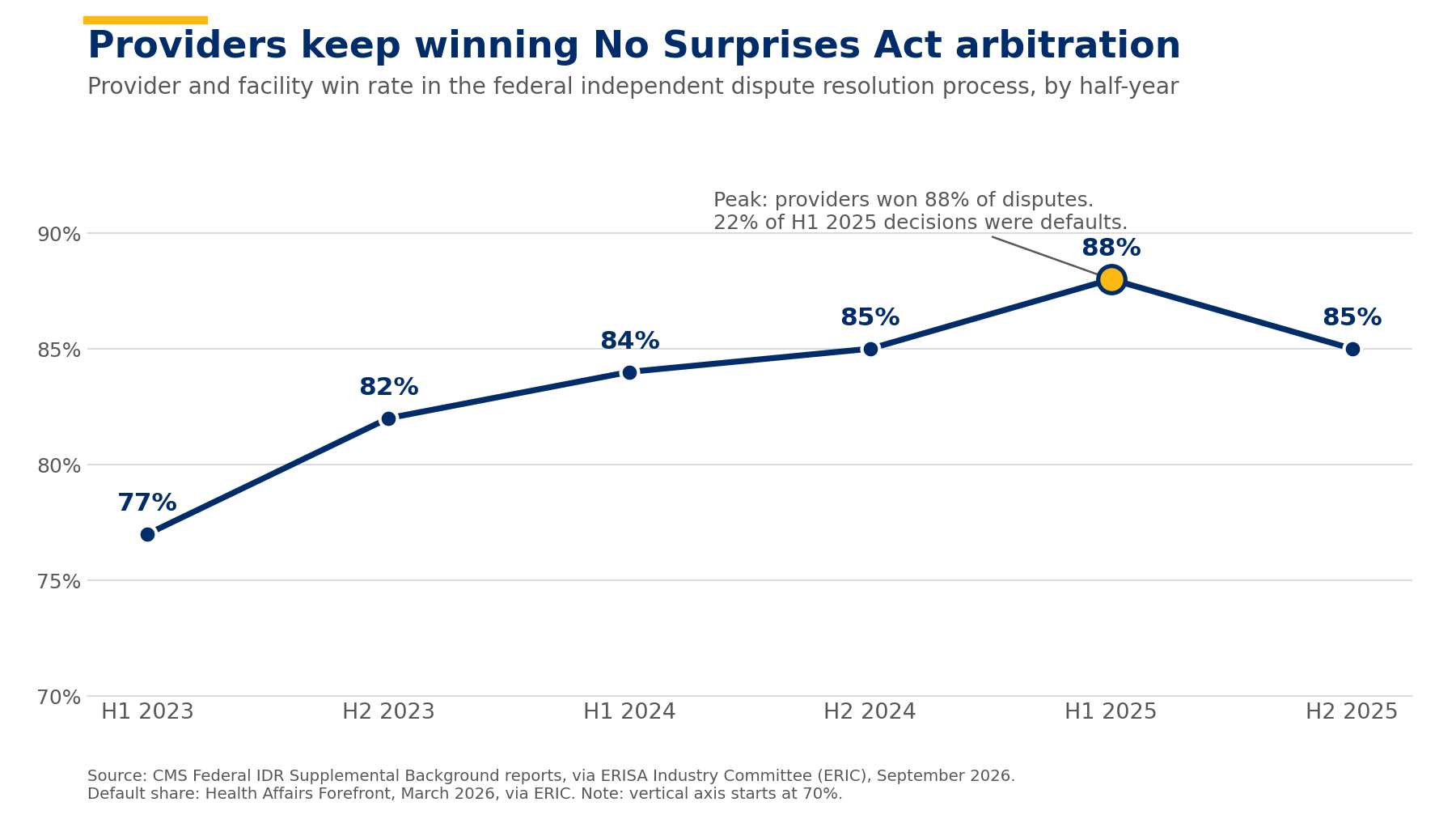
Providers won 59 percent of default decisions in the second half of 2023 and 75 percent in the first half of 2024, based on Centers for Medicare & Medicaid Services (CMS) data in the report. On fully contested cases their win rate stayed close to 86 percent over the same period. The authors read that as a sign that some of the rise in provider wins has more to do with how many cases go uncontested than with how arbitrators judge the merits. Overall, providers and facilities won 88 percent of disputes in the first half of 2025 and 85 percent in the second half.
Federal data don't identify which side defaulted. One sponsor interviewed for the paper suspected its own carrier was defaulting more often than the providers filing against it. Its theory was that a provider group files a dispute ready to fight it, while a carrier handling disputes for its whole book of business may not get documents in on time.
Another sponsor brought IDR management in-house after relying on its administrator and reported a meaningful improvement in its win rate. The statutory factors arbitrators weigh hadn't changed. The authors argued that procedural attrition, not the substance of the claims, explains part of the gap between providers and plans.
Handling disputes directly has limits, though. One sponsor had its representatives offer the qualifying payment amount (QPA), the plan's median in-network rate for a service, plus 10 percent. After two years it found the results had almost no relationship to what it offered. At least one sponsor has also turned down repeated pitches from contingency-fee vendors that wanted to take over its disputes, because it expected their fees to consume most or all of any savings.
Cumulative filings reached approximately 4.8 million through December 2025. The Congressional Budget Office (CBO) and federal regulators had projected roughly 17,000 non-air-ambulance disputes a year before the law took effect. A final rule issued May 28, 2026, lowered the per-party administrative fee from $115 to $15, which the paper expects to push filings higher. Researchers at Georgetown University put total No Surprises Act arbitration costs at $22.4 billion from 2022 through 2025.
Several employers told the committee they couldn't see which providers were driving their exposure or how administrators were handling disputes on their behalf. CMS doesn't report IDR outcomes by plan funding type, which leaves self-funded sponsors without a public benchmark for their own results.
"Employers are shouldering these unintended, unsustainable costs, and we are shouting from the rooftops about the need to fix this system," said James Gelfand, president and CEO of the ERISA Industry Committee (ERIC) in Washington, D.C. He said member companies work to protect employees from unnecessary costs and that an arbitration process "with no basis on real prices, no brakes, and no way to appeal is making that job impossible."
Standard renewal reports don't capture default rates. A broker or sponsor would have to ask the administrator directly how many disputes were filed against the plan last year, how many it contested and lost by default, who set each final offer, and which providers account for most awards. Unless the administrative services agreement requires that reporting, the sponsor may have no way to check the awards it pays.
Under the Employee Retirement Income Security Act (ERISA), sponsors are required to manage plan costs prudently. The paper argued that duty is difficult to meet when a sponsor controls neither the outcome nor, often, the offer made in its name. The benchmark itself is also in flux following the Fifth Circuit ruling that voided the formula for calculating the QPA.
ERIC's white paper on employer exposure asks Congress to restore the QPA as the primary factor in arbitration and create a limited appeals process, and asks CMS to publish outcomes by funding type. A 67-group coalition wants Congress to replace arbitration with a benchmark system entirely. The departments' May rule left the QPA's weight and the lack of an appeals route untouched, according to the paper.