Carriers that build fraud-detection AI in-house will still miss professional fraud rings, no matter how much data they hold, says Bryan Falchuk, CEO of the Property & Liability Resource Bureau (PLRB) in Downers Grove, Illinois.
The reason is structural. Professional rings don’t repeat a scheme at any one insurer long enough for that insurer’s data to reveal it. The stakes are large: the Coalition Against Insurance Fraud estimates fraud costs the US about $308.6 billion a year across all lines, including $45 billion in property and casualty (Coalition Against Insurance Fraud, 2022). The coalition acknowledges the true figure can’t be measured precisely.
[Insert graphic: us-insurance-fraud-cost-by-line-chart.svg. Alt text: Bar chart of the Coalition Against Insurance Fraud’s estimated $308.6 billion annual cost of US insurance fraud by line, led by life insurance at $74.7 billion, with property and casualty at $45 billion.]
“No matter how big you are, you only see what’s presented to you,” Falchuk said. “That’s fine for casual fraud, but for professional fraud, they know better than to perpetrate the same scam with the same carrier in a fixed period of time, because they understand within your dataset you will catch that at some point.”
Pooling signals across companies reveals what each one alone cannot, he said. “If you can see across carriers, then you can start to pick apart the patterns that no one carrier – State Farm, Travelers, Liberty, no matter how gigantic they are – they will never catch.”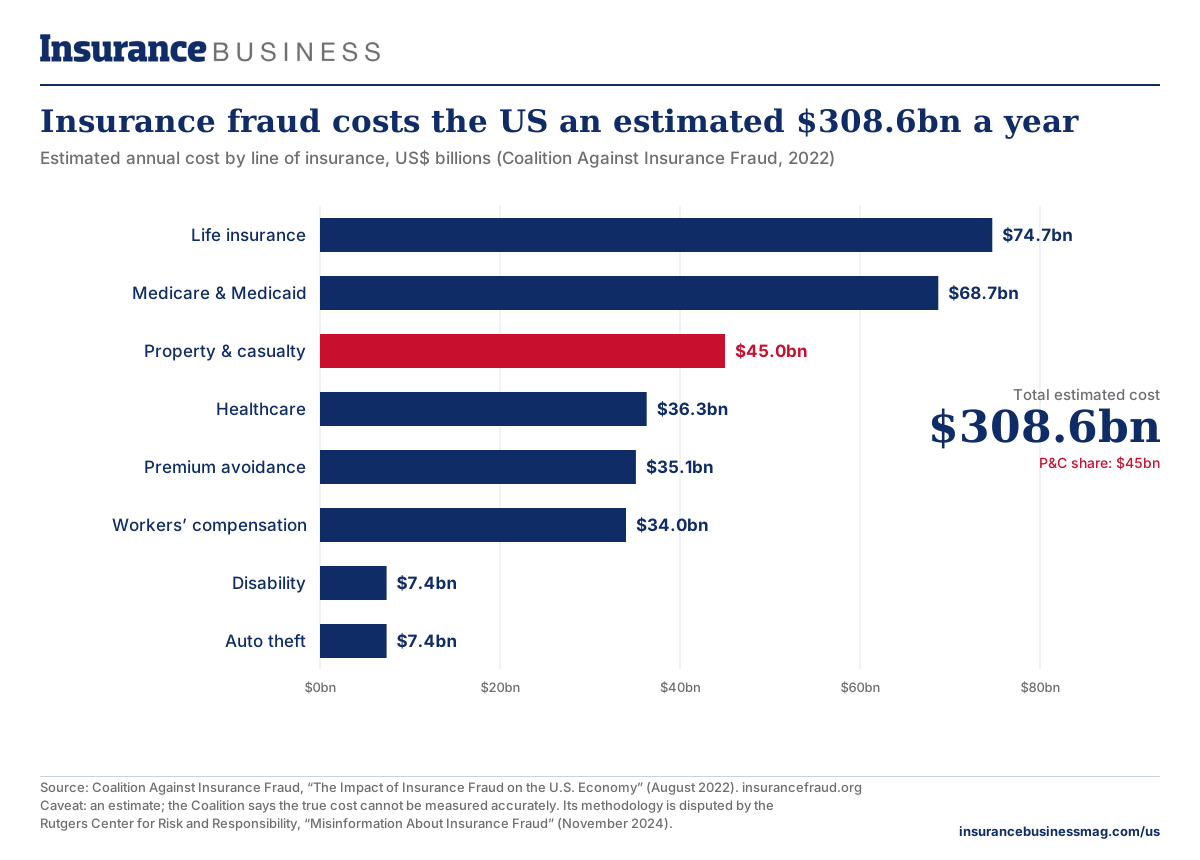
“I don’t like the idea of a carrier building it themselves, even though you can,” Falchuk said. “Just because you can doesn’t mean you should.”
Falchuk said the pattern worth catching increasingly sits in the AI tools fraudsters share, not in one large operation. “It could be a lot of small-time fraudsters, but they’re all using the same shared model to do that fraud. And that’s the level you want to catch the patterns in,” he said.
Adish Kasi, a New York-based vice president and head of core sales at Socure, said the cost of launching and scaling attacks has dropped sharply over the past two years. Fraudsters now “emulate entire digital personas, make up fictitious personas at scale,” he said.
Jennifer Kostyrna, senior director of product management and insurance identity solutions at LexisNexis Risk Solutions in Alpharetta, Georgia, sees both solo actors and coordinated groups attacking insurers. “Sometimes it’s lone wolf single actors, but a lot of times it’s also highly coordinated,” she said. “We see very sophisticated crime rings coordinating attacks on not just insurance websites, but across industries.”
The networks sold by fraud-prevention vendors extend beyond insurance. That matters because policyholders rarely log in to an insurer’s site. “It may be the first time you’ve ever seen this person on your website, but it’s very unlikely that that’s the first time we’ve ever seen that person across our entire digital identity network,” Kostyrna said. “Very likely this device, this IP, this digital identity has been seen somewhere in the banking space, somewhere in the social media space.”
That reach matters more as identity theft increasingly drives insurance fraud losses, a trend the National Insurance Crime Bureau has flagged.
Kasi said that being able to track a person’s activity as they move across rideshare and gaming apps, a neobank, a large bank and a credit card issuer is important. “Having that data across multiple years of a user’s journey is the kind of ingredient that we leverage to fight fraud,” he said.
Banks classify fraud far more precisely than insurers, Kasi said, and that difference shapes what carriers can learn from pooled data. Banks separate stolen identities from synthetic ones. They also split synthetic identities into fabricated and manipulated types, in line with the Federal Reserve’s industry-recommended definition, published in 2021. And they track first-party fraud, in which the real person commits it, as its own category.
“Those taxonomies are never really clearly defined in insurance,” Kasi said. “As I talked to a number of insurers, it’s just fraud, which then turns into an investigation, which then turns into maybe a filing.”
Each label calls for a different response, Kasi said:
“Clearly labeling the type of identity fraud that’s taken place is the most critical piece to get right because it has massive downstream impacts operationally across different teams,” Kasi said. For carriers contributing to a shared network, that labeling also decides whether their reports produce signals other members can use.
Falchuk’s buying test starts with the problem, not the technology. “I’m not here to buy tech. I’m here to solve a problem,” he said.
He separates vendors that need a carrier’s claims data to prove their model works from vendors that have tested it across millions of images and can state an accuracy rate. He also screens out vendors whose methods look fixed, since fraud techniques change month to month. A tool that works today, he said, may leave a carrier “stuck because you will have implemented something that you now need to pick apart and replace.”
He also cautioned against asking a public chatbot to judge a claim, because a wrong answer costs a carrier in both directions. Paying claims the premium never contemplated raises costs for every policyholder, while wrongly denying a valid claim can put a carrier “on the front page of the newspaper,” Falchuk said.
Five questions to ask a fraud-network vendor
For carrier executives weighing an in-house build against a network, Falchuk’s most important test is that first question.