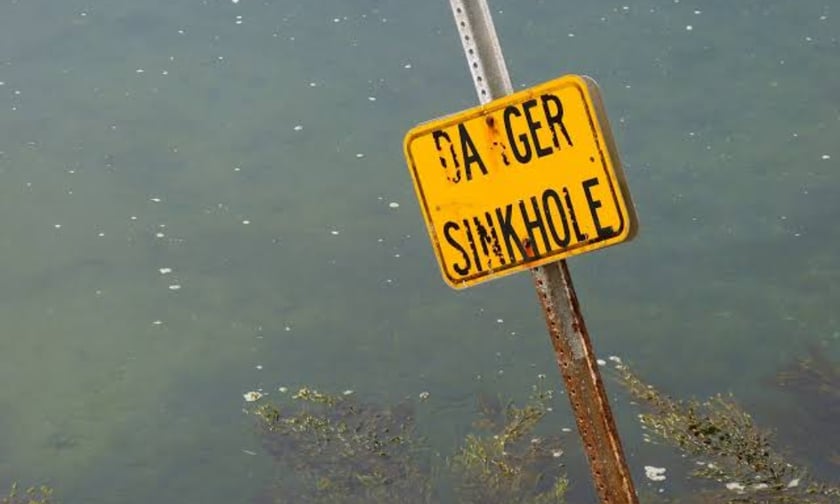
A sinkhole estimated at 30 feet by 30 feet opened outside a Malibu home reportedly belonging to actor Nicolas Cage after the property's driveway collapsed following heavy rain from Tropical Storm Marie.
Cage purchased the home in 2024, according to a prior New York Times report. No injuries have been reported.
Nearby residents said an eight-foot sinkhole had begun forming Monday, before significantly more ground gave way overnight into the 30-foot crater that swallowed much of the driveway. The collapse triggered a gas leak that prompted an emergency response before SoCalGas confirmed the leak had been secured. Malibu city officials have declared at least five homes on the street unsafe for entry, saying emergency access is "severely constrained" given how much of the road has collapsed.
The central insurance question in a loss like this is whether the damage falls under an "earth movement" exclusion, language present in nearly every standard homeowners policy issued in California.
The California Department of Insurance's consumer guidance lists earth movement, landslide, subsidence and sinkholes among standard exclusions, meaning ground collapse typically isn't covered unless a homeowner separately purchased earth movement or landslide coverage. California does not mandate that insurers offer optional sinkhole coverage, unlike Florida and Tennessee, and relatively few homeowners in the state carry the add-on.
The same CDI guidance stated that most homeowners policies will cover an ensuing fire or explosion resulting from earth movement, even when the earth movement itself is excluded.
That means if the gas leak triggered by the collapse had ignited, the resulting fire damage would likely be covered even though the underlying sinkhole would not, a split-coverage outcome common in cases involving a single triggering event with multiple types of resulting damage.
California courts apply the efficient proximate cause doctrine to disputes involving a mix of covered and excluded perils. Under that doctrine, if a covered peril, such as heavy rain or coastal flooding, was the dominant cause setting off a chain of events that included an excluded peril like earth movement, a policyholder may still have a coverage argument.
If the excluded peril was the predominant cause, the claim fails regardless of what triggered it.
Any claim tied to this collapse is likely to turn on whether Tropical Storm Marie's rain and wave action functioned as the efficient proximate cause of the ground failure, or whether the collapse reflects longer-term coastal erosion and bluff instability that would have occurred regardless of the storm.
Malibu's coastal properties sit on unstable bluffs and cliffside terrain, and homes built along the waterline face compounding pressure from wave action, storms and gradual erosion that can undermine foundations over years before a single event makes the damage visible.
That gradual erosion is the kind of foreseeable earth movement insurers are least willing to cover, compared with a sudden, storm-triggered event, which is why efficient proximate cause analysis in cases like this is typically contested rather than routine.
For adjusters evaluating a claim tied to this kind of loss, establishing a clear timeline that distinguishes gradual bluff erosion from the specific storm-driven collapse will likely determine whether a covered-peril argument is available at all.
For brokers serving high-value coastal California clients, the case is a prompt to confirm whether existing clients carry earth movement or landslide endorsements, given how few standard policies include that protection by default.