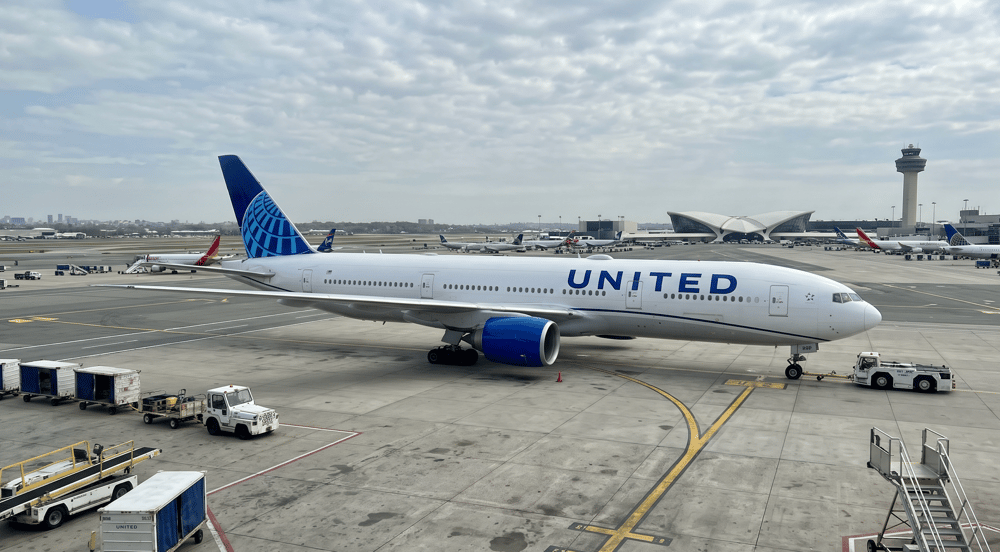
On Friday afternoon, the Federal Aviation Administration stopped every commercial departure in the US after a communications failure hit the centers that guide aircraft between cities. As of the latest reports, the FAA has not announced when departures will resume. Officials point to a telecom outage and say they have no evidence of an attack. Big questions remain about the cause, the backup systems and the cost.
The effects reach well beyond US airports. An Insurance Business employee is stuck on a US-bound flight at Toronto Pearson.
"News is saying they aren't diverting flights, but pilot keeps updating us that the flights we see in the air are all ones being diverted from the USA. Also the Canadian airspace was temporarily closed as well and that isn't being reported," she told us. "Vancouver reopened about 30 mins ago but pilot hasn't updated us on Calgary. Airspace being closed suggests more than communication being down".
The FAA's Air Traffic Control System Command Center ordered every US airport to hold departing traffic from about 3:53 p.m. ET on Friday, November 13. It cited "extraordinary circumstances" and safety. Aircraft already in the air can keep flying to their destinations. Inbound international flights are being handled case by case, which is why passengers in Canada and Mexico are also stuck. Toronto Pearson, a major gateway for US flights, said its operations have been affected.
The trouble showed up first in the middle of the country. Shortly before the national order, both of Chicago's main airports, O'Hare and Midway, were placed under ground stops for an equipment outage. Initial reports suggest Kansas City Center was the first en route facility affected. The FAA has not confirmed that.
Officials have said it's a communications failure, but they haven't confirmed a root cause.
The FAA has described it as a "temporary telecommunications outage" affecting "multiple" Air Route Traffic Control Centers. An earlier social media post from Transportation Secretary Sean Duffy referred to "all" of them. These centers manage high-altitude traffic between airports.
It's not yet clear whether only the radios controllers use to talk to pilots are down, or the radar that keeps planes safely apart as well.
Aviation safety expert Steve Arroyo, a former United pilot, has explained why a radio outage forces a full stop. If controllers can't reliably talk to aircraft, the safe choice is to keep planes on the ground rather than launch flights they may lose contact with.
There's no evidence of one so far. Homeland Security Secretary Markwayne Mullin told reporters there was no indication of a "nefarious attack." He said officials are not ruling anything out and that this is not "another 9/11." Mullin also said the outage is unrelated to the global Microsoft outage the day before.
Lawmakers say they haven't been given answers. Rep. Jim Himes, the top Democrat on the House Intelligence Committee, has said he has not been told the cause.
Read next: Cyber insurance is evolving fast – but systemic risk still outpaces readiness
The numbers are still climbing. By 5 p.m. ET, FlightAware showed more than 9,000 US flight delays and more than 440 cancellations. The FAA's estimated end time has already been pushed into late Friday evening. Even that is an estimate, and the stop could end earlier or run longer.
Those totals include more than the outage. A storm in the Northeast had already disrupted flights on Thursday and Friday.
The longer the stop runs, the worse the knock-on effects will be. Crews will hit their legal duty limits and aircraft will be stuck in the wrong cities. That disruption is likely to carry into the weekend.
Very. The FAA has halted all departures nationwide only twice before. The first was after the September 11 attacks. The second was in January 2023, when a contractor's mistake took down the Notice to Air Missions system. That stop lasted roughly 90 minutes to two hours and contributed to more than 1,000 cancellations. Friday's stop has already gone on longer than that.
It also follows a run of smaller failures. Radio and radar outages have hit FAA facilities in the New York area, Dallas and the Upper Midwest in recent years. Earlier this year, a contractor accidentally cut a fiber line in New Jersey, halting New York-area flights.
American said in a statement that it expects disruption for the rest of Friday and promised an "all hands on deck" recovery once the FAA lifts the stop. United said it is holding new domestic departures while keeping airborne flights moving. Southwest said it is working with the FAA to resolve the problem.
Refunds. If an airline cancels a flight and the passenger chooses not to travel, federal rules entitle them to a cash refund. That holds even when the cause, like this outage, is outside the airline's control. Meal and hotel vouchers are another matter. They are voluntary commitments that usually apply only to delays the airline caused, so travelers stranded by an FAA failure may get little help.
Trip delay cover. These benefits typically pay for meals and lodging once a delay passes a minimum number of hours, often six or more, and stems from a covered reason. A short hold may not qualify. An overnight wait is far more likely to. When the FAA grounded LaGuardia flights last year, Squaremouth said travel delay and missed connection benefits could respond to ground stops.
Missed events. Travelers who miss prepaid plans, such as cruises, conventions or weddings, may look to trip interruption or cancellation benefits. Policy wording on covered reasons will decide those claims. Advisors should tell clients to keep receipts, airline notices and flight-status screenshots, and to check their policy before canceling anything.
The bigger trend. More of these costs are moving from airlines to travelers. A DOT rule taking 10 more delay causes outside airlines' control takes effect February 1, 2027. With Thanksgiving less than two weeks away, delay claims are likely to rise.
Read next: Holiday flight delays highlight growing need for travel insurance protection
For most business clients, probably very little recovery. Property business interruption cover typically requires physical loss or damage. Contingent BI usually needs damage at a supplier. A telecom failure inside a federal air navigation system involves neither.
Cyber policies are an awkward fit as well, because system failure and dependent BI triggers generally focus on the insured's own systems or IT vendors. Event cancellation and parametric flight delay products are better candidates, depending on how their triggers are written.
The larger lesson is about accumulation. Two outages in two days, first a global cloud platform and then national air traffic control, show how shared infrastructure can stop activity across whole sectors without any physical damage. Lockton has warned that cloud outages are putting cyber coverage under new pressure. The CrowdStrike outage showed how dependent business interruption becomes the key question when shared technology fails.
Read next: Assessing the "perfect storm" repercussions of the CrowdStrike outage