In ACORD's 2026 Insurance Digital Maturity Study, which measures how deeply insurers embed and orchestrate digital capabilities across the value chain, only the top echelon of carriers - the 7% it classified as “Digital Competitors” - beat the study average on both profitability and total shareholder return (TSR).
Every tier below, including firms that have already digitalized across their operations, fell short. David Sterner, senior vice president of research and development at ACORD, the New York-based global insurance standards body, says the finding marks a real differential in what separates leaders from the rest; in previous years, multiple tiers together surpassed the average.
The study assessed 210 insurers worldwide (over half, 60%, of the global market and about $4 trillion in gross written premium) and sorted them into five tiers. Digital Competitors posted an indexed relative profit of 135.7 against a study average of 102.5, and a 10-year TSR of 254% versus 202% for the study group and 186% for the S&P 500. The four lower tiers all landed below the average on profit. In earlier editions, ACORD notes, the top two tiers tended to beat the average; this year only the top one did.
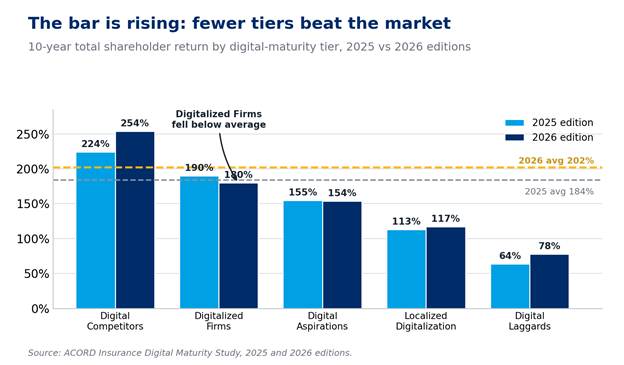
The study's framework measures eight capabilities: customer platforms, data analytics, infrastructure, operations, automation, investment, business models, and culture. “They're all very important, and the order of importance is really going to depend on each individual carrier,” said Sterner. “When we look at the companies at the top of our maturity spectrum, all of these work in harmony... “There's an integration across the organization.”
Pushed to name the highest-impact pairing of capabilities, Sterner landed on the combination of data and analytics; and process automation. Data, he said, supplies “the raw materials of our business” - the feedstock for underwriting, pricing, and claims. Automation then moves related decisions faster. In the study, that pairing surfaces as concrete operational gains at the top tier: straight-through processing for well-defined cases, automated data capture and rule-based handling, and AI woven into daily decision flows to triage, route, and prioritize work while people handle oversight and complex exceptions. ACORD found the most digitally mature carriers push 70 to 90% or more of routine customer interactions through digital or no-touch channels, compressing quote-to-bind and claims cycle times that once depended on manual handoffs.
Together they compound, and the effect cuts both ways. “If you have really good automation and you can move things quickly but you have poor data, you could just make mistakes faster,” he said. WTW's 2026 Advanced Analytics and AI Survey found that insurers using more sophisticated analytics posted combined ratios six percentage points lower and premium growth three points higher than slower adopters between 2022 and 2024.
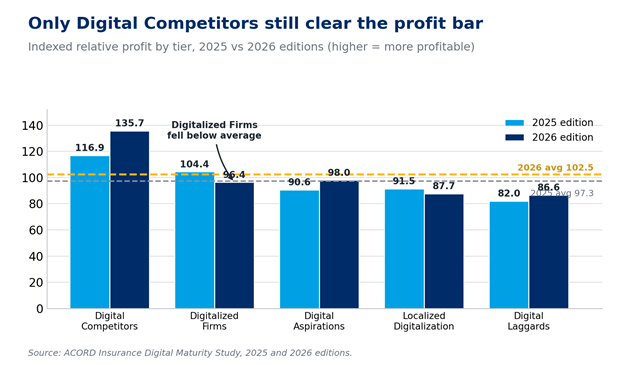
Sterner's sharpest warning targets how carriers choose what to build. Many chase the technology of the moment (today, AI) then hunt for a problem it can solve. Leaders invert that. “It can't be that we find a technology or a capability and we look for a problem to solve,” he said. The strongest organizations start from the business goal and look across capabilities to reach it, and they plan over a longer horizon than the next quarter's point solution. That discipline matters as AI keeps accelerating across insurance and vendors multiply.
That discipline, Sterner argues, is ultimately a question of culture and leadership rather than technology. “It really is a top-down view,” he said. “You have to have in place, at the board level, at the C-suite level, the understanding of the value that digital capabilities can achieve.” The study bears him out: at the top tier, named executives own the digital and data agenda under enterprise governance and active board engagement. Weaker performers chase the hype technology of the moment and buy point solutions to fix narrow problems; leaders take a longer, more holistic view, positioning the organization for opportunities that do not exist yet and pushing resources and permission to experiment down to every level rather than hoarding them at the top.
For carriers climbing from ACORD's middle tiers, Sterner describes a consistent order of operations. First, they confront technical debt and modernize the core. “A lot of companies struggle in this area because they've accumulated what we call technical debt,” he said. Next they build data governance and process automation. Only then do the advanced capabilities - customer portals, AI, advanced analytics - pay off, because the foundation can finally carry them. Carriers making that climb increasingly recruit senior technology leaders to drive AI across specialty lines.
The line between a merely digitized firm and a true Digital Competitor comes down to ambition, Sterner said. Digitized firms use technology to do existing things better - cheaper, faster, cleaner.
But Competitors use it to do entirely new things: digital investments that generate new products, services, and revenue streams, not merely lower costs. In the study, that ambition shows up as usage-based pricing, risk-management services sold alongside cover, and the commercialization of a carrier's own platforms, APIs, and analytics - revenue that traditional underwriting never produced. Competitors also plug into partner journeys through APIs and embedded flows, pushing coverage into new channels such as embedded insurance, which platforms like those chasing the mid-market growth gap now pursue. “Are they looking at leveraging emerging tech like AI and advanced analytics to enable new business opportunities rather than just reducing costs?” Sterner said - that question, more than any single tool, sorts the tiers.
Just as telling is what a carrier does after a pilot. Top performers, Sterner said, practice what ACORD calls incremental innovation: running many experiments, then industrializing the ones that work. “They're doing a lot of pilots,” he said, “but they're also turning those pilots into actual implementations, and they're able to scale those across the organization.” The result reaches the bottom line - Digital Competitors grew premiums at a 6.7% compound annual rate while lifting profits at 12.9%, expanding the business and its margins at once rather than trading one for the other.
Sterner sees the same discipline defining the next phase of AI. Carriers that win, he said, will move past the hype and embed AI in real process flows rather than bolting it on as a point solution. ACORD's own analysis puts the prize at up to 14.6% in expense reduction for property and casualty insurers - more than $480 billion a year across the industry, with over $300 billion more for life insurers. The gap between the 7% and everyone else, on the study's evidence, will keep widening - and it will track how well carriers execute, not how much they spend.