Australian businesses are putting more money into leased vehicles than at any time in more than two decades of data, and the cost of insuring those vehicles is climbing at the same time.
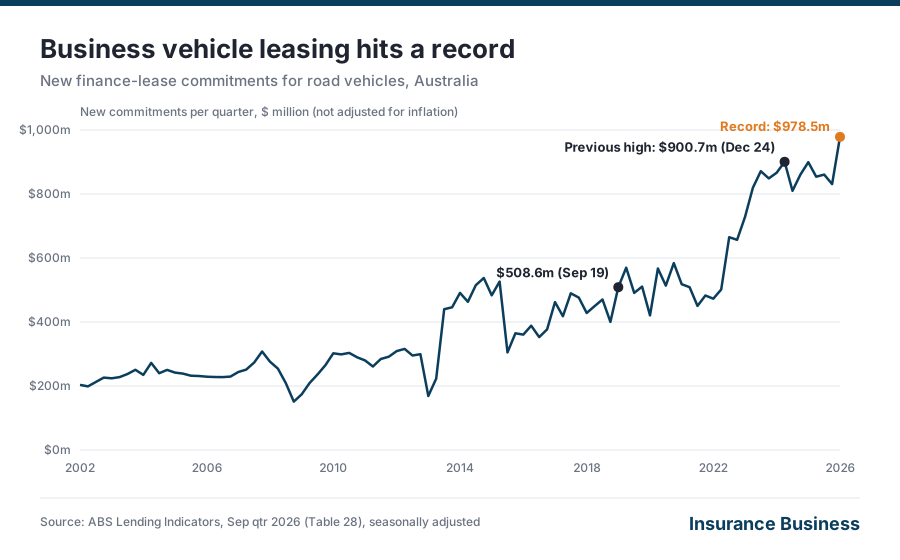
New finance-lease commitments for road vehicles reached $978.5 million in the September quarter, seasonally adjusted, according to lending indicators from the Australian Bureau of Statistics released on Wednesday. That is up 17.8% on the June quarter and 8.8% on a year earlier, and almost 9% above the previous record of $900.7 million set in the December quarter of 2024.
In unadjusted terms, the quarter crossed $1 billion for the first time. Quarterly leasing for road vehicles has nearly doubled since September 2019, when it stood at $508.6 million.
For fleet underwriters, record lease values flow straight through to exposure. Dearer vehicles mean higher sums insured, and every write-off is paid at today's replacement prices.
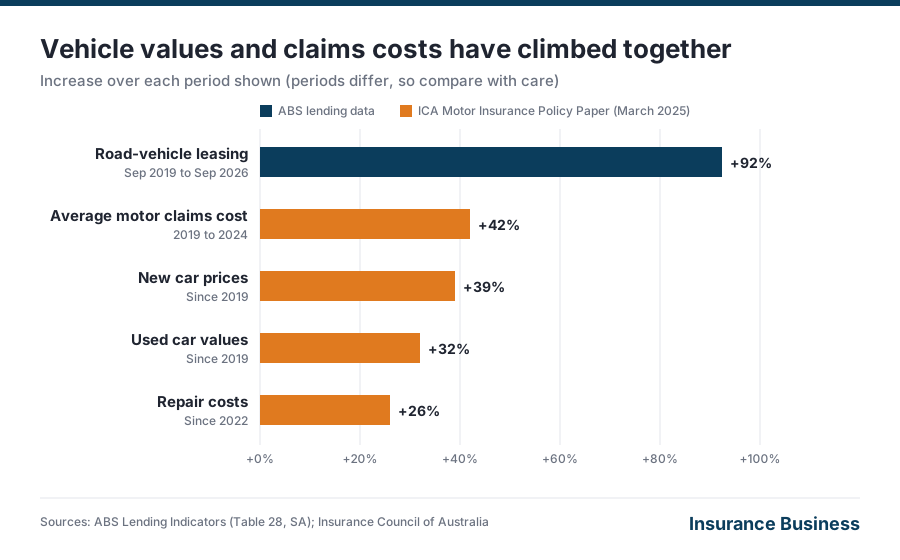
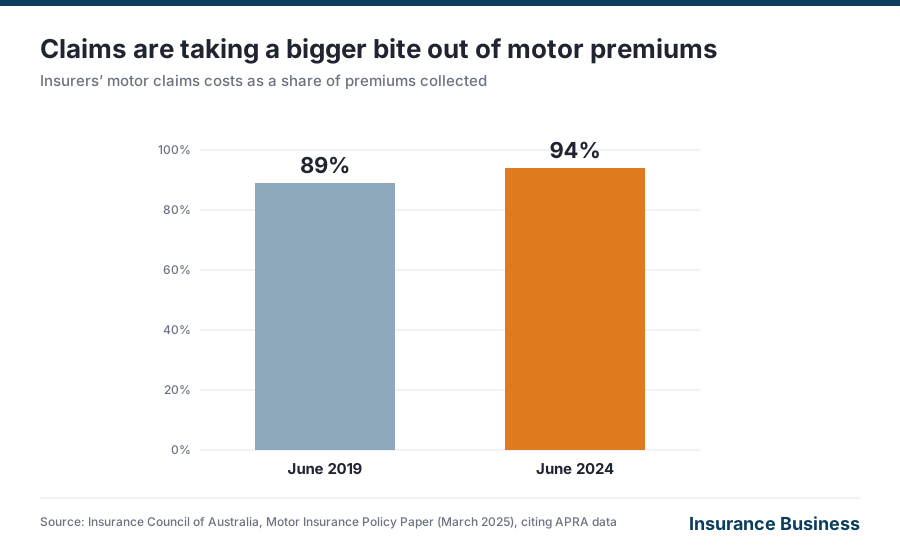
Those prices have moved a long way. The Insurance Council of Australia's motor insurance roadmap found new car prices rose 39% and used car values 32% between 2019 and 2024, a trend Insurance Business has tracked as repair costs keep pushing more vehicles into total-loss territory. The same paper put the rise in repair costs at 26% since 2022, with repairs making up around 60% of what insurers pay out. Average claims costs rose about 42% from 2019 to 2024, and motor claims as a share of premiums collected climbed from 89% to 94%.
The pressure has not let up. The ICA now puts the average motor claim at $6,266, up 32% over four years, as renewal season brings another round of steep increases.
Those costs are already reshaping commercial renewals. Insurance Business reported in September that rising claims costs are widening the gap between commercial fleets, with insurers increasingly pricing on what a fleet can prove about its own risk. That report cited Bellrock Advisory's January market overview, which found small vehicle and small fleet policies commonly facing increases of 5% to 10%.
For a business that has just added leased vehicles, that puts telematics data, driver training records and a clean claims history at the centre of the renewal conversation.
Part of the jump in lease values is likely to reflect the switch to pricier electric and hybrid vehicles. Battery EVs outsold every other fuel type for the first time in August, and repair networks and claims data are still catching up.
That gap shows up in pricing. An April analysis by actuarial firm Taylor Fry found EV premiums ranged from on par to 39% above comparable petrol models, depending on the insurer and vehicle, as Insurance Business reported in its coverage of Australia's growing EV insurance challenge. Fleets adding EVs and newer Chinese brands are bringing that uncertainty straight onto commercial books.
The leasing record does not necessarily mean more vehicles on the road. The ABS figures measure dollar value, not vehicle numbers, and are not adjusted for price changes. Light commercial sales, the utes and vans at the core of many small business fleets, fell 14.4% year on year in July and 22.1% in August, according to Federal Chamber of Automotive Industries VFACTS data.
The likeliest explanation is pricier vehicles, a shift towards leasing over other forms of finance, or both. The ABS release does not say which. For insurers, the value per vehicle is the number that counts.
Leased vehicles come with strings attached. Lessors typically require comprehensive cover and expect to be noted as an interested party, so brokers need to make sure new leases are added to fleet schedules promptly and correctly.
Gap cover, which pays the difference between the insured value and the amount owed on a lease if a vehicle is written off, deserves a fresh look. With EV resale values volatile, a lease balance can quickly exceed market value.
Automatic cover for newly acquired vehicles, standard in many commercial fleet policies, often comes with value caps and notification deadlines. A fleet adding expensive vehicles quickly can breach both without anyone noticing until a claim.
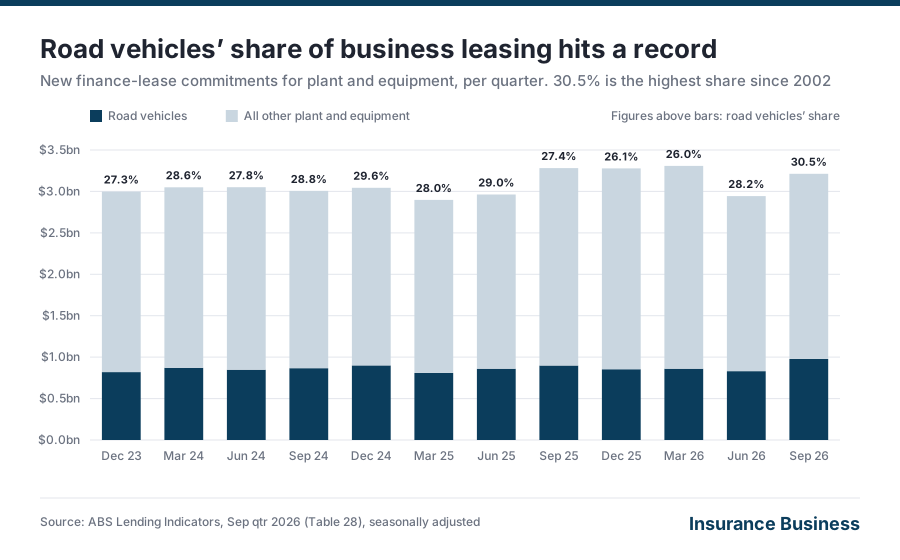
The broader leasing numbers were also strong. Total new finance-lease commitments hit a record $3.73 billion, and road vehicles now make up 30.5% of leasing for plant and equipment, up from 27.4% a year ago. Leasing of other transport vehicles and equipment rose 30.5% to $241.9 million, its highest level since early 2014, which marine and transport underwriters may want to watch.
Businesses are still investing in vehicles despite higher interest rates. For commercial motor insurers, that growth is arriving with higher values and higher repair bills attached.