New research from Real Insurance indicates a marked shift in how Australians approach their working lives, with many prepared to trade income for wellbeing and flexibility amid ongoing cost-of-living pressures and uncertainty about artificial intelligence. The Real Jobs of the Future 2026 report finds 59% of workers would accept lower wages in exchange for improved overall wellbeing, while 76% say mental health and work-life balance now influence their career decisions.
The Real Jobs of the Future 2026 report, produced with consumer research firm MYMAVINS, is based on an online survey of 5,011 Australians aged 18 and over conducted between January and March. The study explores attitudes to AI and technology, financial pressure, flexibility, and how different generations expect their careers to develop. The findings show younger cohorts reporting stronger preferences for flexibility and reduced hours. Among Gen Z respondents, 65% say they are more likely to consider lower pay in return for fewer working hours, similar to 64% of Gen Y. Almost three in five Gen Z workers (59%) indicate they are likely to leave their current employer in the next 12 months to pursue higher pay, more flexible arrangements, or clearer career progression.
Flexibility has become a central feature of job choice. Nearly 89% of respondents say flexibility and autonomy are more important than they were five years ago. Around 66% indicate that a four-day workweek is appealing, with women and Gen Y reporting the highest levels of interest. Career trajectories are also shifting. Two in three respondents (66%) expect to have multiple careers or very different roles during their working life. More than four in five (86%) have either taken up or would consider non-traditional arrangements, including side businesses (44%), casual or shift-based roles (31%), or running their own business (30%).
Managing director and recruitment specialist Keiran Hathorn said these patterns reflect long-standing dynamics in the labour market. “We are standing at a genuine inflection point in the world of work. I have seen cycles come and go, from the dot-com boom and crash through to COVID and now the rapid rise of AI. One thing that remains constant is the push and pull between employers and employees. Flexibility, purpose, and engagement have always been the forces shaping the employment market,” Hathorn said.
Read next: More Australians depend on income support after injury and illness - CALI
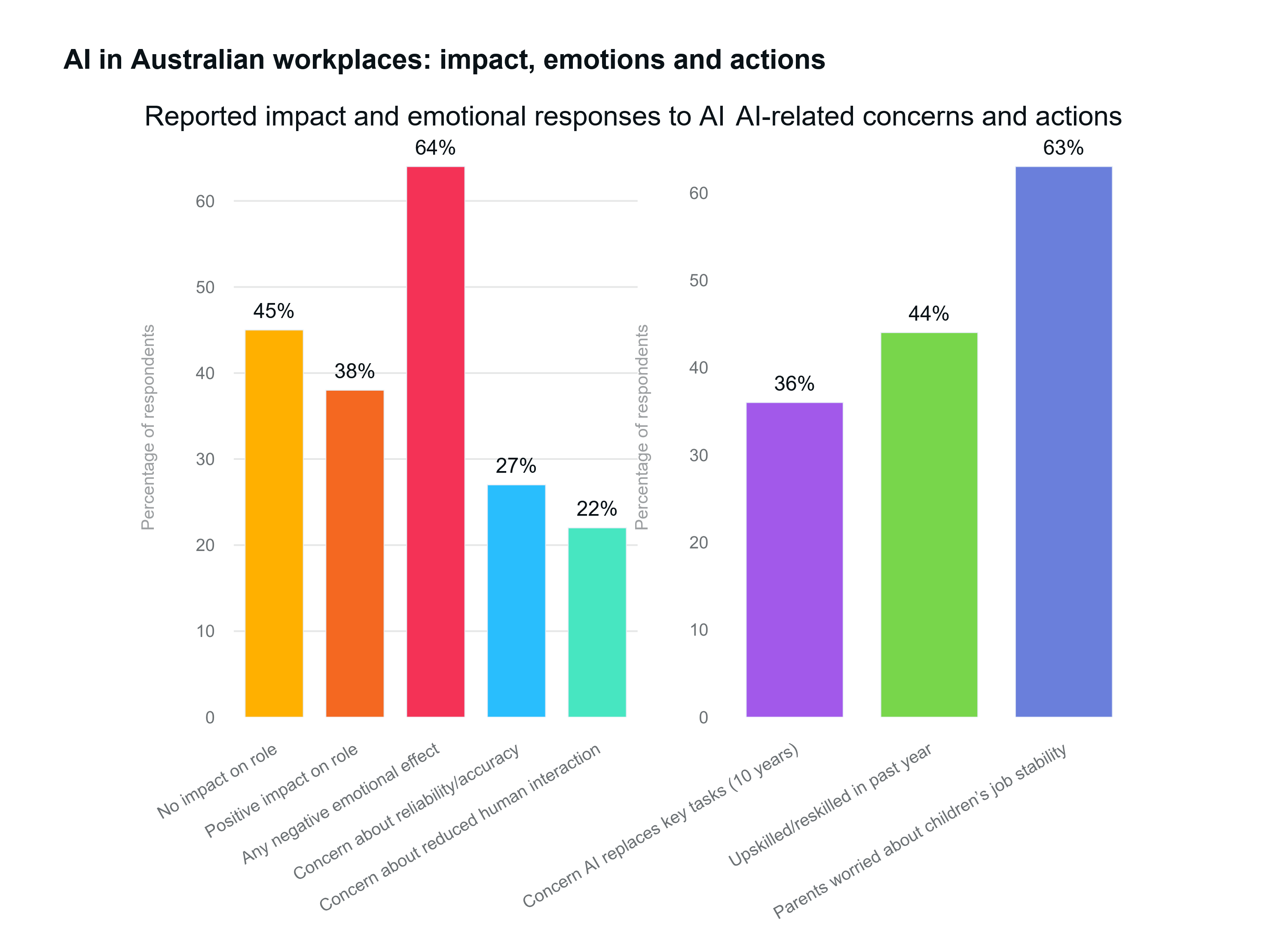
The Real Insurance data points to a mixed response to AI in the workplace. About 45% of workers say AI and automation have not affected their current role, and 38% report a positive impact. At the same time, nearly two in three respondents (64%) say they have experienced at least one negative emotional response to AI at work. The most cited concerns relate to reliability and accuracy (27%) and reduced human interaction (22%). More than one in three workers (36%) are concerned that AI could replace key tasks within their role over the next decade. In response, 44% of Australians say they have engaged in upskilling or reskilling over the past 12 months to reduce the risk of redundancy linked to technological change.
Hathorn said worker sentiment on AI is divided. “There are two dominant camps. One believes AI will replace large parts of human work, creating uncertainty about what comes next. The other, where I sit, sees AI as an enabler. A tool that removes repetitive and mundane tasks, allowing people to focus on more creative and meaningful work. The hesitation around AI is understandable. It is not just the technology, but the uncertainty of where it lands. The truth is no one fully knows yet. What I do know is that every major shift creates opportunity for those willing to adapt. AI will be no different,” Hathorn said.
Legal and regulatory developments are evolving alongside these changes. Accredited specialist and senior lawyer Roxanne Hart noted that employees covered by the Fair Work Act who have at least 12 months’ service can request flexible hours, a reduction in working days, or remote work. “Certain employees have the right to request flexible working hours, a reduction in working hours/days, and remote working. There have been recent changes to the Fair Work Act which now give certain employees (and employers) a right to apply to the Fair Work Commission to resolve the dispute. The Fair Work Commission must try and mediate the dispute and if that is unsuccessful it can arbitrate the dispute and make a binding decision on the parties,” Hart said.
Hart also referred to the “right to disconnect,” introduced in 2024. She said the reforms were intended to support productive flexible and remote work while setting clearer expectations around contact outside contracted hours. “Essentially ‘availability creep’ has been caused by changes in technology and the line between flexibility and unreasonable expectations has been blurred, resulting in negative consequences for the wellbeing of workers,” she said.
Read next: Nearly two million workers lose sleep over job pressure - Allianz
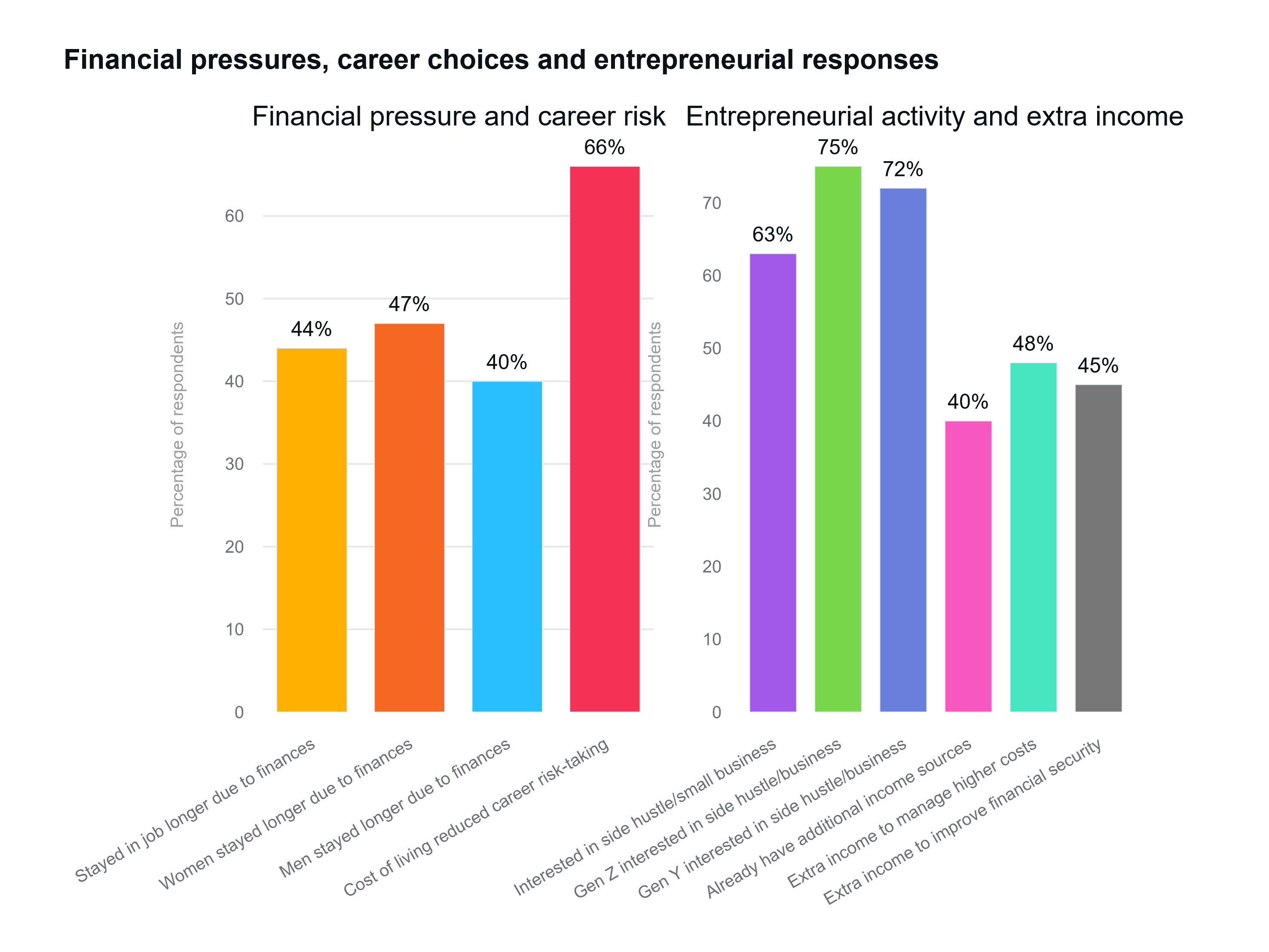
The Real Insurance report links the current economic backdrop to more cautious job moves and a greater focus on security. Around two in three Australians (66%) say rising living costs since 2020 have reduced their appetite for career risk or non-traditional work. Financial pressure is also influencing tenure: 44% report staying in a job longer than they wanted because of money concerns, including 47% of women and 40% of men. Alongside this, many respondents are seeking to diversify their income. More than three in five (63%) are interested in starting a side hustle or small business, rising to 75% among Gen Z and 72% among Gen Y. About 40% already have additional income streams, primarily to manage increased expenses (48%) and to support financial security (45%).
When asked what would most strengthen their sense of security in the labour market, nearly half of respondents (48%) identify income protection or other financial safety nets. Subsidised or fully funded training (41%) and flexible upskilling options (40%) are also cited. Respondents see responsibility for protecting future job prospects as shared across institutions. They assign the greatest responsibility to government (67%), followed by employers (57%), individuals (46%), and the education and training system (43%). Support for further structural changes is high: around 64% back a right-to-disconnect law and 80% favour a broader shift toward what the report describes as “life-work balance.”
Allianz Australia’s March 2026 research and claims data align with the Real Insurance findings on workplace wellbeing, highlighting implications for insurers and employers. Allianz estimates nearly 2 million Australian employees often lose sleep due to work-related stress and pressure, and 74% of surveyed workers believe their organisation does not have a clear strategy to reduce burnout. This perception comes despite an estimated $36.2 billion in wellbeing and cultural initiatives allocated by Australian businesses, with one in 10 organisations planning to spend more than $100,000 this year.
Surveyed employees nominate specific measures they would value: 45% point to mental health days and wellbeing leave, 31% call for steps to reduce administrative and unnecessary tasks that contribute to cognitive overload, and 35% want improved in-office benefits such as free coffee and lunches to support social interaction and breaks. Almost one in five (18%) say they would consider negotiating pay in exchange for flexible or hybrid working arrangements.
Allianz workers’ compensation data shows a 17.3% relative increase in primary psychological claims between the 2024 and 2025 calendar years. The insurer reports that 42.3% of psychological claims are associated with mental stress and work pressure, and that psychological injuries cost about 2.7 times more than physical injuries. The research also finds nearly 2 million employees hold negative feelings toward their work, three in four say they lack clear channels to raise burnout concerns with their manager, and 15% report that work demands are affecting their relationships with friends and family.