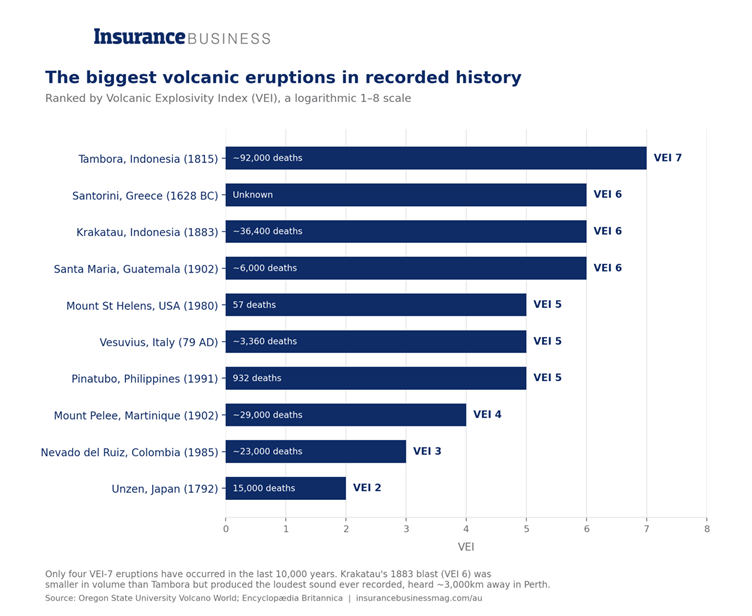
Just before 4am local time on Sunday, Anak Krakatau – the young, restless offspring of the volcano that reshaped the planet's climate in 1883 – blew its top in the Sunda Strait, sending two distinct ash plumes into the sky above Java and Sumatra. One cloud climbed to roughly 6,100 metres and drifted north-east over Jakarta and Banten; the other punched up to about 15,200 metres and pushed west across Lampung, Bengkulu and out over the Indian Ocean.
By sunrise, Jakarta's Soekarno-Hatta International Airport – the busiest in the country – had suspended all operations. Angkasa Pura, the airport operator, put the toll at 301 disrupted flights, 58 of them international, with 170 aircraft left sitting on the apron overnight.
By Sunday evening, Indonesia's transport ministry said the disruption had grown well beyond that first tally: eight airports across Java and Sumatra were temporarily closed, more than 1,558 flights had been delayed, and around 170,000 passengers were left stranded nationwide. Singapore Airlines pulled its Jakarta services for the day. Qantas cancelled its four direct return flights between Sydney and Jakarta and Melbourne and Jakarta, and said its operations team was rerouting other services around the affected airspace. Garuda Indonesia's Sydney–Jakarta run was delayed rather than scrapped outright.
Further afield, schedules to Hong Kong, Amsterdam, Seoul, Doha and Kuala Lumpur all felt the knock-on effect, alongside domestic cancellations to Bali, Surabaya and Lampung.
Indonesia's Centre for Volcanology and Geological Hazard Mitigation and the Darwin Volcanic Ash Advisory Centre both tracked the plumes by satellite. No injuries were reported and no evacuation was ordered – the nearest village sits more than 16 kilometres from the crater – though a three-kilometre exclusion zone remains in force. The island, formed after Krakatau's catastrophic 1883 eruption and now roughly a quarter of its original size, sits on the second-highest of Indonesia's four alert tiers.
This eruption isn’t a sudden new risk. A flank collapse at Anak Krakatau triggered an underwater landslide and a tsunami in December 2018 that killed more than 430 people; scientists later measured some of the rock chunks that slid from the volcano's flank at 70-90 metres high. This volcano's risk profile runs well beyond ash and delayed departures.
Australian travellers caught up in it face the familiar scramble at check-in counters and call centres. The more interesting question, for brokers and insurers, is how much of that bill is actually covered by a policy.
Read next: Bali volcano threat highlights importance of travel insurance
Every time a volcano in the archipelago acts up, the same coverage question resurfaces: were you insured before the mountain made headlines? Standard cancellation benefits generally respond to natural disasters and severe weather, but insurers apply "known event" cut-off dates the moment a hazard becomes public knowledge – after which new policies, or upgrades to existing ones, simply won't respond to that specific peril. Anyone who bought cover before Friday, when Anak Krakatau's geological agency first flagged elevated activity, is in a materially stronger position than someone who purchases today.
Consumer group CHOICE notes that most Australian travel insurers do cover natural disasters, but only for policies bought before the event becomes a "known event" - cover levels and cut-off timing still vary significantly between insurers, which leaves plenty of room for disappointment at claims time even among policyholders who did the right thing and bought early. Allianz Partners research shows 82% of Australians now intend to buy travel cover before their next trip, so appetite for the product is strong — the gap is in understanding what it excludes.
Read next: Travel insurance a priority for Australians amid rising costs – Allianz Partners
Indonesia's health ministry has urged residents in ash-affected areas to stay indoors and wear masks, after schools cancelled activities and residents reported eye and respiratory irritation from falling ash. For Australians already in the region, that points to a second, slower-moving claim sitting alongside cancellation cover: most travel policies bundle in overseas medical benefits, but treatment for eye irritation, respiratory complaints or other ash-related symptoms falls under a policy's medical section, not its cancellation section - and the sub-limits and excesses that apply there vary just as much between insurers as the "known event" cut-off dates do.
While passengers at least have a shot at a travel insurance payout, airlines themselves sit in a much colder position. Business interruption cover in aviation is traditionally triggered by physical damage to an insured asset – a fire, a collision, structural failure – not by an ash cloud that simply closes the sky. That gap was pushed into the limelight during the 2010 eruption of Iceland's Eyjafjallajökull, which grounded roughly 100,000 flights across Europe and, according to the International Air Transport Association, cost carriers more than US$1.7 billion in lost revenue in less than a week.
Aon's global risk consulting arm said at the time that standard aviation business interruption wordings simply weren't built to respond to that kind of loss, since no property had actually been damaged. Australian and New Zealand carriers hit by the Puyehue-Cordón Caulle ash cloud the following year found themselves in an almost identical bind, with brokers noting few, if any, airlines carried the specialist non-damage cover needed to soften the blow.
Swiss Re and others have since built niche "non-damage business interruption" products covering ash clouds, earthquakes and extreme weather, but uptake remains limited, and price scales with how much risk an airline is willing to retain itself. For carriers like Qantas and Garuda, that likely means Sunday's disruption is absorbed as an operating cost rather than an insurance claim.
Read next: What are the biggest risks your clients are facing?
For brokers with clients travelling to or through Indonesia, this is a practical moment rather than a theoretical one. Confirming exactly when a policy was purchased relative to Friday's activity warning is now the single most important claims variable in play. Clients already overseas should be pointed toward their insurer's emergency assistance line rather than left to negotiate directly with airlines, and anyone travelling to the region in the coming weeks should be advised that a second eruption, or a prolonged elevated alert status, could trigger a fresh cut-off date at short notice. Indonesian authorities have also pushed airlines to speed up refund processing given the scale of cancellations, which is worth flagging to clients weighing an airline refund against a travel insurance claim, since pursuing both at once can complicate settlement.
Fifteen years on from Eyjafjallajökull, the products on both sides of this equation still haven't caught up with how often ash clouds and other non-damage catastrophes are grounding flights. Sunday's eruption is unlikely to change that on its own - but it's another data point brokers can use when the next client asks why "the volcano" isn't covered the way they assumed.