At about 3:53 p.m. Eastern on Friday, November 13, the Federal Aviation Administration told every airport in the country to hold its departing traffic. It took until 8:15 p.m. for the agency to reopen US airspace, and airlines warned that untangling the knock-on cancellations could take days.
The stop landed on one of the busiest windows of a busy week. Some 11,000 flights, carrying more than 1.5 million passengers, had been due to leave US airports after 4pm, according to aviation data firm Cirium, as reported by MarketWatch. Transportation Secretary Sean Duffy said more than 3,500 aircraft were already airborne when the order went out and the Associated Press counted at least 600 diversions.
The damage kept compounding after the stop lifted, as aircraft and crews ended up in the wrong places. About 15,000 flights were delayed or canceled on Friday, CNN reported, citing FlightAware, and Flightradar24 counted nearly 10,000 cancellations to or from US airports through Saturday. Counts were still moving at the time of writing.
Washington was quick to blame equipment that is decades past its prime. But for anyone who has read the federal audit trail, the more important thing is how long the warnings have been sitting there.
Why it matters for insurers: the outage fell into the gap between what airlines owe and what travel policies cover. When air traffic control is at fault, carriers generally owe little beyond a refund, which leaves trip delay, missed connection and interruption benefits to absorb hotels and meals. Even by the government's timelines, the system is unlikely to be much sturdier before the end of 2028.
By Friday evening, the official explanation had settled on hardware. Duffy told reporters at the White House that switches and routers in the FAA's analog telecommunications network had become overloaded with data and stopped passing reliable information to controllers.
Homeland Security Secretary Markwayne Mullin said officials had seen no sign of a cyberattack. What tipped the routers over has not been confirmed. Some outlets have reported that a network update at a contractor may have been involved, but no official account has backed that up.
Mullin added that officials were looking at incompatibilities between the old equipment and newer technology now being installed, Axios reported. If that line of inquiry holds up, the upgrade program itself becomes a near-term source of risk as installations speed up through 2028.
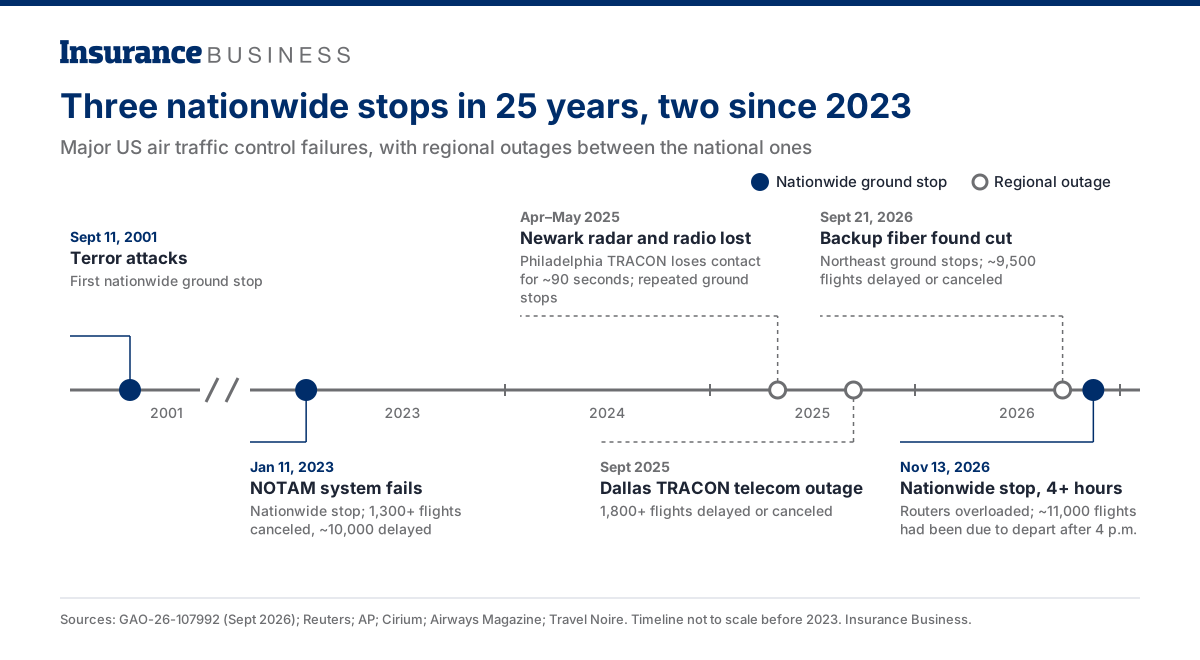
This was the first coast-to-coast stop since January 2023, when a corrupted file in the system that sends safety notices to pilots froze departures. Before that, the only precedent was the September 11, 2001, attacks, according to the GAO.
It also came less than two months after a regional warning shot. On September 21, a communications circuit at the FAA's Philadelphia radar facility failed, and when the system reached for its backup, technicians found the fiber had been severed by a construction crew in New Jersey. Ground stops hit Newark, Philadelphia, JFK, LaGuardia and Teterboro, and roughly 9,500 US flights were delayed or canceled by nightfall, Reuters reported.
Read next: FAA grounds every US departure as air traffic control communications fail nationwide
On paper, the US has had a dedicated way to pay for air traffic infrastructure since 1970. That year's Airport and Airway Revenue Act created a trust fund fed by ticket, cargo and fuel taxes, and it remains the only money behind the FAA's facilities and equipment account, according to the Congressional Research Service.
In practice, the tap has been shut more than once. The fund's taxing authority lapsed for most of 1996 and again in early 1997, costing it about $5 billion in forgone taxes, CRS estimates.
A two-week lapse in the summer of 2011 drained another roughly $400 million, by the FAA's estimate, the Government Accountability Office noted.
Then came sequestration. In 2013, automatic federal spending cuts required the FAA to find $637 million in savings. The agency furloughed staff, including controllers, and drew up plans to shut 149 contract towers at smaller airports.
Within days, airport delays forced a fix. The Reducing Flight Delays Act of 2013 let the FAA move up to $253 million, largely from airport grant money, into its operating budget. It ended the furloughs, but it did so by raiding capital funds meant for the long term to keep the lights on in the short term.
The 2023 outage prompted the FAA to grade every one of its 138 air traffic control systems. The verdict, published by the GAO in September 2024, was grim: 51 were unsustainable and 54 more potentially so, more than three-quarters of the total.
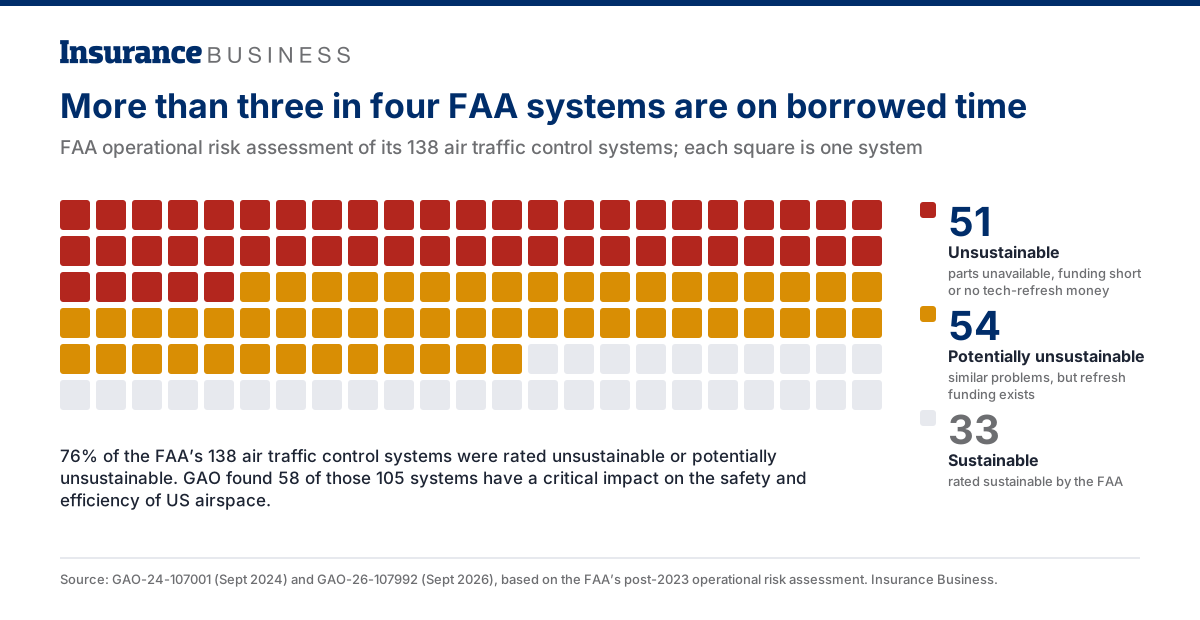
The reasons ranged from parts that are no longer made to a shrinking pool of technicians who know how to fix decades-old equipment. Of those 105 troubled systems, 58 have a critical impact on the safety and efficiency of national airspace, the watchdog said.
Money to replace them kept falling short. In a 2024 hearing, then-FAA Administrator Mike Whitaker described the agency's facilities as long underfunded, while the White House budget pegged the gap at $5.2 billion just to sustain some operations. Neither chamber's fiscal 2025 transportation bill included the administration's proposed $8 billion, five-year facility and radar replacement plan.
What the agency did spend largely went on life support. In written testimony to the Senate before his confirmation in 2025, current Administrator Bryan Bedford said he had been told that more than 90% of the FAA's roughly $6 billion annual modernization budget was going to maintain the old system, leaving almost nothing for genuine upgrades.
Read next: DOT takes airlines off the hook for 10 delay causes – and travel insurance fills the gap
After a string of close calls and radar blackouts at Newark in 2025, the Transportation Department unveiled its "Brand New Air Traffic Control System" that May. Congress approved $12.5 billion for it in July 2025, with $9 billion earmarked for systems and the rest for buildings, according to a GAO audit published in September.
The same audit found real progress and real risk. By May 2026, the FAA had swapped 2,560 of its 5,170 aging copper lines for fiber, roughly half. The administration put the figure at 68% on Friday, a number that could not be independently checked.
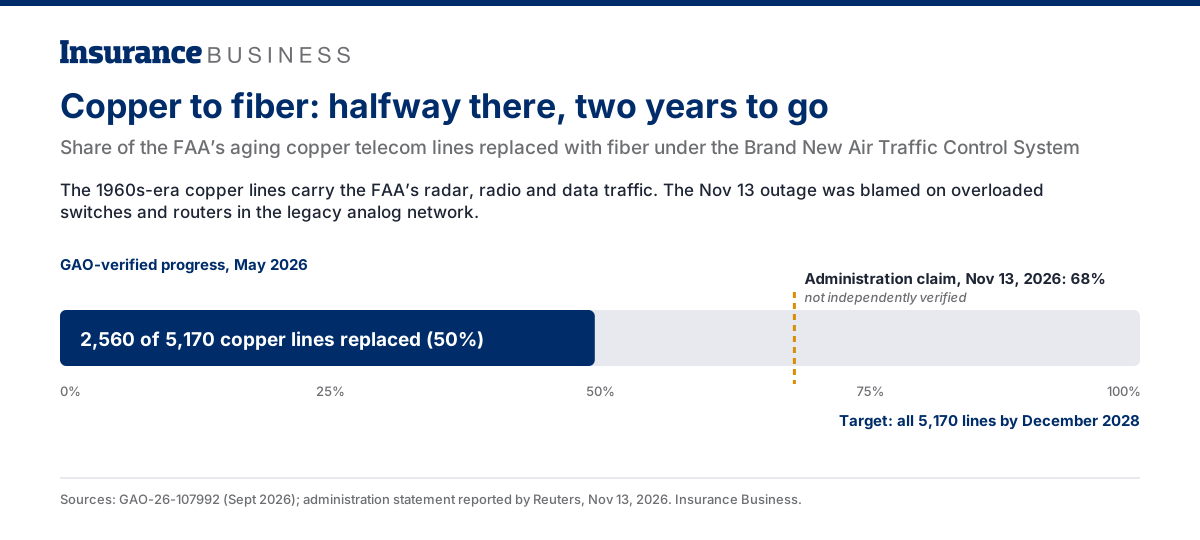
But the GAO also found that the FAA had no reliable lifecycle cost estimate for the program and no integrated master schedule. Instead, it was juggling 11,389 separate project schedules that did not talk to each other, meaning crews could visit the same site repeatedly for different installations.
Phase one, due by December 2028, is still about $574 million short. Phase two, which would replace the core automation that tracks aircraft, needs roughly $10.2 billion more, and the President's fiscal 2027 budget asks for just $860 million to begin it.
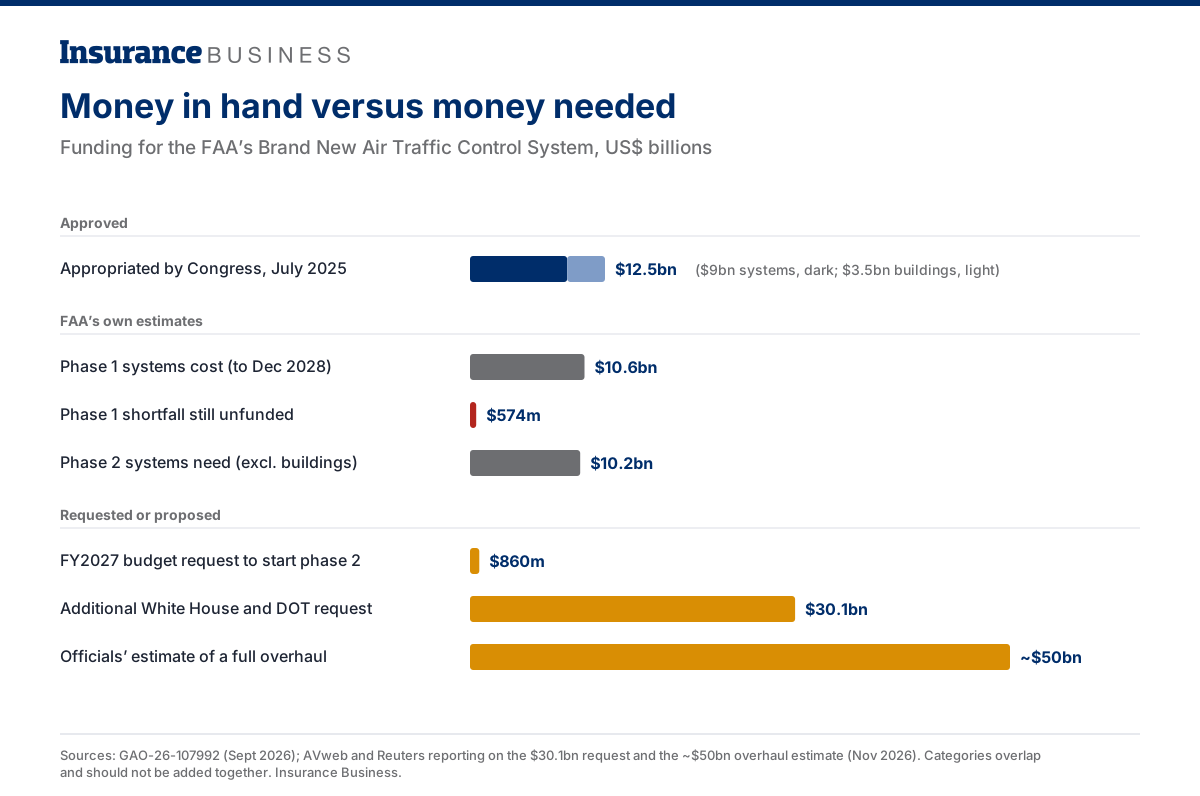
This week, the White House and Duffy pressed Congress for a further $30.1 billion for air traffic control and airports. After the ground stop, Duffy put the price of a full overhaul at about $50 billion and asked lawmakers how many more failures it would take. Critics noted that the president's party has controlled both chambers of Congress since January 2025.
Read next: US FAA aircraft grounding: what we know so far
For insurers, the funding saga matters because it changes the odds. If the GAO is right, nationwide outages are becoming a recurring hazard rather than a freak event, and more of their cost is drifting from airlines to travelers.
An air traffic control failure is filed under the National Aviation System, not the airline, in federal delay reporting. That means carriers generally owe no meals, hotels or cash for a night like Friday. One right survives: a passenger whose flight the airline cancels, and who chooses not to travel, is still owed a full refund whatever the cause, under the DOT's 2024 refund rule.
The gap is set to widen. A DOT rule moving 10 more disruption types outside airlines' control, including unexpected failures of government systems, now takes effect on February 1, 2027, after the department delayed it. Some outlets reported Friday that it was already in force; it is not. As Insurance Business has noted, the DOT itself expects the change to reduce what airlines provide passengers, and travel insurers are positioning trip delay cover to fill the gap.
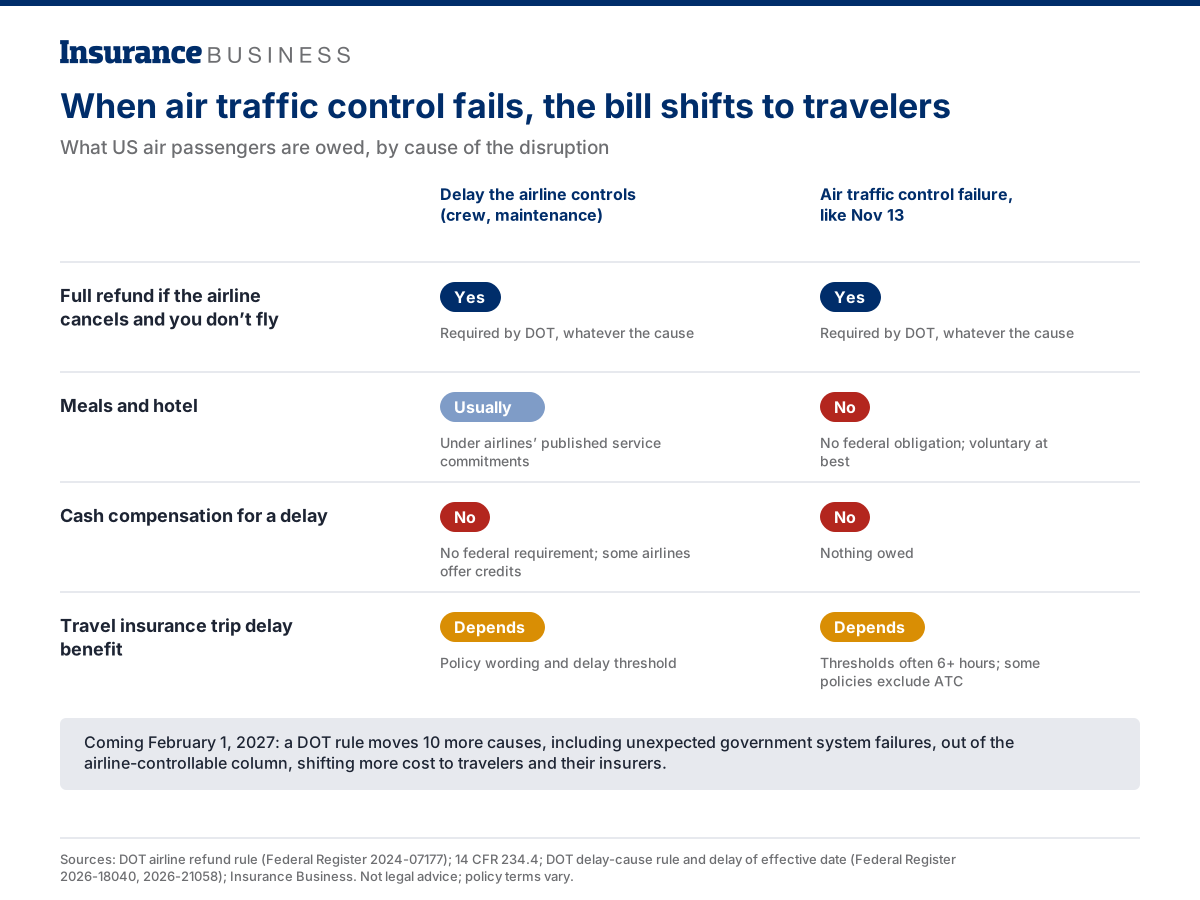
That puts travel delay, missed connection and trip interruption benefits in the firing line. Whether they respond depends on the wording. Some plans set delay thresholds as long as six hours, and some card-linked policies have denied claims tied to air traffic control on the basis that it is not a named hazard. With Thanksgiving on November 26, any lingering disruption could add to the bill.
Brokers should tell clients to keep receipts, airline notices and flight-status screenshots, and to let the airline cancel before cancelling themselves. Under the DOT's refund rule, the cash refund right belongs to passengers whose flight the airline cancels; a traveler who cancels first under a waiver often ends up with a credit instead.
Commercial clients face a more difficult road. In our analysis, property business interruption typically needs physical loss or damage, and contingent or dependent BI under cyber policies usually turns on the insured's own systems or named IT vendors, not a federal network. Event cancellation and parametric flight-delay covers are likelier to respond, subject to their triggers.
The bigger question is accumulation. A single failure in shared public infrastructure halted departures across a continent without breaking anything physical. The same pattern has pushed UK regulators to scrutinize travel cover after repeated failures at NATS. On the GAO's timeline, the US system is likely to stay fragile until at least the end of 2028.
Read next: Repeat Nats failures draw regulatory scrutiny to travel cover