
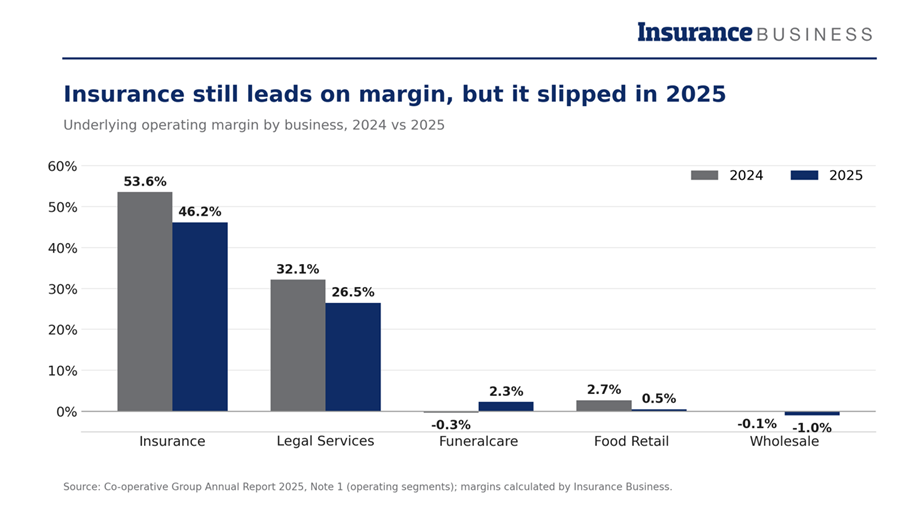
For a business best known for its corner shops, the Co-op's half-year numbers make an unusual case. The largely unsung parts of the group, meaning funerals, legal work and insurance, are carrying much of the load while the supermarkets struggle.
The Co-operative Group's interim results for the six months to 4 July, published earlier today, show group revenue up 2.4% to £5.6bn. Losses deepened, though: the underlying operating loss widened to £45m from £32m a year earlier. The group attributed £11m of that movement to accounting treatment, and the rest to heavy spending on promotions and store investment in food retail.
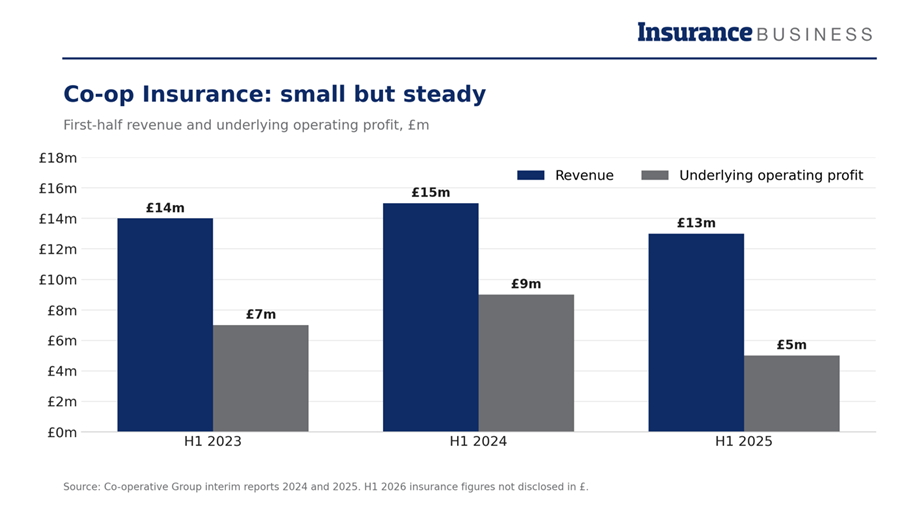
Against that backdrop, insurance had a good half. Underlying operating profit in the insurance business rose 20%, and life insurance sales grew by the same margin. Co-op said the growth followed a reset of the unit's operating model.
It is worth explaining what "insurance" means at the Co-op these days. The group no longer carries the underwriting risk on its main personal lines. It sold its general insurance underwriting business to Markerstudy for £185min a deal that completed in December 2020. Markerstudy now underwrites Co-op-branded home and motor policies under a 13-year partnership.
On the protection side, Co-op's life cover is underwritten and administered by Legal & General, with Co-op Insurance Services earning commission. Profit growth in the insurance arm therefore reflects how well the brand distributes, not underwriting results.
Read next: Revealed – how giant Markerstudy-Co-op deal came about
Insurance sits within Life Services, alongside funeralcare and legal services. The division grew revenue 8.1% to £227m and posted an underlying operating profit of £28m, up from £24m last year. It was the only one of the group's reporting divisions to disclose a profit rather than a loss.
Funeralcare revenue rose 8% even though a lower UK death rate is shrinking the overall market. At-need funerals, those arranged at the time of death, were up 6%. The group said its share of that market is at its highest since 2020, when it ran more funeral homes than it does now.
Pre-paid funeral plan sales rose 27%. That is a substantial number for a product that has been under Financial Conduct Authority regulation since July 2022. The regulator banned cold calling and commission payments to intermediaries such as funeral directors, and brought plan holders under the Financial Services Compensation Scheme.
Rising costs are helping push demand: SunLife's latest research put the average simple attended funeral at £3,828.
Legal services also had a busy half. Revenue climbed 15% and case openings rose 29% as the business marked 20 years of trading.
Read next: The cost of death in the UK: rising funeral costs expose gaps in life cover
All of this plays out in the shadow of the attack that breached Co-op's systems in April 2025. The group now puts the damage at £285m of lost revenue and £107m off profit. Of that £107m, £86m was lost margin and £21m was one-off costs.
For the insurance industry, the important fact here is who paid for that loss, and the warning to clients that it highlights. Last year the group confirmed to Insurance Business that it had no dedicated cyber insurance, having chosen to invest in security technology instead. Marks & Spencer, hit in the same wave of attacks, recovered £100m through its cyber programme. The Co-op met its losses from its own balance sheet, an awkward position for a group that sells insurance under its own name. It has not said publicly whether it has since bought standalone cyber cover.
Cyber specialists say retailers are especially exposed. "Retail is particularly sensitive because downtime immediately affects revenue and customer trust," Isaac Guasch of Tokio Marine HCC told Insurance Business earlier this year.
Read next: "We didn't have enough cyber insurance"
The fallout has not only been financial. Chief executive Shirine Khoury-Haq stepped down in March, after the group spent February defending itself against reports of a "toxic" culture among senior leaders. Chair Debbie White and managing director Matt Hood have also left this year. The mutual is also working through a £200m cost-cutting programme after swinging to a £126m underlying pre-tax loss for the year to 3 January.
Retail analyst Jonathan De Mello, founder of JDM Retail, said ahead of the results that "the business is wrestling with a costly hangover from a major cyber attack".
Interim chief executive Kate Allum described 2026 as "a year of two halves". She said the business was now seeing "bigger baskets and more transactions" and expected sales and profitability to improve in the second half.
The balance sheet looks steadier than the profit line. Liquidity stands at £1.2bn, including a new £350m sustainability bond that was 3.3 times oversubscribed. Net debt excluding leases fell to £239m from £317m at the end of 2025.
Read next: UK faces four major cyberattacks weekly - report
The next hurdle is regulatory. In July, Southern Co-op's 170 stores, 70 funeral homes and three crematoria moved into Siena Co-operative Limited, a Co-op Group subsidiary, and more than 300,000 Southern members joined the group. The two businesses are being run separately while the Competition and Markets Authority reviews the merger.
The CMA's phase one decision on September 15 found competition concerns in local convenience grocery markets around 19 stores. It also flagged at-need and pre-paid funeral services around one Co-op and one Southern site.
The societies had until September 22 to offer binding undertakings, or face an in-depth phase two probe. Co-op said the watchdog had found no national-level concerns and that it would keep working with the CMA on remedies. The regulator has not yet said whether it will accept what was offered.
Any fix involving funeral locations will interest plan providers and the insurers behind them. It would decide who delivers funerals that many families have already paid for