
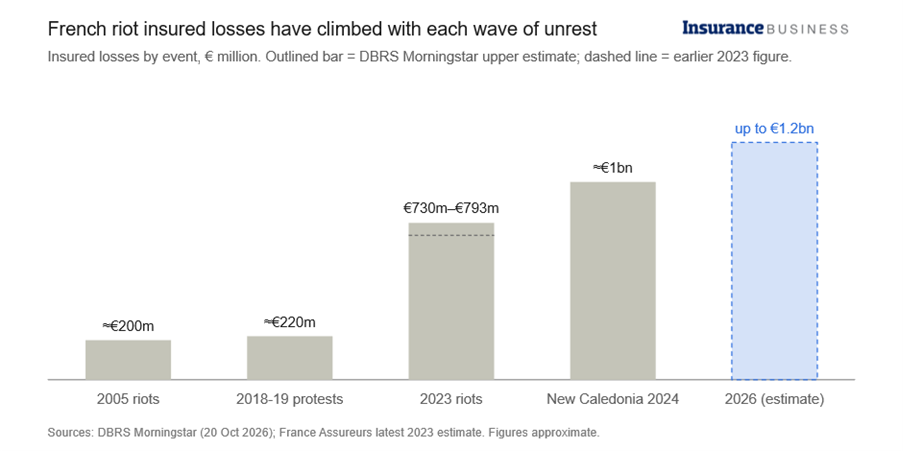
French insurers face a riot bill of up to €1.2bn after nationwide protests on Saturday 17 October descended into looting and arson, according to DBRS Morningstar. The rating agency reckons that would take a meaningful bite out of property and casualty earnings this year. It would not, on its own, threaten the capital or credit ratings of the country's biggest carriers.
What makes this loss awkward is its timing, as France legislated in February for a public-private riot regime, with compulsory cover and a state-guaranteed pool run by reinsurer CCR. That system is not yet switched on. So this bill will be split the traditional way: primary insurers first, then their reinsurance panels, specialist strikes, riots and civil commotion (SRCC) and political violence cover written in London, and possibly a contested claim against the French state.
What began as demonstrations over living costs and public services drew more than half a million people onto French streets. In several cities it curdled into looting and arson: cars were torched, shopfronts smashed, and the town hall in Limoges was badly damaged by fire. Interior Ministry figures put arrests on the day at 2,397. Things have since quietened down.
The bill for businesses is still being tallied. Retail representatives have suggested direct damage could run to several hundred million euros, while Serge Papin, minister for commerce and SMEs, has said at least 3,000 shops were damaged or looted and promised a dedicated support fund for those hit.
Insurers have moved quickly to soften the blow. Industry body France Assureurs said members would stretch the usual five-working-day window for reporting claims to 30 days, and Axa and BPCE Assurances are among the carriers to have done so. Finance minister Roland Lescure met insurers, banks and business federations this week and unveiled support for firms directly hit, while prime minister Sébastien Lecornu has promised a partial unemployment fund for staff at businesses forced to close.
Read next: France's riot losses put insurance cover and state recovery in focus
French riots have a habit of getting pricier. The suburban unrest of autumn 2005 cost insurers roughly €200m at the time. The gilets jaunes protests of 2018-19 came in at around €220m, according to DBRS Morningstar.
Then came 2023. The riots that followed the police shooting of a teenager outside Paris left insurers facing a bill DBRS puts at €730m across about 15,600 claims, though France Assureurs' most recent estimate has since climbed to €793m across some 16,400 claims. Commercial property made up roughly two-thirds of the cost and council buildings more than a quarter. Burnt-out cars generated plenty of claims but a comparatively small share of the money.
New Caledonia raised the stakes again. The May 2024 unrest in the French Pacific territory produced around €1bn of insured losses from a single, geographically concentrated event - the clearest sign yet that riot risk could pile up in one place.
DBRS expects this month's damage to look a lot like 2023, with shops and public buildings again bearing the brunt. How far the final figure lands below its €1.2bn ceiling will depend on how long the unrest lasted, how widely it spread, the size of individual commercial losses and how many business interruption claims come through. The estimate also assumes there is no fresh flare-up.
On paper, French policyholders are reasonably well protected. Most multi-risk home and commercial property policies pick up fire and vandalism caused by rioting, and comprehensive motor cover will pay out for a torched car. But the gaps are real. Drivers with third-party-only cover get nothing for their own vehicle. Looting and theft can be excluded or capped, glass may carry its own excess, and business interruption is usually an optional extra that only kicks in when there is insured physical damage.
The upshot, DBRS warns, is that the true economic cost to retailers - lost trade, uninsured stock, excesses, closures without physical damage - is likely to be several times the insured figure.
For carriers, the first hit lands on France's big motor, household and commercial writers, though DBRS says there isn't yet enough public data to pin losses on individual names. Each will keep losses up to the attachment point on its reinsurance programme, with excess-of-loss and other treaties passing the rest to global reinsurers. Larger corporates may also hold standalone SRCC or political violence cover placed in London and at Lloyd's.
Then there is the French state. Under Article L.211-10 of the Internal Security Code, the state can be held liable for damage caused by violent crimes committed by crowds, which lets insurers that have paid out use their subrogation rights to pursue it. Recovering that money is far from straightforward. French courts have tended to treat spontaneous disorder differently from organised violence, so how this month's events are characterised could make a big difference to what insurers claw back. Business interruption and other consequential losses typically fall outside the state's liability altogether.
Read next: Portsmouth protests expose SRCC gap insurers already knew about
The 2023 riots, followed by New Caledonia, persuaded Paris that riot cover could not be left to the private market alone. Some insurers in France's overseas territories had already pulled riot cover from certain policies, and some local councils were hit with eye-watering excesses after 2023.
The answer is Article 171 of the 2026 Finance Law, promulgated on 19 February after the Constitutional Council rejected a challenge to its place in the budget. Riot cover becomes compulsory in qualifying property damage policies, with no exclusions allowed, and extends to business interruption where a policy already includes it. Businesses refused cover because of their riot exposure can go to the Bureau Central de Tarification, which can force an insurer to write the risk.
Behind it sits a mutualisation fund managed by state reinsurer CCR, which will reimburse at least 90% of the riot losses insurers cede to it. Insurers pay a solidarity contribution of no more than 1.5% of relevant premiums, with the exact rate set by decree. The state guarantees the fund each year up to €4bn or ten times its expected income, whichever is lower, and charges for doing so. Riot risk insurers choose not to cede can still be reinsured by CCR at market rates.
The catch is the start date. The scheme only switches on by government decree, no later than 12 months after the European Commission clears it under state aid rules. France Assureurs officials have said they are working towards 1 January 2027, while New Caledonia and French Polynesia would each need a separate agreement with the state to join. Either way, DBRS is clear that the pool will not pick up the October losses.
That leaves insurers in an uncomfortable in-between: still relying on private reinsurance and contested claims against the state for this event, with a much clearer framework only weeks or months away.
The wider lesson, according to DBRS analysts Marcos Alvarez and Elisabeth Rudman, is that civil unrest now behaves more like a natural catastrophe than a run-of-the-mill property peril. Any single claim may be modest. The danger is thousands of correlated claims landing at once across commercial property, motor, public buildings and business interruption as disorder jumps from city to city.
France is hardly alone. DBRS points to the US, Chile and South Africa, where individual bouts of unrest have each produced insured losses above $2bn. It expects repeated episodes to keep pushing up SRCC pricing, deductibles and underwriting scrutiny, and to keep limits tight. Its verdict is blunt: civil commotion "can no longer be treated as an incidental property peril", particularly in France.
Read next: Why is demand for strikes, riots and civil commotions insurance increasing?
That message is important for London too. The UK has its own backstop in the Riot Compensation Act 2016, which caps claims at £1m and does not cover lost trading income, and UK civil unrest is becoming a major risk for insurers after the 2024 summer riots, which DBRS expected to cost the market less than £250m. Many carriers have trimmed SRCC limits or removed the cover from standard wordings over the past decade, pushing larger clients towards standalone placements in the London market.
For UK brokers running multinational property programmes, there is a more immediate question: how France's compulsory riot cover will sit alongside master policies covering clients' French sites once the regime goes live.
Read next: War is now the risk every boardroom fears most, and insurers are hiring accordingly
Read next: Civil unrest rocks UK businesses - Gallagher