The Fidelis Partnership has hired a new group head of claims and a new head of political risk this week. The appointments land against a backdrop of Lloyd's announcing a £1.4 billion loss from war risk, and a Fidelis that spent June building a dedicated political violence and terrorism consortium specifically because demand was rising while supply was contracting. When a carrier hires for both claims leadership and specialist underwriting at the same time, it is usually a reliable signal about where it expects the next concentration of losses to come from.
Steve Crabb joins as group head of claims after nearly 25 years in specialty claims, most recently as European head of claims at Allied World. Megha Khanduja becomes head of political risk, arriving from Bloomberg, where she led insurance solutions for Europe and multilateral institutions. Before that she spent eight years underwriting political risk, credit and bond business at AXA XL across Africa, Latin America and South Asia. Both are based in London.
Fidelis's group director of underwriting, John-Paul O'Hare, said a strong claims function was fundamental to the firm's promise to clients. Group president for strategic partnerships Richard Coulson linked Khanduja's hire to rising demand for political risk cover amid what he described as a more complex and volatile global environment. Those are not standard appointment lines - they map directly onto a market that has shifted shape materially this year.
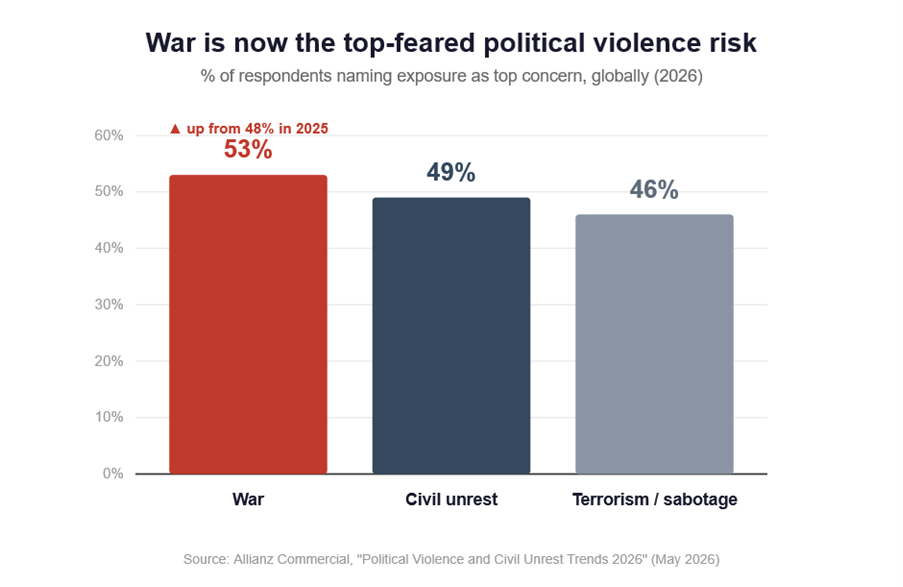
War has overtaken civil unrest as the political violence exposure companies fear most, for the first time on record. Allianz Commercial's 2026 Political Violence and Civil Unrest Trends report puts armed conflict at the top concern for 53% of respondents globally, up from 48% a year earlier, and closer to 60% across Europe and Asia-Pacific specifically. Civil unrest, which had led the rankings for the past two years, has fallen to second at 49%, with terrorism and sabotage close behind on 46%.
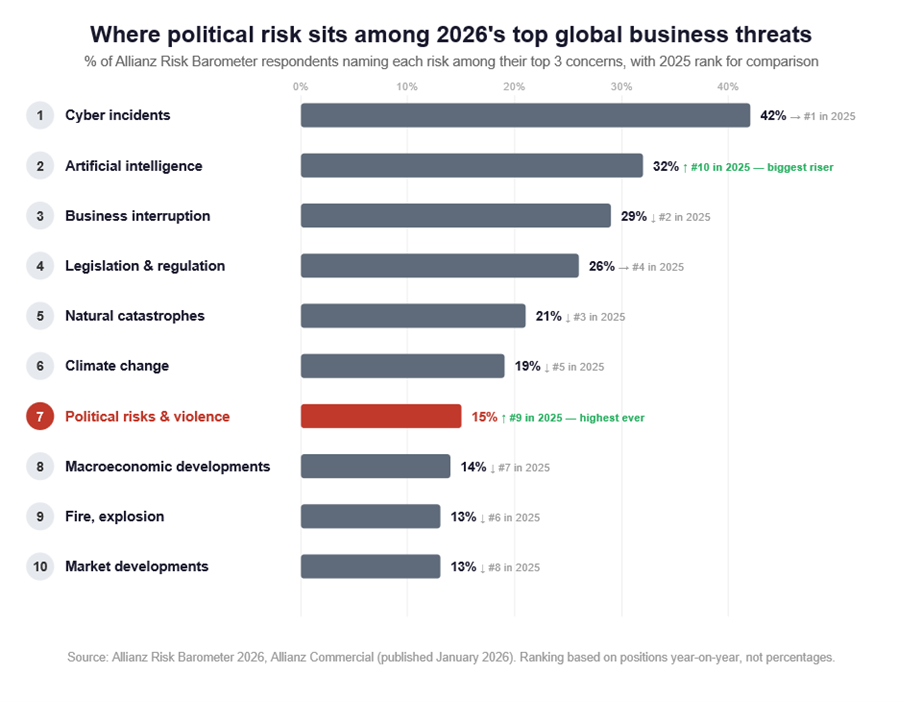
Political risk and violence as a category has never ranked higher in the Allianz Risk Barometer, climbing to seventh place among all global business risks. Allianz Commercial chief executive Thomas Lillelund said war and the threat of future conflict would undermine geopolitical and economic stability for years to come, and that risk managers needed to stay relentlessly forward-looking as threats emerge simultaneously from multiple directions.
The premium pool attached to that risk level is substantial. At a Marsh Re briefing in Monte Carlo, Richard Morgan, CEO of Marsh Re Bermuda, estimated the political violence and war risk market at approximately $2.5 billion in annual premium - a market that, according to Marsh Re's own commentary, has not recorded an underwriting loss since the September 11 attacks. That record now looks under pressure. Morgan warned that Middle East losses from the Iran conflict alone could approach $2 billion, raising the prospect of the market posting its first underwriting loss in more than two decades.
Read next: Lloyd's puts a number on the Iran conflict for the first time — and flags a tougher year ahead
Allianz survey data is one measure. Lloyd's half-year results put an actual figure on what six months of conflict in the Middle East had cost the market: £1.4 billion in losses, spread across marine, energy and political violence lines tied to shipping damage, energy infrastructure and physical assets across the Gulf since Iran's missile and drone campaign began.
Lloyd's chief of market performance Rachel Turk had already signalled in May that the conflict was not shaping up to be a capital event. Chief executive Patrick Tiernan confirmed that in the half-year statement, saying that based on exposures and damage observed to date, Lloyd's did not expect the situation to have a material impact on profit and loss. Against £34.7 billion of premium and £48.4 billion of capital, £1.4 billion does not threaten the market's solvency.
That context matters for how brokers read the loss. A market that is absorbing £1.4 billion and remaining profitable overall is not pulling back - it is repricing and restructuring. Lloyd's says it responded to the conflict with additional capacity, including new marine war facilities led by Chubb and Beazley. Allianz Commercial has separately flagged that the eventual loss quantum for political violence and terrorism lines tied to the Middle East could exceed what the market paid out on Ukraine-related PVT claims.
Fidelis moved before the picture had fully settled. In June 2026 it launched the TFP PVT Consortium, placed by Marsh Re and pooling capacity from Lloyd's syndicate Argenta alongside Fidelis's own Syndicates 3123 and 2126, backed by cornerstone capacity provider Pelagos Insurance Capital. The facility can deploy up to $47.5 million per risk in the Middle East and up to $345 million per risk globally, into a market where demand was rising while supply was contracting.
Billy Ayres, Fidelis's head of underwriting for crisis management, described the consortium as a direct expression of the firm's high-conviction approach and said losses from the Middle East conflict would significantly shift the wider global WTPV market. The firm's intention, he said, was to stay open and disciplined through it.
Crabb and Khanduja's appointments sit downstream of that decision. Claims leadership matters most in exactly the kind of high-severity, headline-loss environment WTPV produces. How quickly and fairly a claim is handled after a major event tends to determine whether a client renews with that carrier at all. An underwriter who has spent her career pricing conflict and credit exposure across Africa, Latin America and South Asia brings a different kind of judgement to that environment than one who has only worked the calmer end of the political risk book.
At the same Marsh Re Monte Carlo briefing, Laurent Rousseau, head of international at Marsh Re and global head of capital and advisory, described the current environment as one where the market has more capital than at any point in its history while facing a risk environment more volatile than at any point in recent memory. Supply of capital is at historic highs, he said, with returns for traditional reinsurance business still projected to outpace the cost of equity through 2028.
That combination - abundant capital and rising political violence losses - creates a specific dynamic for brokers placing WTPV, trade credit or crisis management business. Capacity is being built rather than withdrawn, and Fidelis's consortium and the Lloyd's marine war facilities from Chubb and Beazley both point to insurers structuring new solutions rather than retreating. But this is one class where underwriters are likely to hold pricing discipline even as they compete harder across the rest of their portfolios. Political risk and violence is now a top-ten global business concern for the first time. The carriers who are hiring specifically for it this week are not doing so by accident.
For brokers placing these lines, the appointments are not a curiosity. They are a signal about where capacity is being concentrated, where loss expectations are sharpening, and where clients with genuine conflict-zone exposure should be having the most detailed coverage conversations before January 2027 renewals.