For most of the past decade, the story of America’s excess and surplus (E&S) market was a simple one. Politicians got involved in fixing pricing, admitted carriers headed for the exits, rates climbed and specialty underwriters picked up what was left behind.
Speaking to Insurance Business at the WSIA Annual Marketplace in San Diego last month, senior figures painted a more nuanced picture. The capacity squeeze is over. What keeps risks in the non-admitted market now is complexity.
“Now capacity is abundant, and it’s really that complexity shift that we’re seeing driving the flow,” said Lynanne St Denis, head of wholesale property and casualty at Navigators, a brand of The Hartford. Clients, she said, are innovating faster than admitted policy forms can follow.
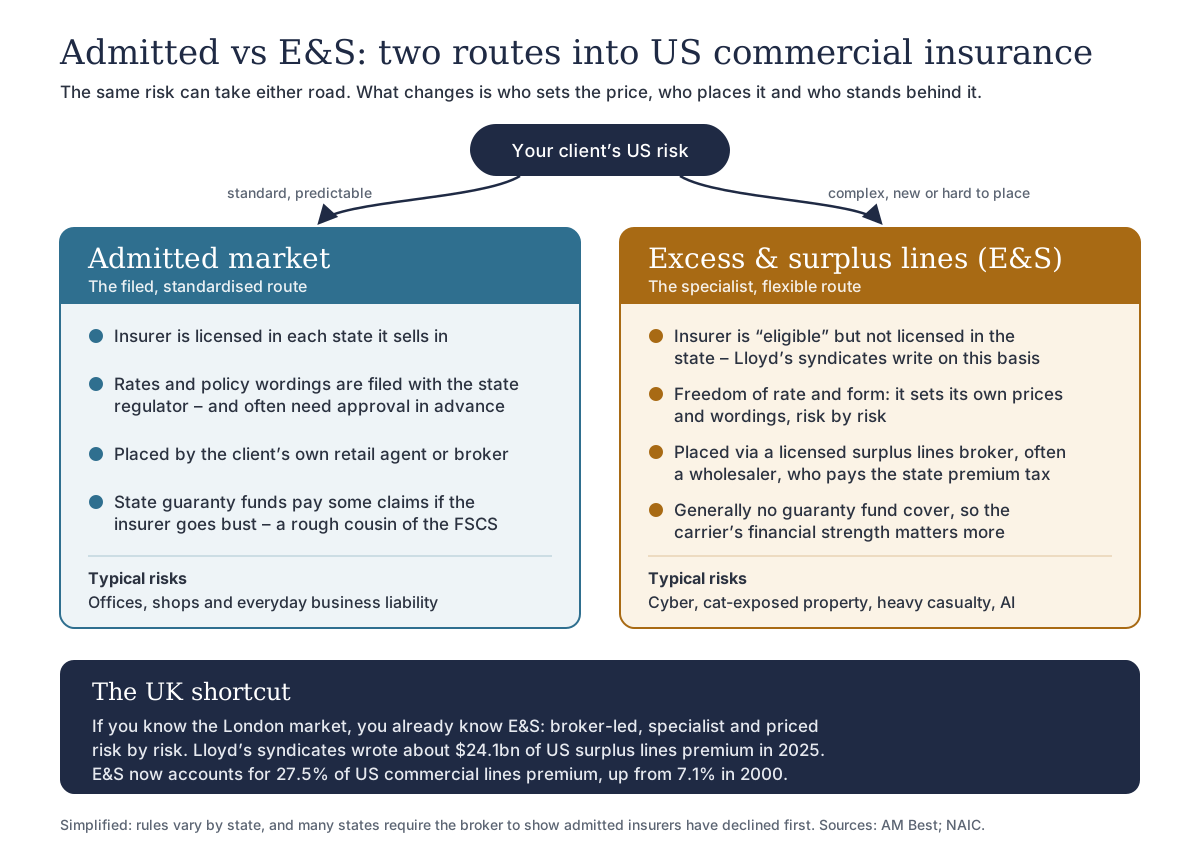
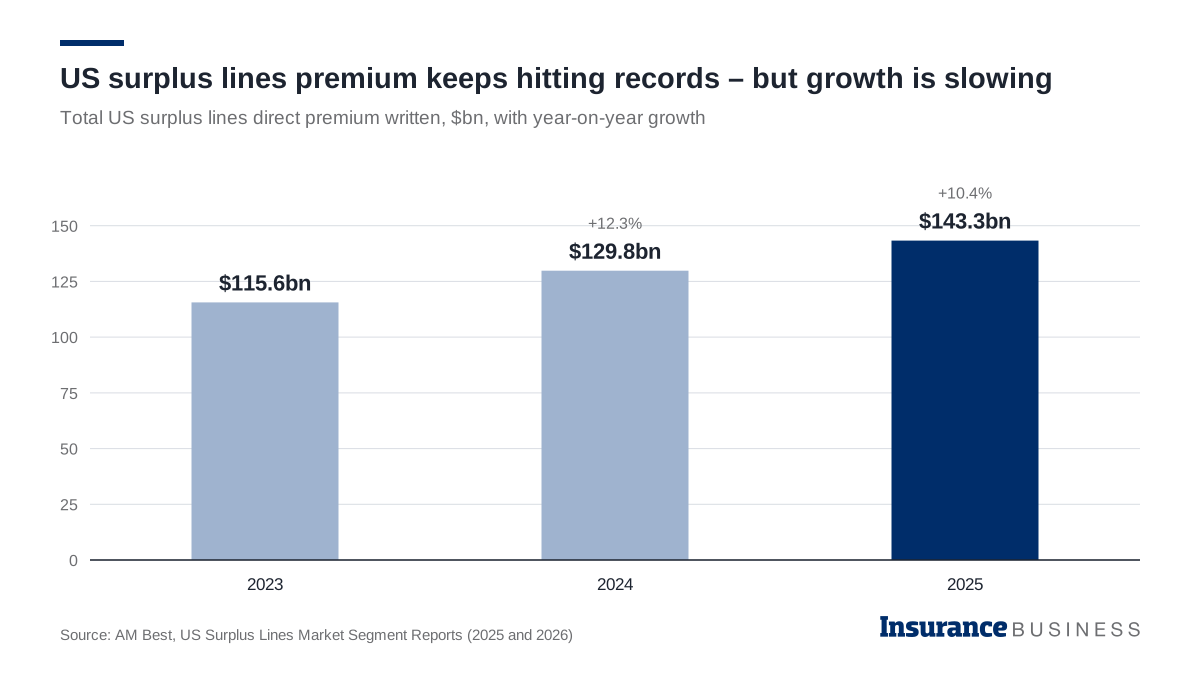
The numbers are still big. US surplus lines premium reached a record $143.3bn in 2025, up 10.4%, according to AM Best’s annual study, as IB reported in September. Surplus lines carriers wrote more than $51bn of general liability – 39% of the entire US industry’s volume in that line – and the channel now accounts for 27.5% of US commercial lines premium, against 7.1% in 2000.
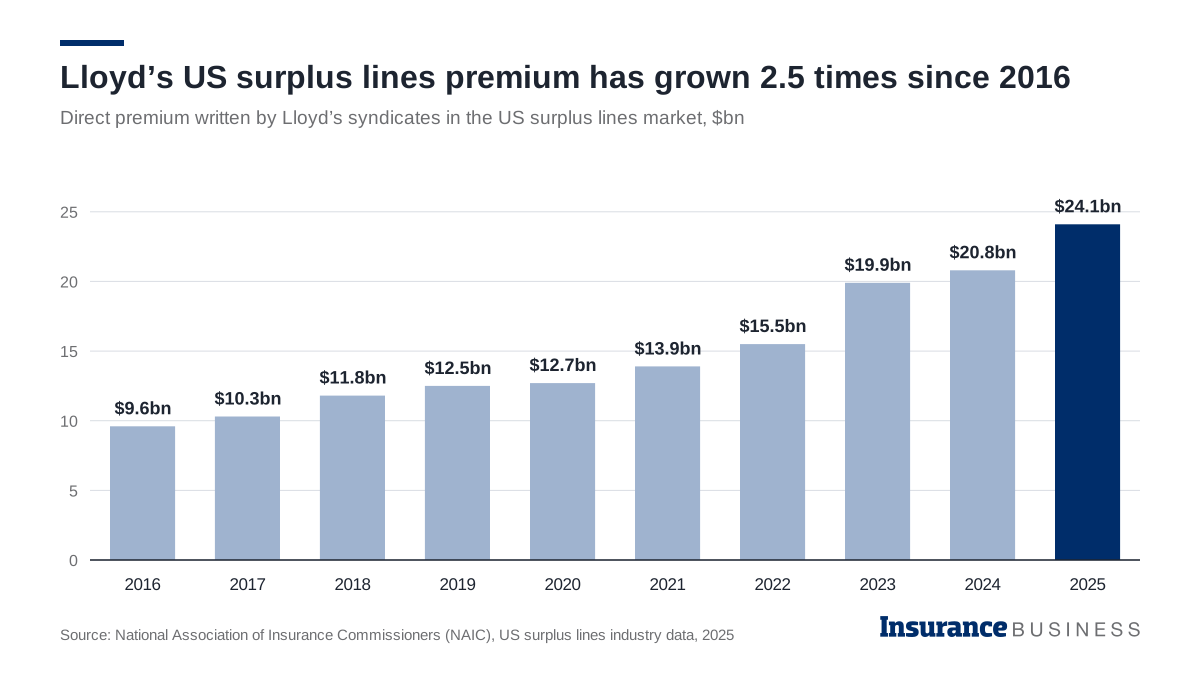
London has a big seat at that table. Lloyd’s underwriters are approved surplus lines insurers in every US state, and Lloyd’s syndicates wrote about $24.1bn of US surplus lines premium in 2025, up from $20.8bn a year earlier, according to National Association of Insurance Commissioners data. That is roughly a sixth of the total.
Read next: Lloyd’s rates fell 6.7% in H1 – nearly twice the pace of last year. Brokers should be watching
Not every line is moving in the same direction. Property rates are under heavy downward pressure, while liability is becoming harder to price, not easier. Jon Monks, head of distribution, business development and client management for Sompo in North America, blamed litigation funding, nuclear verdicts and an expanding “frontier of risk”.
“A little bit of a tale of two cities with liability outpacing property but still overall growth,” he said.
Demand is holding up even as pricing eases. José Pagan, director of regulatory affairs at the Florida Surplus Lines Service Office, said policy counts are still climbing while premiums soften, pointing to “sustained demand for E&S coverages even as prices moderate”.
Erich Bublitz, executive vice-president for E&S at AmTrust, pointed to human and social services, where sexual abuse and molestation claims can now be brought decades after the event. That kind of open-ended tail is hard to sustain on admitted paper, he said. Long-tail environmental risk is heading the same way.
David Corry, head of casualty at Argo, welcomed the new capital flooding into the sector but sounded a warning about oversupply in some classes. Casualty results, he noted, can take five to ten years to reveal themselves – and new entrants without a loss history may find that catches up with them sooner than they think.
Mike Kerner, a member of Munich Re’s board of management, offered a tidy rule of thumb. The faster things change – inflation outrunning filed rates, climate change reshaping catastrophe exposure, new technology creating risks nobody has priced – the more the non-admitted market comes into its own. “The innovation normally comes from the E&S market,” he said.
David Haas, president of global specialty at CNA, agreed. “Sometimes things move so fast that there’s just no way to get filings done,” he said, which is why manuscript wordings and bespoke approaches are not going away.
Lindsay Shipper, Beazley’s head of commercial property for North America, gave a practical example. An off-the-shelf admitted property policy, she said, “has exclusions and gaps for cyber coverage” – and a standard cyber policy does not necessarily fill them.
Wholesalers we spoke to also said AI is the next test. Tom DeCotis, chief executive of DeCotis Specialty Insurance, said there is simply not enough case law yet for carriers to rate AI exposures with confidence. Those coverages will be born in the E&S market, he predicted, and adopted by the standard market later – the usual pattern.
Read next: Specialty market has given back 65% of hard-market rate gains
For London, the shift brings opportunity and competition in equal measure. More US E&S business is being written on American paper. Beazley has moved US surplus lines premium from its Lloyd’s syndicate to its US carrier, Aviva is building an onshore surplus lines operation in New York, and newer platforms such as Fidelis’s syndicate 2126 have secured US surplus lines listings.
All of this is happening while the London market softens. Lloyd’s risk-adjusted rates fell 6.7% in the first half of 2026, and its underlying combined ratio rose from 82.1% to 84%.
So is the gap between the two US markets widening or narrowing? It depends who you ask. Shipper said it is “absolutely widening”. Haas thinks it is broadly static, with broker consolidation and competition offsetting new exposures. Dustin Applebaum, president of Element22 Insurance Group, called it “a little bit of both”: narrower where admitted carriers are dipping back in, wider wherever risks are getting stranger.
If complexity is now the engine, London’s specialists should be well placed. They will just have to compete harder for it.