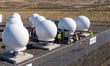
A fire at a satellite ground station in central Poland that helps keep Ukraine online is being treated by Warsaw as deliberate sabotage. On the same day, Danish intelligence has warned that Russia's hybrid campaign against Europe is about to escalate.
The blaze broke out late yesterday (23rd September) at a facility in Wola Krobowska, in the Mazovia region, run by state-owned telecoms company Exatel. The site routes internet traffic through Poland and on to Ukraine, and SpaceX uses it to support Starlink connectivity. The fire tore through the station's power supply, distribution board and generator. Nobody was hurt, and the station is back online.
Deputy prime minister and digital affairs minister Krzysztof Gawkowski told TVP Info that the attack was designed to knock out the station and cut internet access to institutions including the Ukrainian military. Speaking to TVN, he went further and called the modus operandi "clearly Russian". He conceded, though, that it was not yet possible to say for certain who was behind it. Poland's Internal Security Agency is investigating. Russia has repeatedly denied carrying out sabotage in Poland.
Read next: Now it's arson - Germany's infrastructure incidents are now an insurance underwriting question
Last week, prime minister Donald Tusk told parliament that intelligence pointed to Russian plans for hybrid drone and missile strikes on Ukraine's allies, which Moscow would pass off as accidents. Earlier today the Danish Defence Intelligence Service said it expects Russia to step up hybrid attacks on the West and NATO in the coming months, with heavier consequences than before. That follows Germany blaming Russia for an attempted drone attack on Leipzig/Halle Airport.
For insurers, the fire is a live example of a question the market keeps circling. Many all-risks property wordings would cover arson on infrastructure as malicious damage. Once the attack is tied to a hostile state, war exclusions come into play. But a minister's verdict is not a coverage decision.
Alexandra Lyons, a partner in the policyholder disputes team at Stewarts, told Insurance Business earlier this month that government attribution can be important evidence. But blaming a state, she said, "does not automatically mean an incident will be treated as war" for insurance purposes. She added that under English law, it is generally for the insurer to prove that an exclusion applies.
The Nord Stream ruling shows how that can cut the other way. This summer, the High Court found that the pipelines' insurers did not have to pay out €580m for the 2022 blasts. Mrs Justice Moulder held that whichever of the possible culprits was responsible, the war in Ukraine was a significant cause of the sabotage. She never decided who did it. Where causation wording is broadly drafted, Lyons warned, only a fairly loose link to war may be needed.
Read next: State attribution won't settle whether a war exclusion applies
The Polish site's mix of users adds another complication. It serves a state telco, a private satellite operator and military customers across a border, which makes it a single point of failure. Had the outage dragged on, the contingent business interruption questions would have multiplied quickly.
UK buyers have their own gap. Pool Re typically responds to certified terrorism rather than state-linked sabotage, which has pushed more demand towards specialist political violence cover in London. Allianz Commercial's 2026 Risk Barometer ranked political violence seventh, its highest position yet. Meanwhile, political violence reinsurance hardened at the 1 July renewals.
Read next: F-16s scrambled to destroy suspected Russian explosive sea drone near European gas rig
For brokers, the lesson from Warsaw is less about who started the fire than about what the policy says. Clients in telecoms, energy, logistics and defence supply chains should check how their programme treats sabotage and how tightly the war exclusion's causation language is drawn. They should also ask whether standalone political violence cover would close the gap. If Denmark's spies are right, the next test case won't be long in coming.