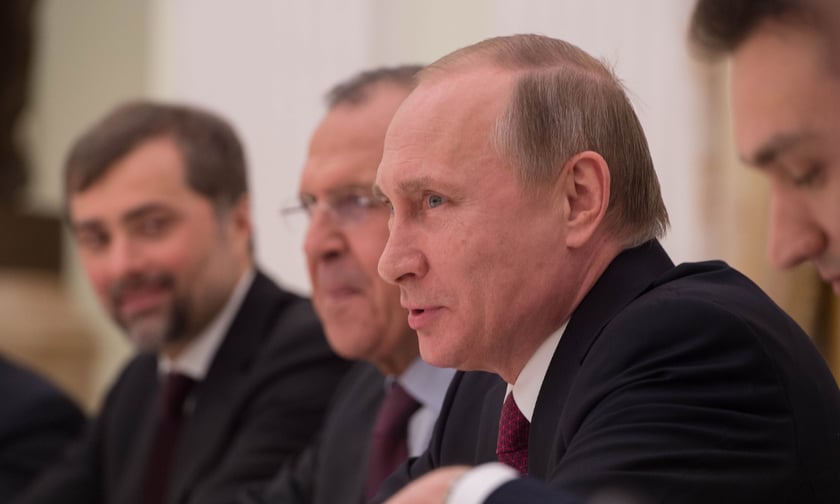
Vladimir Putin has asked fellow BRICS members to help build a standalone insurance mechanism for the bloc, a proposal that wades straight into the middle of one of the insurance industry's most closely watched sanctions fights.
Addressing the closing session of the 18th BRICS summit in New Delhi on Sunday, the Russian president said the grouping had already found ways to move capital, labour and technology outside Western-controlled systems, and that it was time to add insurance and grain trading to that list.
Putin described the insurance and grain plans as "promising initiatives" that other BRICS members were free to adopt, according to Russian state media, but gave no detail on how either scheme would actually work, who would underwrite it, or when it might launch.
For an audience that spends its days pricing marine, cargo and political risk, the vagueness matters less than the context. Moscow has spent several years watching Western insurers, and the UK's Lloyd's market in particular, squeezed out of its energy trade by sanctions. A Russian-led insurance mechanism, however loosely defined today, is best read as the latest move in that fight rather than a stray comment from a leader's closing remarks.
Why insurance became a sanctions weapon in the first place
The mechanism Putin is trying to route around is well known to UK insurers: the G7, EU and UK price cap on Russian crude, which bars Western insurers, reinsurers and P&I clubs from covering any cargo bought above roughly $60 a barrel. Because most of the world's ocean-going tonnage is covered through the International Group of P&I clubs, based largely in London, that single rule gave Western governments leverage over Russian oil revenue without a single warship or blockade.
It has also, by the industry's own account, stopped working as intended. The International Group told a UK parliamentary inquiry that the policy had become effectively unenforceable, since insurers have no independent way of checking the true sale price a trader declares, and roughly 800 tankers have already migrated out of Group cover into looser, harder-to-trace arrangements.
Mike Salthouse, external affairs head at NorthStandard P&I Club and chair of the International Group's sanctions committee, has previously summed up the core problem: it's "difficult to get to the bottom of what the actual price was" once a cargo has changed hands.
That gap is what's commonly called the shadow fleet: several hundred older tankers, often with opaque ownership, flying flags of convenience and, in many cases, carrying insurance certificates that would not survive serious scrutiny. UK regulators have been chasing this problem for more than two years, sanctioning individual Russian insurers such as Ingosstrakh and VSK, and challenging suspect vessels transiting the Channel to prove they actually hold valid cover.
Putin didn't say whether his proposed mechanism would be a reinsurance pool, a state-backed guarantee fund, or something closer to an alternative P&I club sitting outside Western jurisdiction. Any of those would build on infrastructure Russia already has: sanctioned insurers such as Ingosstrakh and VSK have their major risks backstopped by the state-owned Russian National Reinsurance Company (RNRC), a Central Bank of Russia subsidiary set up specifically to absorb sanctioned trade that Western reinsurers won't touch. A handful of insurers elsewhere in China and the Gulf have stepped into the same gap where Western cover has been withdrawn.
Even parts of the shipping industry that aren't natural allies of Moscow have started asking whether some of these newer insurers might eventually be worth taking seriously. Nikolaus Schues, president of the shipping association Bimco, said earlier this year that "some of the new insurers may become part of the [International Group]" if sanctions were ever rolled back, though he added that a new entrant would first have to prove it wasn't part of the problem it was replacing. That's a different tone from the International Group's own submission to Parliament, which has focused on how hard it is to verify anything the newer players are actually doing.
Read next: More sanctions, more risk for carriers
The risk, as several London market figures have argued publicly, is less about Russia finding cover and more about the quality of that cover. RNRC's own capital base has been repeatedly reinforced by the Russian state since 2022, but analysts who track it describe it as thinly capitalised relative to the scale of the trade it now underwrites, meaning that if a shadow-fleet tanker is involved in a serious spill or collision, there may be little standing behind the policy beyond a political decision in Moscow about whether to pay out at all. That leaves port states, coastal communities and, in the event of litigation, Western courts and P&I clubs picking up costs a nominally "insured" vessel was supposed to cover.
Formalising a BRICS-wide mechanism wouldn't necessarily fix that capitalisation problem on its own, but it would give Moscow and its partners a shared institutional home for the practice, rather than the current patchwork of national workarounds. It would also test how far countries such as India, China, Brazil, the UAE and Saudi Arabia are willing to go in publicly backing a Russian initiative that Western regulators are actively trying to shut down.
The grain market angle isn't new, but it does connect to insurance
The grain proposal is less of a departure than it sounds. BRICS members endorsed the idea of a Russian-led grain exchange as far back as the 2024 Kazan summit, following a pitch from the head of Russia's Union of Grain Exporters, and Moscow has continued pushing the concept through working groups since. BRICS countries between them account for a substantial share of the world's grain production and consumption, which is the argument Russian officials have used to justify building independent pricing and trading infrastructure away from Chicago- and Europe-based exchanges.
For insurers, a parallel grain market matters mainly because of what sits underneath it: trade credit cover, marine cargo insurance and crop and commodity-price protection. If BRICS states build settlement and trading infrastructure that Western banks and insurers aren't part of, the underwriting that currently follows Chicago and European benchmarks may simply migrate with it, denominated and priced by a different set of players entirely.
Putin's comments, he offered no operational detail, no timeline and no named institution, suggest this is currently closer to a political marker than a functioning proposal. The precedent he pointed to, the BRICS New Development Bank, took years from founding declaration to disbursing its first loans, and even now the NDB's $140 billion project book is dwarfed by the scale of global trade the bloc is discussing insuring.
That said, UK insurers have learned over the past few years not to dismiss Russian workarounds too quickly. The shadow fleet itself started as an improvised patchwork and grew, by some estimates, to cover close to a tenth of the global tanker fleet before Western regulators caught up. A slower-moving, state-backed insurance mechanism sitting behind it would be a logical next step, and one the London market, which is still the largest single centre for marine and energy risk, has every reason to watch closely.