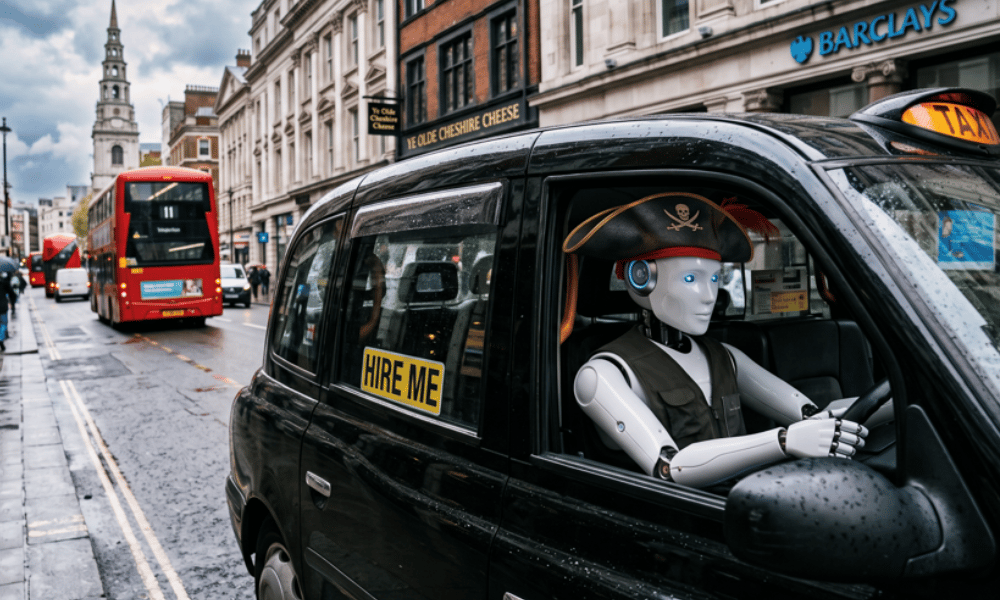
London's black cab trade has weathered Uber, congestion charging and a pandemic that emptied the city's streets. Now it's facing something stranger: cars with nobody driving them.
Waymo and Wayve, the Uber-backed British start-up, are both testing robotaxis on London roads, each racing to be the first to carry paying passengers without a human at the wheel. Public opinion hasn't caught up: a YouGov survey of just over a thousand Londoners, commissioned by the London Assembly Transport Committee and carried out in June 2026, found 42% opposed the introduction of autonomous passenger vehicles, against just 29% in support.
For drivers, the mood is reportedly somewhere between defiance and dread – and for the motor insurance market, the arrival of autonomous vehicles (AVs) on some of Europe's most congested, unpredictable streets raises questions that go well beyond who gets the fare.
Some cabbies aren't planning to make life easy for their new robotic rivals. According to a Financial Times report Drivers have reportedly discussed ways someone might box in autonomous vehicles in heavy traffic, interfere with their sensors, or steer them into box junctions where they'd rack up fines if they wanted to. One driver reportedly even floated the possibility of another tactic: lodging an insurance claim after a minor knock and simply asserting the robotaxi was at fault.
Both Waymo and Wayve say they've seen no evidence of this kind of behaviour from their testing fleets so far, and Wayve's chief executive, Alex Kendall, has argued that building a "humanlike" driving style is central to the vehicles coexisting smoothly with London traffic. But even the suggestion of drivers gaming the system for a payout points to a genuine headache for underwriters: proving fault when one party in a collision has no driver to interview, and the other has every incentive to blame the machine.
This isn't a hypothetical for insurers. Under the Automated Vehicles Act 2024, which received royal assent in May 2024, liability for a collision caused by a self-driving vehicle sits with the insurer in the first instance – a principle carried over from the earlier Automated and Electric Vehicles Act 2018. In practice, that means insurers pay out to injured parties up front, then try to recover costs afterwards from whichever party – a software developer, a fleet operator, a component manufacturer – actually caused the fault.
The trouble is that the detailed rulebook still isn't finished. The full regulatory regime under the 2024 Act, including the licensing of "authorised self-driving entities" and mandatory data-sharing requirements, isn't expected to be fully in force until 2027, even as robotaxi pilots edge closer on London roads under an accelerated timetable. That gap has left insurers working out how claims from trial-period incidents will actually be pursued, and Insurance Business UK has previously reported on why autonomous vehicles are already rewriting the assumptions behind motor insurance, as liability shifts from driver error towards software, sensors and telemetry.
Claims teams are also bracing for cases that don't fit neatly into a single policy. An AV collision could plausibly touch motor liability, product liability and cyber cover all at once, and untangling it may mean poring over vehicle data logs – braking patterns, sensor readings, split-second decisions made by an algorithm rather than a person – rather than taking witness statements from a driver.
The Association of British Insurers has broadly welcomed the shift, telling reporters that the sector has "long supported the development of automated vehicles," given their potential to improve road safety, while stressing that motor insurers need to stay closely involved as AV policy is finalised. But that support comes with a caveat: the ABI has also flagged concerns about a possible rise in low- and medium-severity claims involving pedestrians and cyclists as AVs navigate busy urban environments – exactly the kind of chaotic, mixed-traffic conditions cabbies say London's streets specialise in.
The uncertainty was on full display at this year's Biba conference, where speakers warned that brokers and insurers are still working out how fault, liability and underwriting will actually be determined once AVs are involved in real collisions at scale – not just in trials. Cabbies allegedly weighing up how to needle a robotaxi into an at-fault collision, in other words, would be probing a part of the system insurers themselves admit isn't fully resolved yet.
Motor insurers were watching this shift long before any cabbie muttered the word "skulduggery." Insurance Business UK reported earlier this year that analysts at Barclays had flagged a "slow-burn" squeeze on motor insurers from AI and autonomy, singling out Aviva given how much of its profit relies on the personal motor book. Fewer human drivers, in theory, means fewer human errors – and potentially a shrinking pool of the premium income insurers currently collect from personal motor cover.
Some insurers have been trying to get ahead of it for years. Specialist insurer Adrian Flux was among the first in the UK to offer a policy specifically for self-driving cars, covering owners against software faults, failed updates and hacking rather than the usual list of driving mishaps. AXA XL has gone further into commercial territory, launching a propositionaimed at the companies developing and operating AV fleets themselves, bundling third-party liability with cyber and crisis-management cover. Whether cover of this kind can scale to a London-wide robotaxi fleet, dodging cabbies and all, is still an open question.
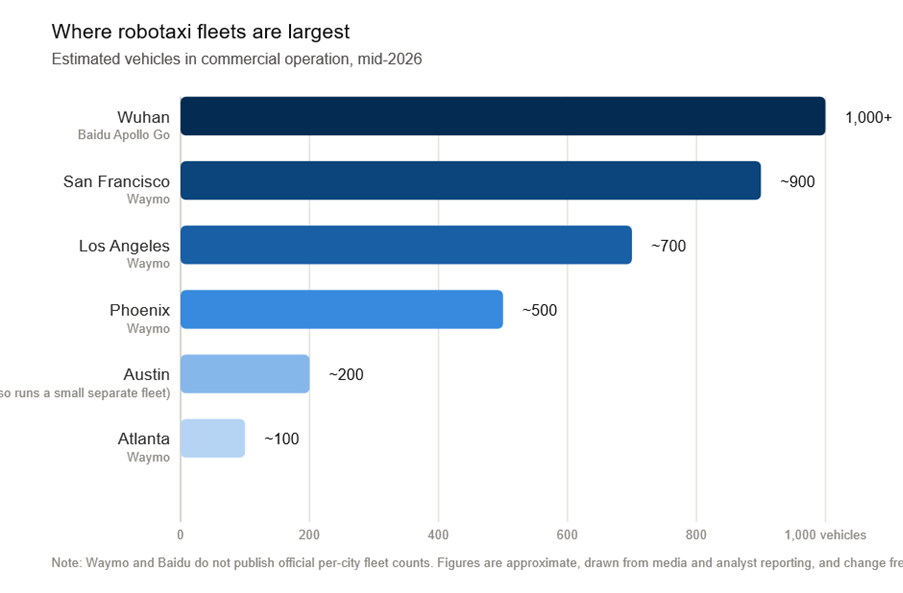
For the trade itself, the robotaxi rollout is really two stories running in parallel. One is about jobs, and the numbers already tell part of that story: official DfT data for England put the licensed taxi fleet at roughly 52,300 as of April 2026, down 7% on 2024, with London's black cab fleet falling by the same margin to around 13,700 vehicles. Private hire vehicles, by contrast, are surging – up 13% nationally to roughly 290,000 over the same period. Economists who've studied Uber's disruption of the US taxi market expect robotaxis to add further pressure on driver earnings before they threaten driver numbers outright, at least in the early years. The other story is about risk transfer: as driving decisions increasingly sit with a company's code rather than a person's hands, insurers are being asked to build products that price software failure and telemetry risk alongside the traditional stuff – speed, road conditions, other drivers' mistakes.
Add in a workforce that, by its own admission, might not always play nice with its new robotic competitors, and underwriters have a genuinely fresh category of claims-handling problem on their hands – one that has very little to do with how carefully anyone was driving.