Five out of six full-time workers in the UK have no income protection. A 200-year-old mutual in Manchester thinks it knows why, and it has just reorganised itself to do something about it.
Shepherds Friendly, founded on Christmas Day 1826, has made Dan Simpson its chief commercial officer, putting sales, partnerships, protection product and marketing under one roof. Simpson has been chief innovation officer since 2021. His brief is to grow the business the mutual does through advisers, and he has said his priorities are backing advisers, deepening intermediary relationships and widening the protection range.
The logic is simple enough. If the person who decides what the product looks like also owns the conversations with advisers, the feedback loop gets shorter. The harder question is whether any provider, let alone a mid-sized friendly society, can shift a market where most working people still go without cover.
The mutual's research, a survey of 2,000 UK adults published earlier this month, found that only 16% of full-time workers hold income protection. That is two points higher than a year earlier. Flip it round and roughly five in six full-time workers have nothing beyond sick pay and savings if illness or injury stops them working.
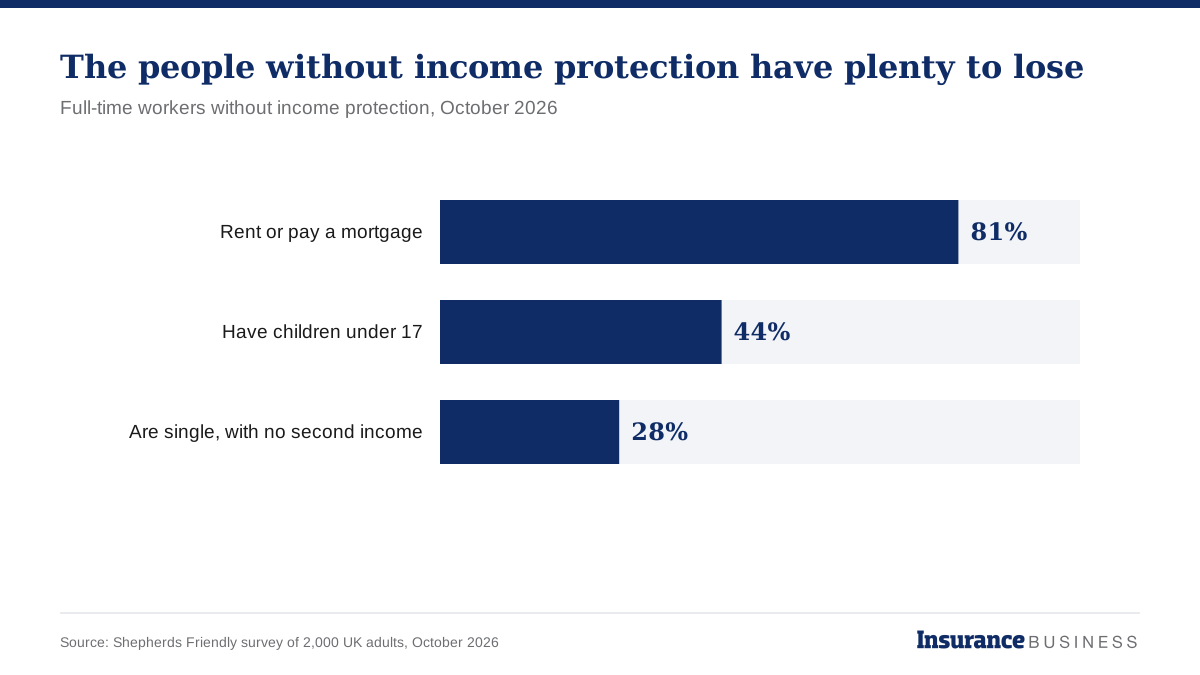
The uninsured are often the people who can least absorb a hit. Of those without cover, 81% were renting or paying a mortgage, 44% had children under 17 and 28% were single, so there was no second income to lean on.
This is not an abstract risk, either – 20% of full-time workers aged 18 to 64 said they had already spent time out of work without their usual pay. Among 18- to 24-year-olds that rose to 40%. Looking five years ahead, 38% expected something outside their control to dent their income, with the cost of living, a downturn and ill health at the top of the worry list.
Read next: Sick days stay high as one in 10 adults have no savings, Everywhen says
People have heard of it. They just don't believe it's for them
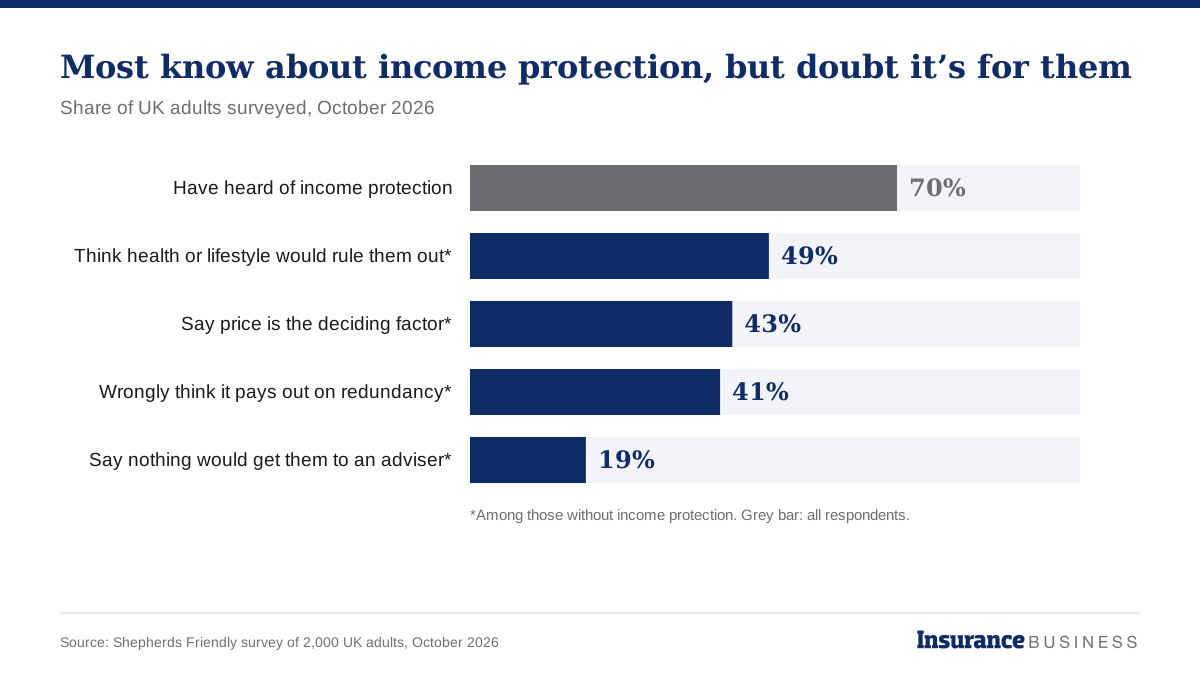
The interesting finding is that ignorance isn't really the problem. Seventy percent of people surveyed had heard of income protection. What they think it does is another matter.
Among those without a policy, 41% believed it would pay out if they were made redundant, which standard long-term income protection does not. Almost half (49%) assumed that a health condition or habits such as regular drinking would automatically shut them out, a view held by 57% of 18- to 24-year-olds.
"The findings from this year's research suggest that low Income Protection take-up is not primarily driven by a lack of awareness," Simpson said when the research was published.
Price still looms largest. Some 43% of the uninsured named cost as the deciding factor when choosing protection. A free consultation (28%) and no broker fees (22%) were the things most likely to get them talking to an adviser. But 19% said nothing at all would.
That last number is the uncomfortable one for the advice market. Correcting myths only works if people are in the room to hear it.
Long-term income protection pays a monthly benefit when illness or injury stops someone working, after an agreed deferred period. It does not pay out on redundancy.
Short-term accident, sickness and unemployment (ASU) cover can include job loss, but it pays for a much shorter period. Short-term income protection is a cheaper middle option that caps how long a claim runs; Shepherds Friendly's version pays for up to 24 months per claim. Neither covers unemployment unless the policy says so.
The research has arrived six months into the biggest overhaul of statutory sick pay in years. Since 6 April, under the Employment Rights Act 2025, SSP has been payable from the first day of absence and the lower earnings limit has gone, so low earners now qualify, as Acas sets out.
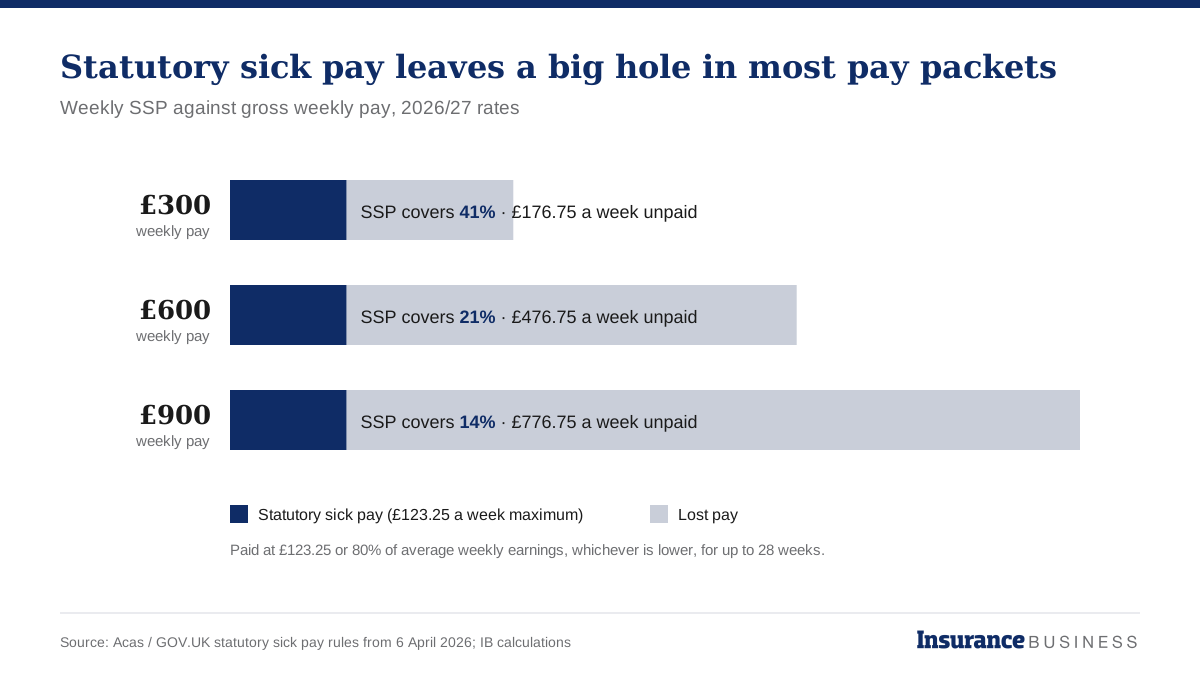
What hasn't changed much is the amount. SSP is paid at £123.25 a week or 80% of average weekly earnings, whichever is lower, for up to 28 weeks. For someone earning £600 a week, that is about a fifth of their normal pay, and it stops after six months unless an employer pays more.
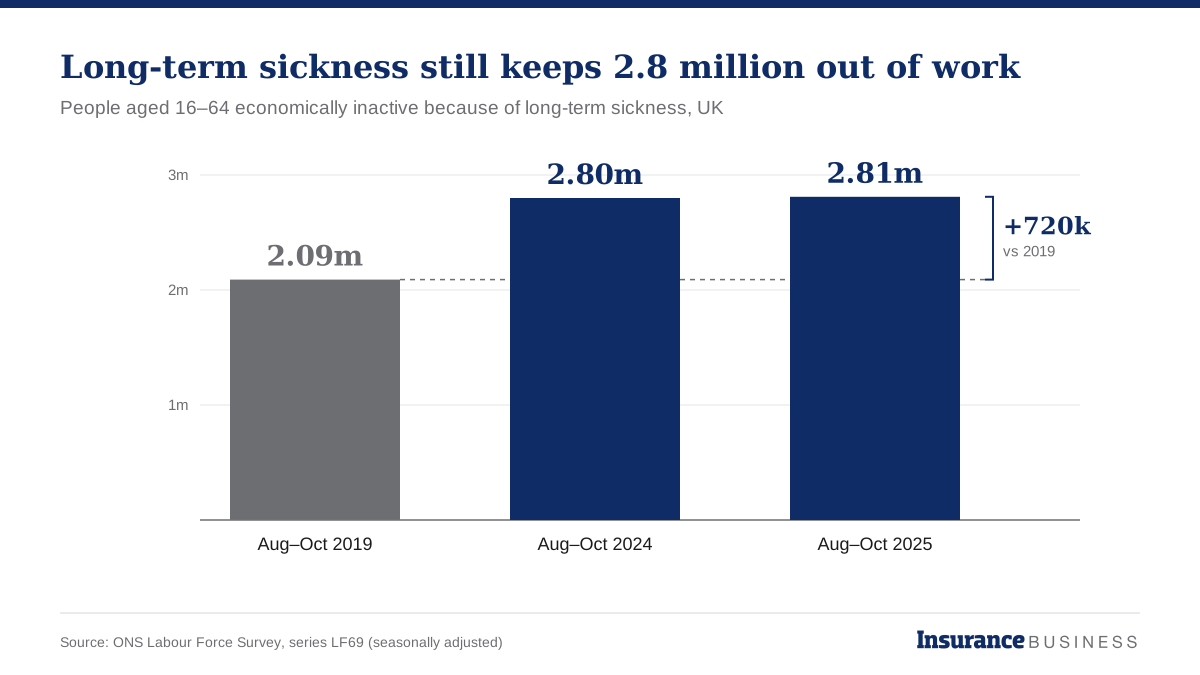
The wider backdrop is not getting dramatically better either. The latest Office for National Statistics figures put the working-age inactivity rate at 20.9% in June to August 2026. Long-term sickness was the single biggest reason people gave for being out of the labour market, accounting for 30% of the economically inactive, according to the House of Commons Library. The ONS did record a fall over the year in the number inactive because of long-term sickness, which is the one bit of good news here.
Simpson's appointment is the latest step in a distribution push that has been running for a while. In recent years the mutual has signed up with SimplyBiz, Next Intelligence, Mortgage Intelligence, Paradigm and The Money Group.
In May it agreed a deal with Primis Mortgage Network that puts its income protection in front of almost 3,000 mortgage advisers, including through the Novium protection sourcing platform. In September it joined The Right DA Club's protection panel.
The mortgage angle makes sense. A mortgage is usually a household's biggest monthly bill, and the point of sale is one of the few moments when people are already talking to an adviser about long-term money.
There is also an underwriting story that speaks directly to the 49% who think they would be turned away. The society has said its fully underwritten product can consider applicants with conditions including diabetes, anxiety, depression, high blood pressure, a raised BMI and back pain, subject to individual circumstances.
And it has a claims record to point to. Shepherds Friendly paid £3.25m in income protection claims in 2025 and paid 97% of the claims it received, supporting 475 families. Musculoskeletal problems were the most common reason for claiming, at 49% of claims.
All of this sits under chief executive Jonathan Sandell, who succeeded Ann-Marie O'Dea at the start of 2026.
Read next: Shepherds Friendly names Jonathan Sandell as next CEO
On its own, no, and it would be odd to pretend otherwise. The market is moving, but slowly. Swiss Re's latest Term & Health Watch found individual income protection sales rose 11.9% in 2025 to just under 267,000 new policies, out of roughly 2 million new protection policies of all kinds.
Shepherds Friendly is a small player in that picture. Its £3.25m of income protection claims last year compares with more than £670m paid under group income protection in 2025, according to industry body GRiD.
But closing the gap was never going to be one provider's job. What a mutual like Shepherds Friendly can do is push hard on the things its research says are holding people back: the belief that cover is unaffordable, that it won't pay out, or that a bad back or a bout of anxiety rules you out. Putting product, marketing and adviser relationships under one person is a reasonable way to do that faster.
For protection advisers, the research is a script for the first meeting. Clients worried about redundancy need to hear that long-term income protection won't help with that, and that short-term accident, sickness and unemployment cover might. Clients who assume their medical history disqualifies them may be wrong.
For commercial brokers, the case for group income protection writes itself. Employer schemes reach people who would never buy cover on their own, and usually without the individual medical underwriting that so many workers fear.
The real test is whether that 16% looks any different the next time the mutual asks the question. If it barely moves, the third century will start with the same problem the second one ended on.
Read next: Insurance hires: Markel, Shepherds Friendly, Brace Underwriting, Specialty MGA UK