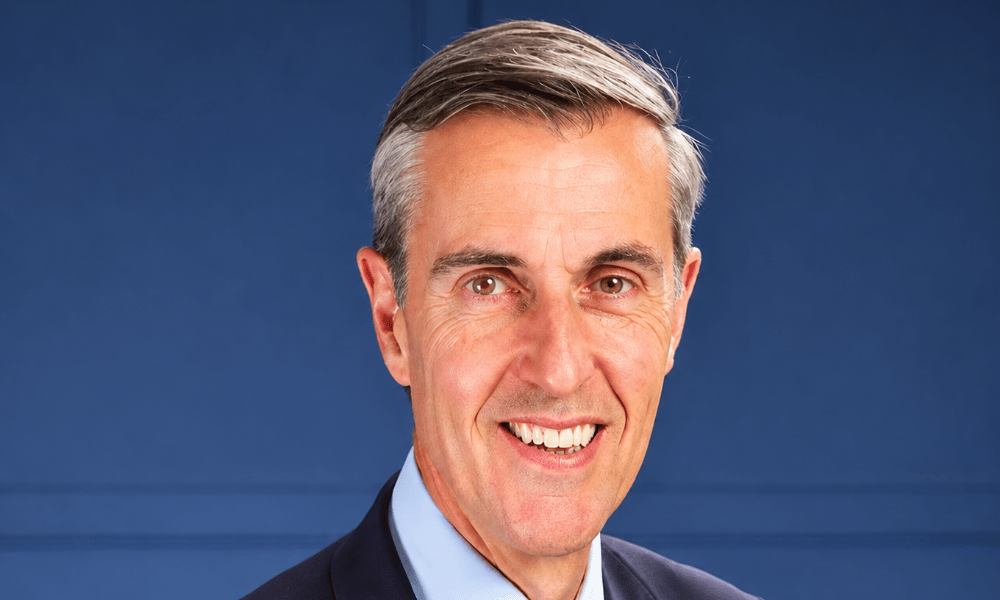
The founding principles of Lloyd's of London, circa 1680, are structurally very similar to Takaful. Both grew from mutual protection societies in which members pool resources to collectively absorb each other's losses. Neither was designed to generate profit for a third-party shareholder. Andrew Selous (pictured) makes this argument not as a historical footnote but as the centrepiece of a commercial case: London built this model and it can lead it again.
Selous is executive director of City and Commercial, an Aldgate-based global insurance group that describes itself as the first company to write Takaful in the UK and is the organiser of the International Takaful Summit taking place in the City next summer. He came to the role in September 2024, returning to insurance after six terms in Parliament, and is now making a case that London is better placed than anywhere to lead the global re-Takaful market.
The scale of the unmet need is hard to overstate. The Islamic Financial Services Board estimates that less than 2% of the $4.4 trillion held in Islamic finance assets globally is insured on a Takaful basis. Global Takaful premium stands at just under $29 billion and of that, only a small fraction is reinsured on a Sharia-compliant re-Takaful basis. The remainder leaks into conventional reinsurance under an Islamic finance principle known as darura, or necessity: if compliant capacity does not exist, conventional alternatives are permitted. That permission is now under pressure.
Governments and Sharia supervisory boards across Malaysia, Indonesia, Pakistan, and Nigeria are all moving in the same direction: re-Takaful capacity must be used when available, not merely tolerated when it is not. Pakistan is making Takaful mandatory across its insurance market, with a constitutional deadline of January 2028 to eliminate interest across the economy. A senior figure at a major Middle Eastern multilateral development bank told Selous directly that resorting to conventional reinsurance is not a preference. The scholarly and regulatory environment that created the leakage is closing.
Then there is the domestic opportunity, hiding in plain sight. Three of London's most prominent buildings are owned by Islamic sovereign and provident funds. Battersea Power Station is owned by a Malaysian consortium, The Shard is 95% owned by the state of Qatar as is Chelsea Barracks. All three are currently insured and reinsured conventionally, because no credible re-Takaful alternative has been assembled to compete for the business.
The mechanism to do it already exists. A Takaful window allows any conventional insurer or reinsurer to ring-fence a separate account where participant funds are segregated, with Sharia board oversight on investment and surplus distribution policy. Brokers can run two parallel slips, one Takaful and one conventional, with identical terms and conditions, shifting the proportion placed on a Sharia-compliant basis as re-Takaful capacity grows. The structure requires no reinvention of existing market infrastructure, just a requirement for brokers and syndicates to understand what is there.
Selous is clear that Takaful's future in the UK is not primarily a story about faith. The country's four million Muslims are a starting point, not a ceiling. His preferred positioning is participative or sharing insurance, language that describes the product's mechanics without encoding its religious origins and he draws a deliberate analogy with halal food: a standard that extends well beyond its original market because the product competes on its own merits.
What he actively resists is the framing of Takaful as ethical insurance. The implication that conventional insurance is therefore unethical is one he rejects, and he worries the label narrows the addressable market before it has had a chance to grow. His pitch is simpler and older: insurance is the prudence of the many coming to the aid of the misfortune of the few at no cost to the state. Takaful, he argues, just does that, returning surplus to participants when the fund performs rather than passing it to shareholders.
The broker education gap is the most practical obstacle. Major London brokers need to understand that Takaful and re-Takaful are an opportunity, not a compliance headache, and that opening a Takaful window inside a Lloyd's syndicate does not require structural upheaval.
Selous has also called on the UK government to issue a new sukuk, an Islamic bond, noting that the previous one, issued under David Cameron, has been redeemed without a replacement, a gap he argues sends the wrong signal to global Islamic finance markets. Insurance already accounts for 37% of the City’s economic activity, according to the London Market Group. The re-Takaful premium currently flowing to conventional reinsurers represents a share of a $29 billion market that London has the infrastructure, the relationships, and the history to serve. The question is whether it moves before Singapore, Dubai, or Bermuda decides to.