At a glance
Britain's general insurers have come through the Bank of England's first live-fire stress test with their solvency intact. The catch is, as the regulator makes clear, is that they didn’t do it on their own.
The Prudential Regulation Authority published the results of its Dynamic General Insurance Stress Test (DyGIST) yesterday, 23rd November. The exercise put 25 major insurers, the Society of Lloyd's among them, through a three-week simulated crisis in May. Together they write more than 80% of the UK general insurance market by gross premiums.
The PRA's published invitation list ran from household names such as Aviva, Admiral, LV= and NFU Mutual to London market carriers including Convex, Fidelis and Markel, plus Flood Re. Results are published only at sector level, so no individual firm's numbers are public.
Taken one at a time, none of the scenario's shocks pushed the sector's aggregate solvency coverage below 100%, and no participant breached its Solvency Capital Requirement (SCR). Stack them together and ignore the rescue plans, though, and the PRA says most participants would have blown through their own internal risk-appetite limits.
That gap – between what insurers hold and what they expect others to provide in a crisis – is the real story of DyGIST. The PRA says resilience depends not just on an insurer's own capital, but on whether the reinsurance, group backing and outside help it is counting on would still be there if half the market reached for the same lifeline at once.
Read next: London insurers face live PRA stress test
For all the catastrophe drama, the biggest hit came from the investment side. A global market downturn with an inflationary sting knocked 25 percentage points off the sector's SCR coverage ratio, taking it from 183% to 158%. Every one of the 25 participants felt it.
Higher discount rates helped a little by shrinking the value of insurers' liabilities. Claims inflation pushed the other way, inflating reserves, especially on long-tail business. The PRA's message for boards is to keep a close eye on inflation assumptions and to check that investment strategies still match the liabilities they are meant to back.
The insured events then piled on. A Pacific Northwest earthquake, borrowed from Lloyd's own extreme disaster scenario and set at a 1-in-100 to 1-in-200 year return period, was the heaviest of the natural catastrophes. It carried a £130.5bn central estimate of global insured losses and landed mostly on the London market, cutting aggregate solvency by about 17%.
A North Atlantic hurricane, code-named Taurus, was modelled at £95bn of global insured losses. Closer to home, Nevis – a UK windstorm pitched at 1-in-100 to 1-in-150 years and built with help from the Met Office and Verisk – was the event that hurt UK retail and commercial insurers most. Losses were driven by wind rather than flood, and all 25 participants reported a hit.
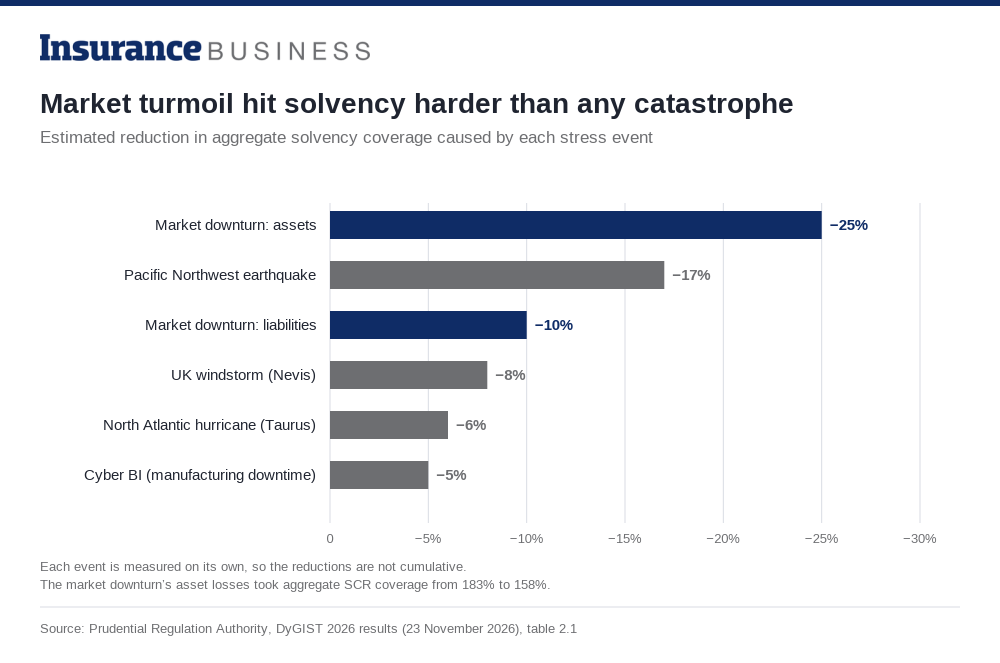
After management actions such as dividend retention and capital support, the sector's coverage ratio fell but never dipped below 100%. The PRA notes that participants reported an average internal risk-appetite threshold of 130%, which gives a sense of how far below comfort levels many would have strayed before their recovery plans kicked in.
Solvency ratios were high by historical standards going in, and 2024–25 had been relatively kind on catastrophes. The PRA warns that a weaker capital position or a harder reinsurance market could have produced a very different outcome.
Read next: PRA 2026 priorities: Are insurers overestimating their resilience?
If one number sums up DyGIST, it’s this: reinsurance cut gross losses from the insured events by around 72%. On the earthquake, insurers reported £23.2bn of gross losses, which shrank to £7.8bn net. Taurus went from £11.8bn gross to £2.8bn net.
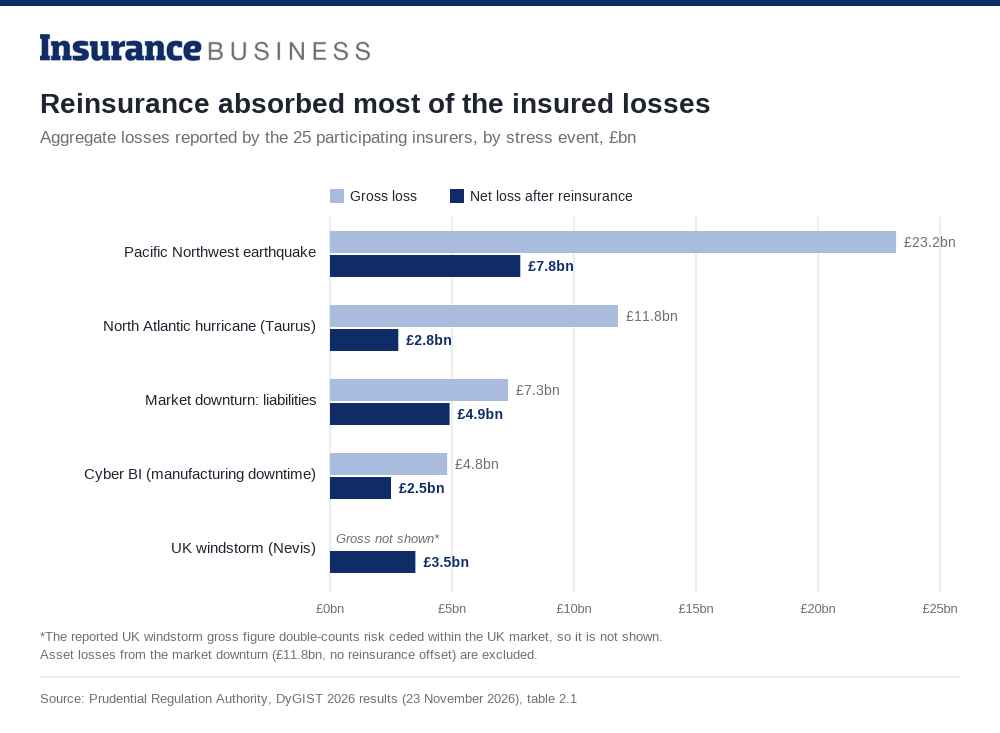
The good news is that the protection was well spread. No single reinsurer accounted for more than 10% of participants' gross loss on any event, and recoveries came from a range of jurisdictions rather than one domicile.
Many carriers assumed claims would be paid quickly and in full, with few disputes, and that replacement cover would be available on sensible terms once their lower layers and reinstatements had been eaten up. The PRA calls some of those assumptions optimistic, given the scenario deliberately wiped out a large chunk of global reinsurance capital.
Reinsurers go into January with record capital and strong returns, and property catastrophe pricing has fallen by more than 20% since 2024. The PRA's point is that a market this generous in calm conditions may look very different the morning after a £100bn-plus loss.
Liquidity told a similar story. Insurers did not see cash as a sector-wide problem, but the PRA found that the pinch point was timing: gross claims, collateral calls and falling asset values could all arrive before reinsurance money did. Cash-call clauses, committed facilities and funds-withheld structures were among the strongest defences.
Read next: Fitch keeps 'deteriorating' call on reinsurance for 2027
Resources that depend on a wider group covered roughly two-thirds of gross losses in the scenario. Contractual intra-group reinsurance accounted for 19%, discretionary group support a further 25% and shared reinsurance programmes another 22%.
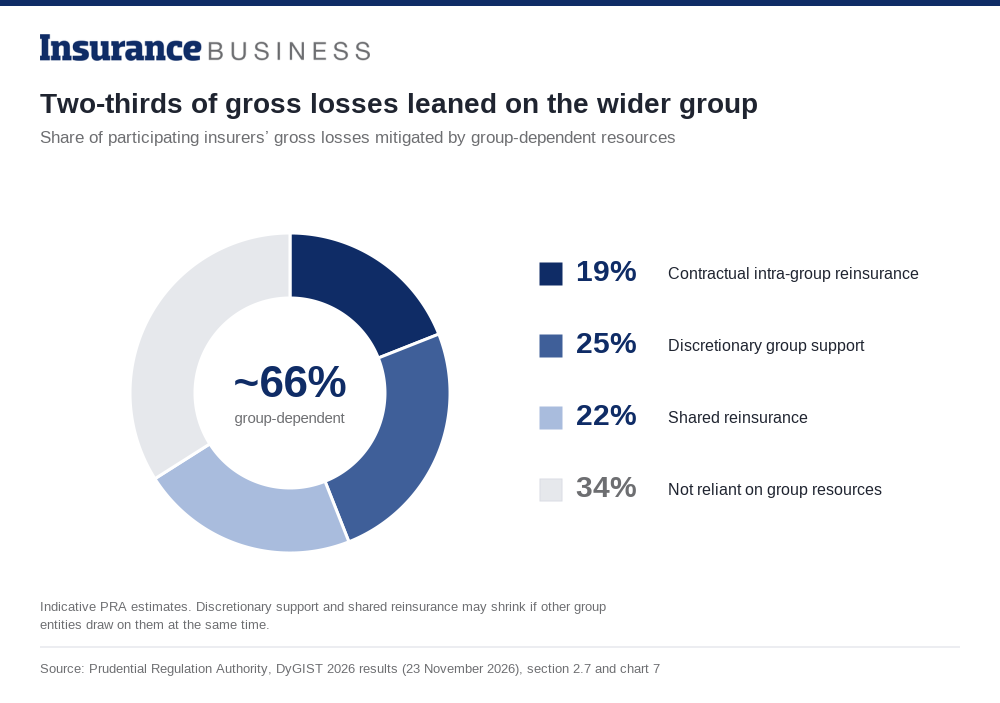
Group support was the management action that did most to restore coverage, with capital injections from parents the main form it took. Withholding intra-group dividends was the most popular, because it is quick and avoids the cost and hassle of raising capital or buying extra reinsurance – though it only works if a business is profitable enough to have a dividend to hold back.
The problem is that discretionary support depends on a parent's capacity and willingness to help at the very moment it may be fighting fires elsewhere. The exercise only tested PRA-regulated entities, so it never checked whether those parents would have been hit by the same events. Shared reinsurance raises a similar worry: if several group companies claim on one programme at once, the slice left for the UK entity could be much smaller than planned.
The PRA wants firms to draw a hard line between what is legally enforceable and what is merely expected, and to test whether the help would arrive on time and at scale. Banks, brokers, catastrophe modellers, claims specialists and repair networks fall under the same scrutiny. Each insurer may count on them individually; the PRA's concern is what happens when everyone calls at once.
There was one reassuring finding. No insurer chose to leave the market, and most planned targeted repricing and portfolio tweaks so they could write profitable business once the dust settled, rather than retreating.
The smallest loss on paper proved the hardest to pin down. A ransomware attack that shut down manufacturing carried a £9bn central estimate of global insured losses. Participants reported £4.8bn gross and £2.5bn net, a net figure in the same range as the natural catastrophes once reinsurance was stripped out.
With little comparable loss history, insurers leaned heavily on expert judgement, and their approaches varied widely. Many started at or near policy limits and then trimmed estimates as the scenario developed, even though the outage dragged on longer than first expected. The PRA reads those falling numbers as initial caution being released rather than the event getting any less severe.
Most insurers placed the event inside the 1-in-200 horizon of the solvency regime, but a minority thought it so remote it fell outside. The PRA's advice to anyone writing, or planning to write, serious volumes of cyber is to check that their internal models really capture systemic and supply-chain scenarios like this one. Several firms also struggled to get detailed technology and supply-chain data, especially on delegated business – a familiar pain point for MGAs and the brokers who place with them.
Just days before the DyGIST results, the PRA, FCA and Bank of England launched a joint consultation on cyber risk and resilience, noting that October saw the second-highest monthly tally of cyber incidents reported to the FCA in five years.
Read next: UK regulators consult on cyber resilience guidance as FCA incidents hit second-highest level
The PRA has no plans to run another general insurance stress test before 2029. That is a notable stretch: back in December 2024, when it postponed DyGIST by a year, the regulator said it intended to run general insurance tests every two years from 2026.
The PRA has not linked the longer gap to feedback, but it comes after industry grumbles that the exercise was too demanding, with some firms reportedly pulling specialists in at short notice. That marked a shift from the mood at launch, when Nafisah Hussain of the International Underwriting Association told Insurance Business that what set DyGIST apart was that it was "a genuinely live test".
The regulator says the firms that learned most were those that treated it as a genuine crisis rather than running through a mechanical process: they pulled in the right people early, named clear owners, kept running records of their assumptions and showed how new information changed their decisions.
In the meantime, insurers are being told to do the homework themselves. The PRA wants smaller, proportionate dynamic exercises run alongside ORSA stress tests. It also wants firms to set escalation triggers that do not rely on waiting for a solvency breach, and to rank recovery actions by how quickly and reliably they can actually be pulled off. Follow-up supervision will focus on catastrophe loss estimation, reinsurance dependencies and whether group support would really hold up in a crisis.
For brokers, the practical takeaway is reinsurance and group structure. A carrier's headline solvency ratio tells part of the story; how much of its resilience rests on a parent's goodwill or a shared reinsurance tower tells the rest. And although the PRA tested only participating firms, the lessons apply to every UK general insurer.