What happened: The court ruled a restaurant's fire claim failed because its ox grill was left unattended, breaching a kitchen equipment condition precedent.
Who's involved: P B Development Company Limited (restaurant operator) and Intact Insurance UK (formerly RSA), the insurer.
What's at stake: The restaurant's entire property damage and business interruption claim for extensive fire damage to an Aberdeen restaurant.
Why it matters: The decision is one of the first to substantively interpret section 11(3) of the Insurance Act 2015, and defines "unattended" in a way that will shape how hospitality risks are underwritten and claims assessed.
Where it stands: Decided. Decree in favour of the insurer on November 11, 2026.
Burning drops of fat were already falling from the extraction canopy when a chef walked back into the kitchen. By then, the fire had a head start.
A Scottish court has ruled that Intact Insurance UK (formerly Royal & Sun Alliance) does not have to pay a property damage claim brought by P B Development Company Limited, the operator of Vovem Meat & Liquor, an Aberdeen restaurant extensively damaged by fire in September 2024. The decision, handed down by the Outer House of the Court of Session on November 11, 2026, turned on whether the restaurant's ox grill was "left unattended" while its heat source was running - and whether that mattered given where the fire actually started.
The insurer said the grill was unattended. The court agreed.
The policy's kitchen equipment clause required that all cooking equipment "is not left unattended whilst the heat source is operating." Failure to comply, the policy stated in bold, "will result in the Company not paying the Policyholders Property Damage or Business Interruption claim." The court found that language left no real doubt: a reasonable person reading the policy would have understood that compliance was necessary before a claim would be paid. That made the clause a condition precedent to liability - in plain terms, the insurer's obligation to pay only kicked in if the restaurant had followed the rule.
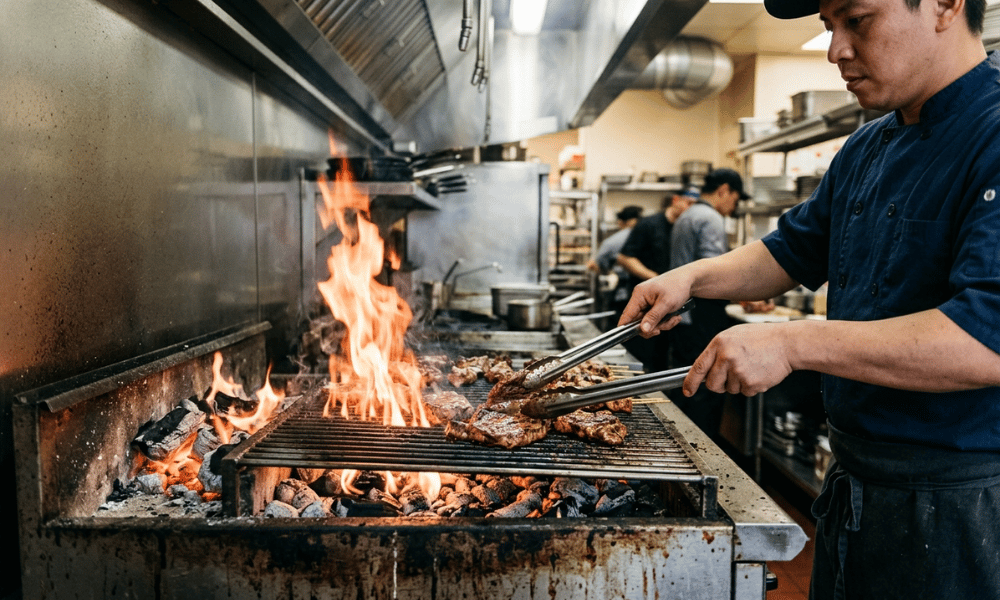
CCTV footage from two kitchen cameras captured the timeline almost in full. The ox grill - a stainless-steel charcoal unit enclosed on three sides by refractory brick - was loaded and lit just after 11am on September 26, 2024. The sous chef who lit it left shortly afterwards to work at a sister restaurant. A colleague took over, tending the grill from time to time while handling food prep nearby.
That colleague was not always watching. He glanced over his shoulder at the grill occasionally. He walked past it. At one point he threw a piece of blue tissue roll onto the fire. But for stretches he was working at a prep area out of sight of the grill - and for roughly two minutes and 45 seconds he left the kitchen entirely and went upstairs.
Other staff were in the building. A prep chef was in the kitchen. A duty manager was setting up the dining room a few metres away, across the pass. But none of them, the court found, were in a position to look after or tend the grill in the way the policy required.
At 11:32, embers appeared in the air above the grill on the CCTV footage. At 11:43, burning drops of fat began falling from the extraction canopy. When the chef returned to the kitchen, a colleague told him the smoke smelled different from normal. He found flames on the canopy and began spraying them with a solution from a plastic bottle. Upstairs, smoke was already issuing from the boiler room. A legal secretary from the firm next door called 999. The kitchen was evacuated by 11:49.
The restaurant argued its staff were close enough - in the kitchen, across the pass - that the grill was effectively attended. The court disagreed. It drew on a long-standing principle from a 1962 case where a driver left jewellery in a parked car and walked roughly 34 metres away. In that case, the court held the car was unattended because the driver could not keep it under observation or intervene if something went wrong.
The same logic applied here. Being "attended" does not require someone standing directly in front of the equipment giving it full attention, the court said. But it does require someone who is in a position to look after it and act if needed. Being merely in the vicinity is not enough.
The restaurant had one more argument. Section 11 of the Insurance Act 2015 says an insurer cannot rely on a breach of a risk-reduction clause if the policyholder can show that the breach "could not increase the risk of the loss which actually occurred in the circumstances in which it occurred." The restaurant's case was that the fire started inside concealed ductwork, where accumulated grease deposits were ignited by heat rising from the grill - meaning no one standing at the grill could have seen or stopped it.
The court was not persuaded. Expert evidence from both sides confirmed grease had built up in the ductwork and eventually ignited. But the court found, on the weight of the evidence - including CCTV footage of a near-miss incident the previous day when staff had to spray flames at the canopy with water - that the fire started under the canopy, below the baffle filters, before spreading into the ductwork above. Had someone been attending the grill and seen that at an early stage, "it is likely that they would have taken action and that might have prevented the fire spreading into the duct."
There is very little case law on section 11(3). The only previous judicial comment on the subsection the court identified, in a 2024 shipping insurance dispute, was non-binding side commentary rather than a ruling on the point. This decision is one of the first to apply the provision substantively.
The court ruled entirely in favour of the insurer. The restaurant's property damage and business interruption claim is dead. No assessment of the claim's value was undertaken.
For underwriters writing kitchen equipment clauses, the decision confirms that clear language tying non-compliance to claim refusal will be enforced as a condition precedent. For claims teams assessing hospitality losses, it sets a concrete, CCTV-documented benchmark for what "unattended" looks like in practice - and it makes clear that the section 11 safe harbour under the Insurance Act 2015 will not apply where the breach and the fire share the same mechanism.