Insurers like to say they are only as good as their claims record. Few claims files carry more weight than this one.
A ledger recording Atlantic Mutual Insurance Company’s share of the hull cover on RMS Titanic will be sold on 21 November by Henry Aldridge & Son in Devizes, Wiltshire, with a pre-sale estimate of £30,000 to £50,000. The auction house, which holds the record for every major Titanic item sold at auction, believes it is the only copy still in existence.
The binder was signed on 27 March 1912. Nineteen days later, the Belfast-built liner hit an iceberg in the North Atlantic on her maiden voyage from Southampton to New York, and more than 1,500 people died.
Atlantic Mutual took a US$100,000 line, which is roughly US$3.5 million in today’s money. That was one part of a total-loss placement worth about US$5 million, spread across a consortium of around 77 insurers, and the New York carrier is believed to have been one of the largest participants. The insured was the Oceanic Steam Navigation Company, the corporate owner behind the Liverpool-based White Star Line.
Read next: Hull premium growth of 9.4% masks a softening market – IUMI
The policy ran for 12 months from 30 March 1912. A handwritten endorsement extended it to the delivery passage from Belfast to Southampton, including any sea trials along the way. The document therefore records the ship’s insured status before any paying passenger came aboard. Andrew Aldridge, the auction house’s managing director, has reportedly called the clause “slightly prophetic”.
The cover was arranged in London. According to Lloyd’s history of the Titanic, broker Willis Faber & Co, a forerunner of today’s WTW, went to the Lloyd’s underwriting room on 9 January 1912 to place Titanic and her sister ship Olympic for White Star. Lloyd’s records the Titanic’s insured value as £1 million. At the exchange rate of the time, that broadly matches the US$5 million figure in American records. The original placement slip is still held by Lloyd’s.
Underwriters were keen to get on the slip, with one exception. British Dominions Marine Insurance refused to sign because it judged the vessel sat too low in the water.
Much of the legal framework would be familiar to marine lawyers today. The Marine Insurance Act 1906 had been in force for six years when Titanic sailed. More than a century later, and despite substantial amendment by the Insurance Act 2015, it remains the foundation of English marine insurance law.
Read next: Supertanker values overtake newbuilds: what it means for hull and risk cover
The numbers explain why Lloyd’s still ranks the sinking among its most significant historical losses, next to 9/11 and the 1906 San Francisco earthquake. Lloyd’s says total insured marine losses for all of 1912 came to £6.75 million, including Titanic, so a single ship made up about a seventh of the year’s marine losses.
On the morning the news broke, reinsurance rates on the vessel reached 60% as reports went from damaged to sinking. Underwriters who had written the hull were rushing to lay off risk on a ship that was already lost. The episode is also an early case study in facultative reinsurance. Delays in the ship’s delivery complicated the back-to-back reinsurance arrangements underneath the original placement.
White Star was still paid in full within 30 days. Today’s large marine losses can take months of salvage, adjusting and coverage argument to settle, so that turnaround still stands out. The aftermath was not entirely clean, though. Insurance Business has previously reported research suggesting a senior Titanic officer played down the iceberg collision, possibly to head off negligence claims.
Atlantic Mutual’s later history makes the document more poignant. The New York carrier was founded in 1838 and by the mid-1800s was North America’s largest marine and general insurer. More than a century later, it was a major insurer of property damaged or destroyed on September 11, an event that still shapes how the market thinks about terrorism cover. That exposure is widely thought to have contributed to the company’s decline. Its licences were revoked and it entered liquidation in 2011, after 173 years of trading. Papers from its archive, including Titanic material, were later exhibited in New York, where a dealer bought them.
Read next: Museum heists put portable collections under fresh scrutiny
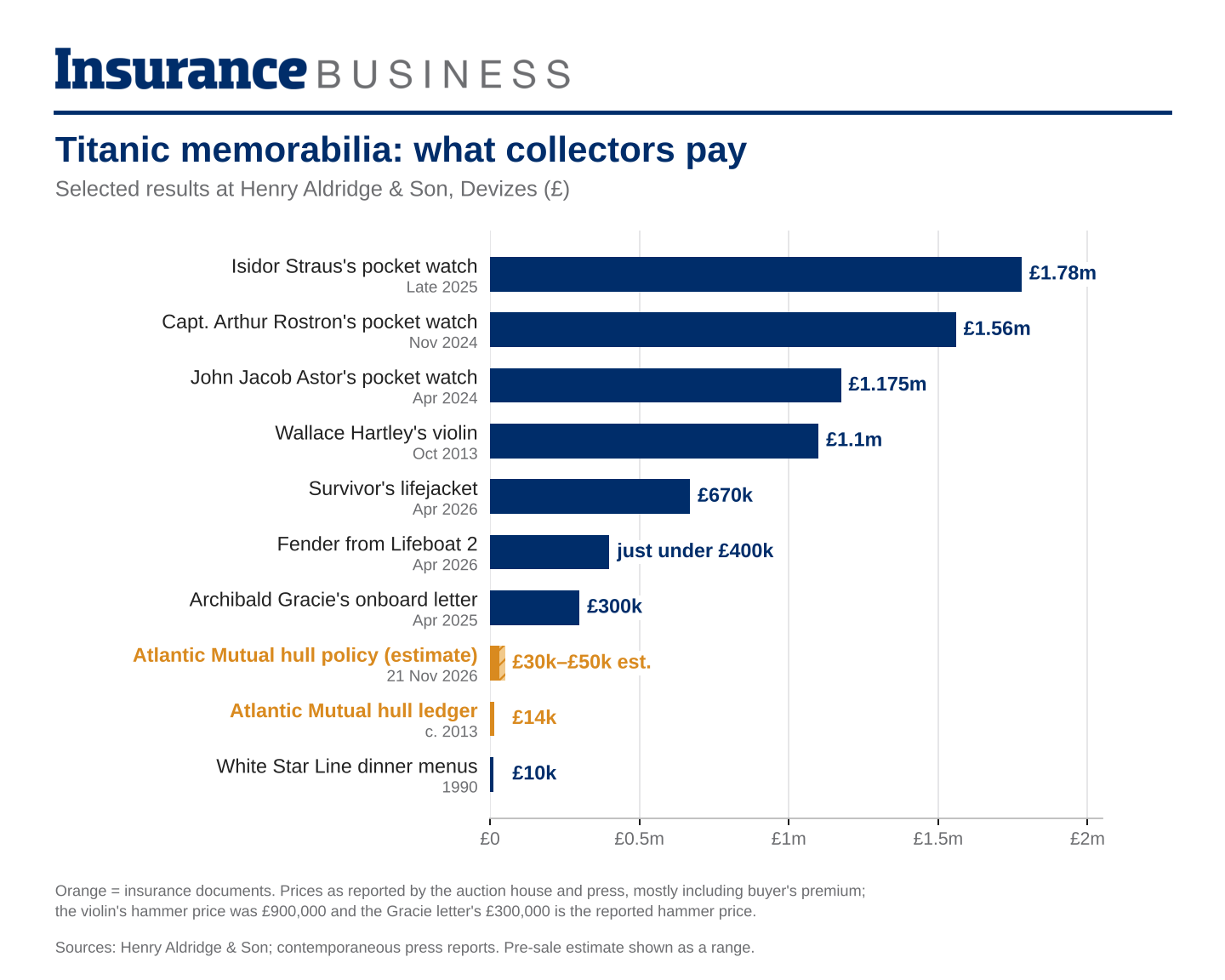
The estimate looks modest next to what Titanic collectors have paid recently. Over the past two years, the Devizes saleroom has sold three gold pocket watches for more than £1 million each. The record is £1.78 million, paid for the watch Isidor Straus was wearing. Captain Arthur Rostron’s watch, presented to him for rescuing survivors aboard the Carpathia, sold for £1.56 million. In April this year a survivor’s lifejacket made £670,000.
Insurance documents attract a narrower group of buyers. The auction house says the market is driven by passengers’ and crew members’ stories, and a hull binder, however significant to underwriters, does not have a person at its centre.
Private client brokers should take note of how fast these values are moving. The violin Titanic bandmaster Wallace Hartley is said to have played as the ship sank sold for £1.1 million in 2013, including fees. Aldridge now suggests it could be worth three or four times that. Clients who hold maritime collectables on a valuation that is several years old may be significantly underinsured.
Andrew Aldridge has said provenance is everything with these objects, and that is particularly relevant here. The auctioneer says it can find no record of an original Titanic policy being sold before. However, a Titanic historian’s account of an earlier Henry Aldridge auction, apparently held in 2013, describes the original Atlantic Mutual hull ledger selling there for £14,000. Separately, US trade press reported that year that a ledger page from Atlantic Mutual’s Titanic policy, number 391550, sold at Doyle New York for US$25,000 to an anonymous buyer.
It is not yet clear whether any of these is the item now on offer, a separate page or another record of the same risk. Serious bidders will want that answered before the hammer falls on 21 November.
Either way, the lot records a London-brokered policy that responded to a total loss exactly as intended, and the claim was paid within a month.
For more on hull, cargo and war risks, see Insurance Business’s latest marine news.