
West of England has picked up an upgrade to A- from Standard & Poor's, its second ratings improvement in under a year. The official framing, from both S&P and the Club itself, is that this is a story about underwriting discipline: five straight years of beating the International Group average on combined ratio, a free reserve at an all-time high, capital comfortably clearing S&P's own model threshold. All of that is true. It's also not the whole story.
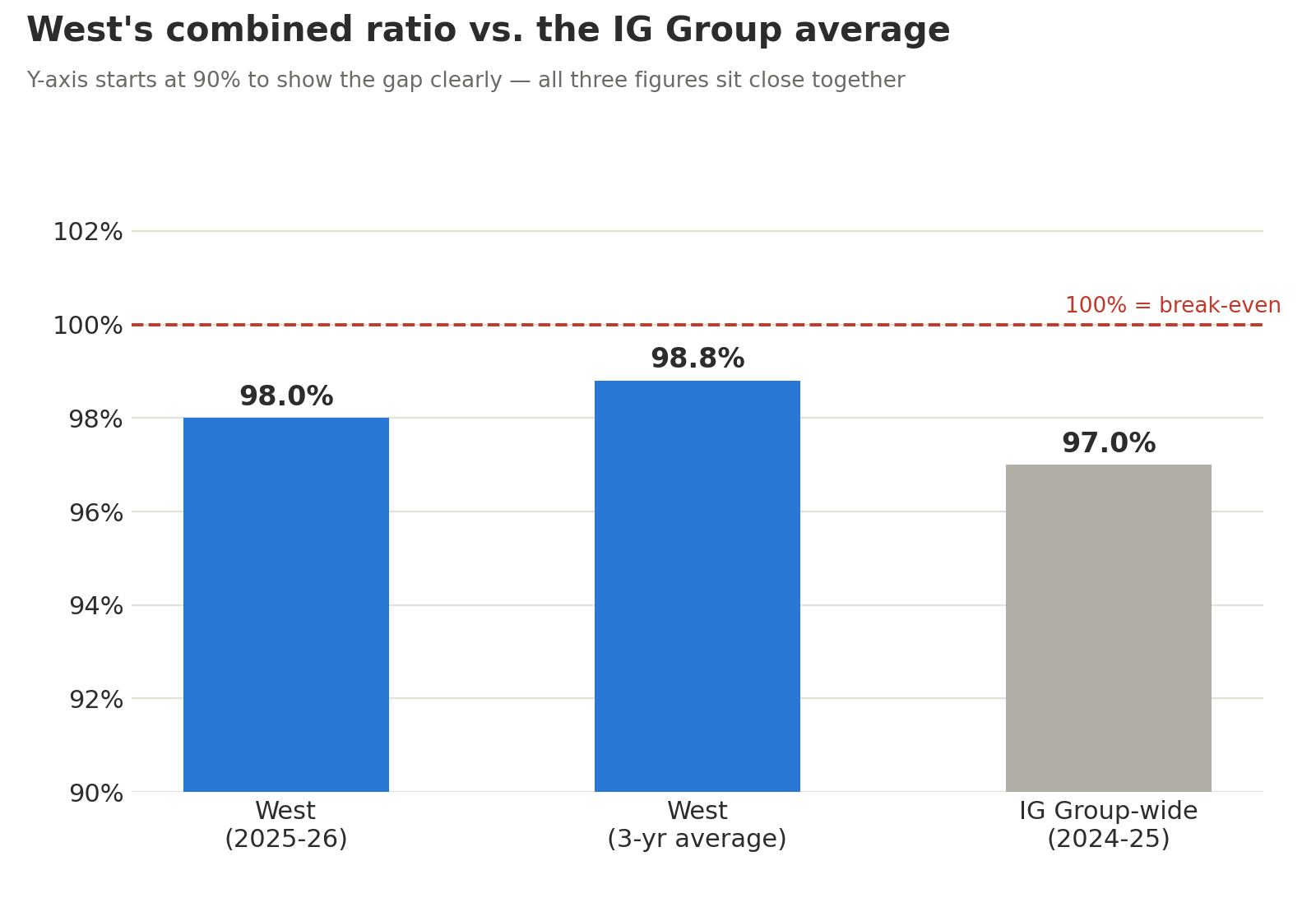
West's combined ratio came in at 98.0% for the year to 20 February 2026, improved from 103.9% the year before, with a three-year average of 98.8% - the figure the board actually targets against. Free reserve rose 23% to a record US$377 million. Gross earned premium climbed 18% to US$409.3 million, helped by a full first year of Nordic Marine Insurance under West's ownership following last year's acquisition. Solvency coverage moved up to 195%.
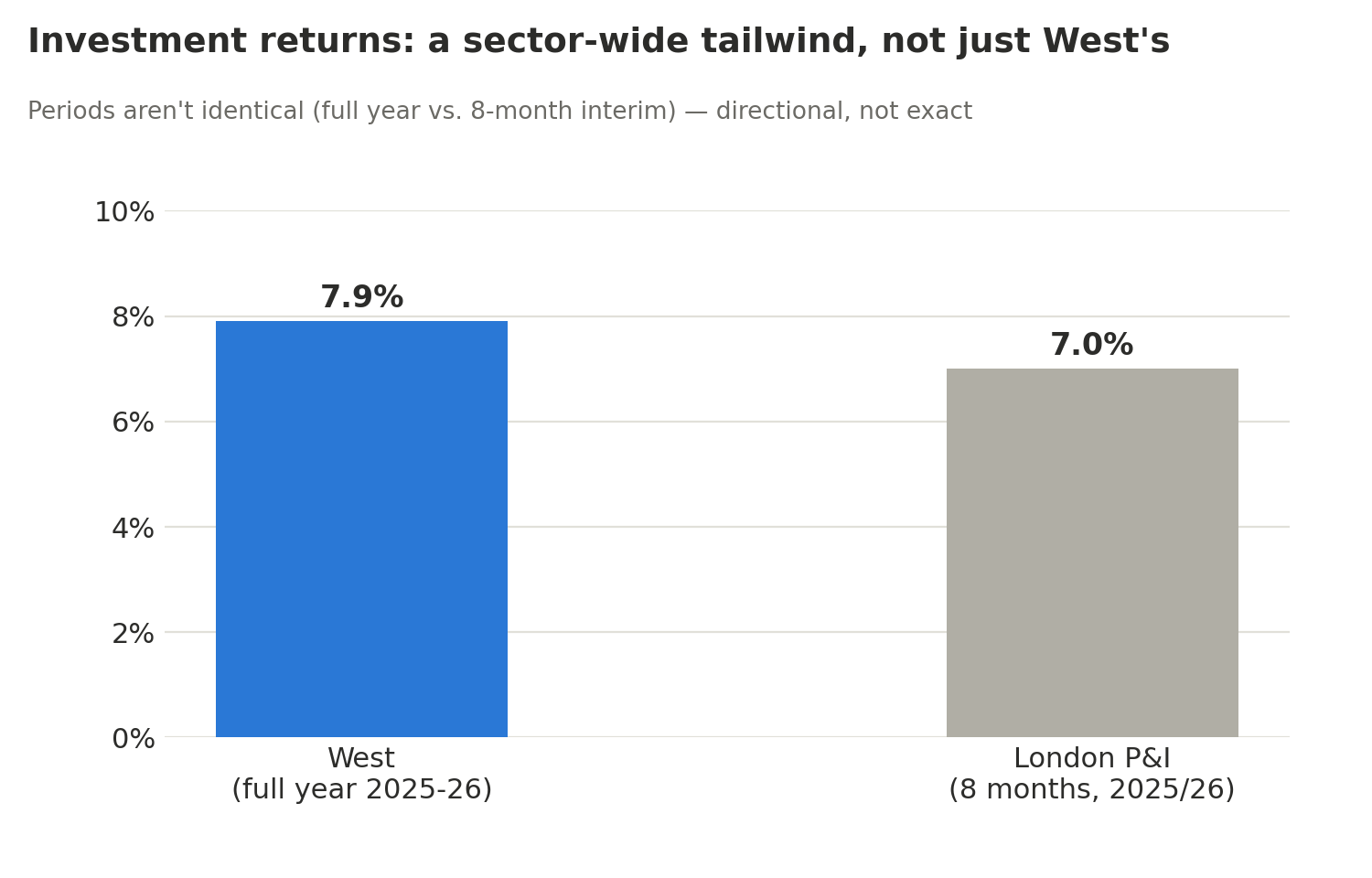
None of that is manufactured. But look at where the improvement actually came from: chief executive Tom Bowsher's own numbers show a 7.9% investment return generating US$65 million - West's best investment result in more than a decade, and the single biggest driver of that record free reserve. Underwriting improved too, but it's the investment line doing a lot of the heavy lifting on the balance sheet.
That matters because West isn't the only IG club citing an unusually strong investment year. London P&I Club reported a 7% cumulative return through eight months of its own 2025/26 policy year (as of its most recent update) - not a full-year figure like West's, but close enough in size and timing to be a fair directional comparison - and Gallagher's own pre-renewal review of the sector noted that clubs broadly "benefited from stronger investment income," which helped paper over underwriting losses across several members. When most of a 12-club mutual pool is riding the same market tailwind, an individual club's investment result says less about that club's specific skill than the headline number implies.
The underwriting side is a more genuinely company-specific claim, and it's the one worth taking more seriously - but it also deserves closer scrutiny than a press release gives it. Beinsure's tracking of the Group put the average combined ratio for 2024-25 at 97%, with individual clubs ranging from 83% to 110.5% and four clubs posting underwriting losses. West's own reported figures - 98.0% for the latest year, 98.8% on the three-year view the Club prefers - sit close to, not clearly below, that Group-wide average, even as West describes itself as outperforming IG peers on the same metric. That's not necessarily a contradiction - the periods and methodologies may not line up exactly, and West's claim may be measured against a different peer set or timeframe than Beinsure's Group-wide figure - but it's a gap worth asking the Club to reconcile rather than repeating their framing unchallenged.
The more interesting context sits in the claims environment West is operating in, not the numbers it's putting out. After a relatively benign run for shared Pool claims in 2022/23 and 2023/24, the International Group's own reinsurance renewal documents point to a return to higher Pool claims activity in 2024/25 and 2025/26, closer to levels last seen in 2019-2021. Because Pool claims are shared across all 12 IG members - which, per the Group's own current figures, cover 87% of the world's ocean-going tonnage between them - a club's combined ratio is never purely a reflection of its own book - it's partly hostage to how badly other clubs' large claims are running. Posting an improving combined ratio into a harder claims environment is a more meaningful signal than posting one during the soft years that preceded it, and it's the detail that got buried under the rating announcement rather than led with.
There's also a cost dimension nobody in the original coverage connected to the rating story: the UK Emissions Trading Scheme extended to ships of 5,000 gross tonnes and above from July 2026, with offshore vessels following in January 2027. That's a new compliance and cost layer landing on shipowners right as clubs like West are asking members to absorb general increases at renewal - accepting a stronger balance sheet on one hand while facing a new external cost on the other. Worth a line acknowledging that members aren't purely benefiting from the good news either.
West's upgrade is real and the underlying five-year underwriting trend is a legitimate achievement worth reporting straight. But "technical performance outpaces peers" is the Club's chosen framing, not an independently verified fact, and the piece that repeats it without interrogating the investment-market tailwind or the Group-wide comparison is telling half the story S&P's own rating action actually supports.