For most of the past decade, CVS Health has argued that its size was the point. A drugstore on seemingly every corner, a pharmacy benefit manager processing hundreds of millions of claims and one of the country's largest health insurers, all under one roof, would bend the cost curve in ways no rival could match.
Now the Rhode Island company may be preparing to cut that roof in two.
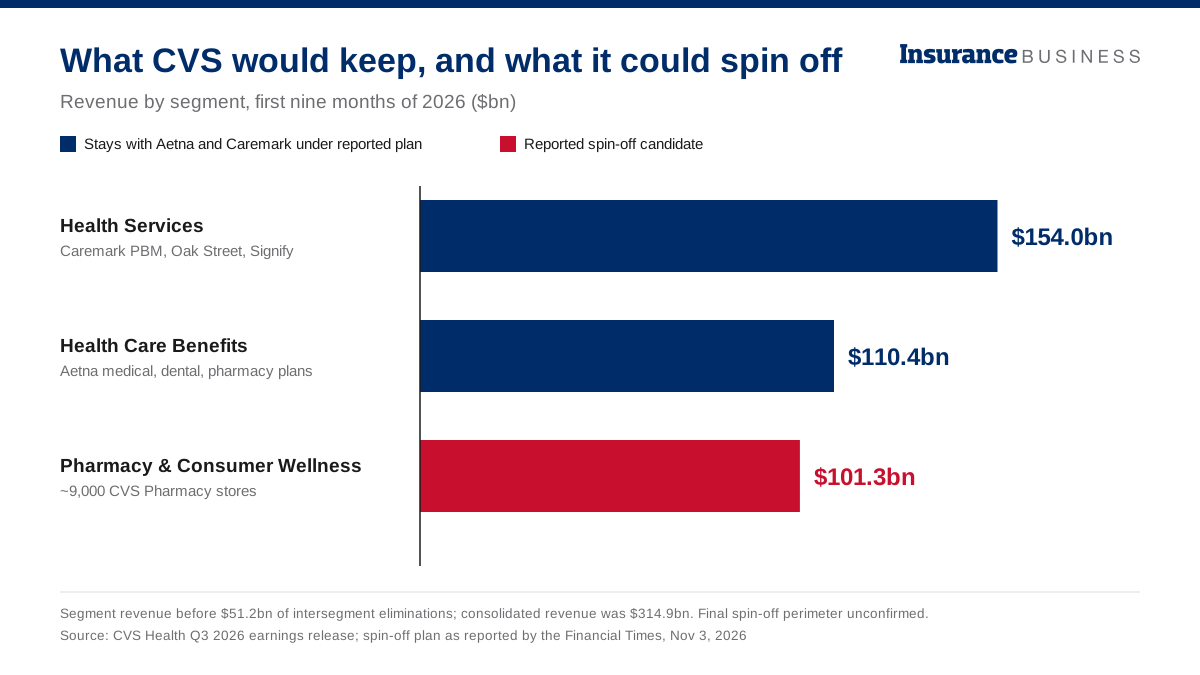
CVS is weighing a plan to spin off its retail pharmacy arm, roughly 9,000 stores, as a separately listed company, according to a Financial Times report published Tuesday that cited people familiar with the deliberations. Insurer Aetna and pharmacy benefit manager Caremark would stay together in the remaining company. The paper cautioned that the structure and timing were still in flux, and Reuters, following up on the story, said talks were at an early stage with no final decision made.
If CVS goes ahead, it would undo much of the logic behind its roughly $78 billion purchase of Aetna in 2018, and it would leave the insurer and its PBM still joined at the hip, which is precisely the combination regulators have been circling.
CVS reported third-quarter results before the opening bell on Wednesday, and its earnings release made no mention of a separation. The company had not responded to requests for comment from either outlet by the time their stories ran.
When CVS agreed to buy Aetna in late 2017, the pitch was that pharmacies, clinics and coverage would feed one another. Then-CEO Larry Merlo argued that the CVS-Aetna combination could push healthcare costs down by steering members to MinuteClinic sites rather than hospitals. The deal closed in 2018 at roughly $78 billion including debt.
The arrangement under discussion would keep the two most insurance-relevant pieces of that machine intact. Aetna's medical plans and Caremark's drug-benefit operation would form the core of the remaining company, alongside the care-delivery businesses CVS bought in 2023, Signify Health and Oak Street Health, according to the FT.
What would leave is the part of CVS most consumers actually see. The retail unit is expected to produce about a third of the group's revenue this year, the FT reported. CVS on Wednesday lifted its 2026 revenue outlook to at least $420 billion.
Read next: CVS Health chases $2 billion after star ratings snub
The insurance arm comes to the table in far better shape than it was two years ago. In the third quarter, the Health Care Benefits segment, which houses Aetna, earned $912 million in adjusted operating income, nearly triple the $314 million it booked a year earlier, according to the company's filing. Its medical benefit ratio, the share of premiums paid out in claims, improved to 91.3% from 92.8%.
That recovery has come partly through shrinking. Aetna left the Affordable Care Act individual exchanges this year, a retreat CVS confirmed in 2025, and commercial premium revenue fell about 17% year on year in the quarter. Medical membership stood at 26.1 million at the end of September, down from 26.7 million a year earlier.
Medicare Advantage remains the swing factor. CVS said more than 69% of Aetna's Medicare Advantage members are in plans rated four stars or higher for 2027, but the company is also suing federal regulators over how those ratings were calculated, alleging the method cost it more than $2 billion in bonus payments. None of the allegations have been tested in court.
The timing is hard to separate from a political climate that has turned decidedly hostile to companies owning an insurer, a PBM and pharmacies at the same time.
Tennessee's FAIR Rx Act, signed by Governor Bill Lee in May, bars a company from holding more than a 5% stake in a pharmacy while also owning a PBM and a health insurer in the state, with a divestiture deadline of July 2028. CVS sued the state's Board of Pharmacy within hours of the signing, and Cigna's Express Scripts followed in June. CVS has warned it could shut all 134 of its Tennessee stores rather than restructure, and a company spokesperson said lawmakers had crafted the law "to exclude CVS Health's pharmacy operations while protecting in-state pharmacy businesses."
Arkansas went first, passing a similar ban in April 2025. That law has been held up in federal court while challenges from Caremark and Express Scripts proceed.
CVS is not the only target. Cigna's Express Scripts, which runs the Accredo specialty pharmacy, has sued Tennessee as well, and UnitedHealth's Optum Rx operates specialty pharmacies of its own. A federal ownership ban would reach all three of the largest PBMs, which is why the industry is watching how CVS restructures.
In Congress, Senators Elizabeth Warren, a Massachusetts Democrat, and Josh Hawley, a Missouri Republican, reintroduced the Patients Before Monopolies Act in May with House co-sponsors from both parties. The bill would bar the parent of a PBM or an insurer from owning a pharmacy business and give violators one year to divest. Announcing the bill, Warren said it was time to "rein in the health care middlemen that are jacking up drug costs."
Read next: Employers turn on their PBMs as healthcare costs near a two-decade high
There is a wrinkle that a retail spin-off alone may not resolve. The text of the federal bill defines "pharmacy" to include mail-order and specialty pharmacies, not just drugstores, and Caremark runs both. The FT report did not say where those operations would end up, so it is not yet clear how much regulatory exposure a split would remove.
The pressure is not only about ownership. Congress wrote sweeping PBM reforms into the spending law signed in February, and last week the Labor Department finalized a rule requiring PBMs to disclose their compensation to large self-insured employer plans. The department projects savings of up to $22 billion over a decade. Brokers and consultants affiliated with a PBM fall under the same disclosure duties.
A break-up would also be a sign of how far CVS has traveled since its low point. In September 2024, activist hedge fund Glenview Capital built a stake of about 1%, and within weeks Karen Lynch was out as chief executive. David Joyner, who had run Caremark, took over in October 2024, as Aetna wrestled with soaring Medicare Advantage costs and weaker star ratings.
The stock bottomed at a 10-year low that December. By Tuesday's close, CVS was worth about $117 billion, more than twice its value at the trough, the FT said. Shares rose in after-hours trading after the report, with the FT putting the peak gain at 3.7%.
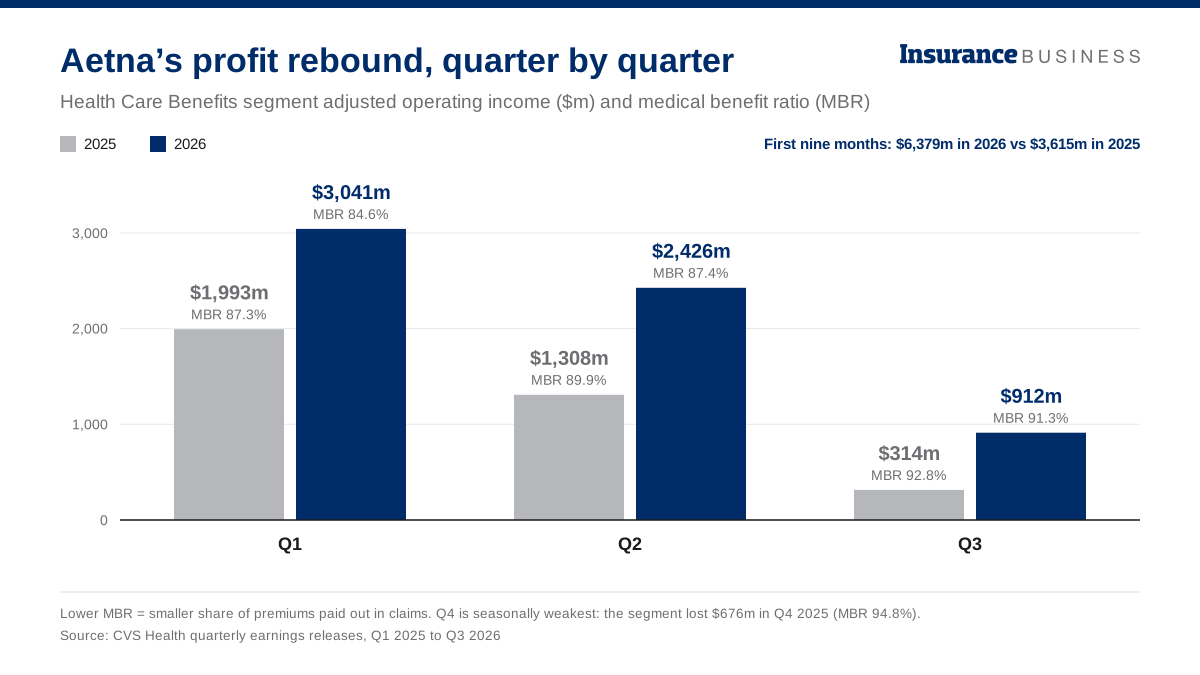
Joyner's fix leaned on discipline at Aetna: higher pricing, cost controls and exits from unprofitable lines, helped along by more generous federal payment rates for Medicare plans. The cuts reached the workforce too, including 313 Aetna roles in Hartford earlier this year. Glenview founder Larry Robbins, who joined the board after the fund's campaign, stepped down in August as the fund pared its holding.
On Wednesday, CVS raised its full-year adjusted earnings forecast to at least $8.20 a share, up from a range of $7.90 to $8.10, after third-quarter revenue climbed 5.4% to $108.4 billion. Adjusted earnings of $2.09 a share were well ahead of the roughly $1.65 analysts expected, according to MarketBeat's consensus. The company still flagged elevated medical cost trends as a risk for the rest of the year.
Read next: UnitedHealth, CVS standardize prior authorization rules
For the agents, brokers and benefits advisers who place Aetna coverage or sit across the table from Caremark, little changes overnight. A spin-off of this size typically takes a year or more to plan and execute, and nothing has been announced. But a few questions are worth keeping on the client checklist.
The first is network access. If CVS pharmacies become an independent company, their contracts with Caremark and Aetna would be negotiated between two separate businesses. That could change how preferred-pharmacy arrangements, mail-order steering and retail-network pricing are structured for employer plans.
The second is clinical integration. Aetna members currently have access to MinuteClinic and in-store services under one corporate umbrella, a selling point in some group renewals. How those ties would survive a split is unknown.
The third is whether a split actually takes CVS out of the regulatory crosshairs, or merely shifts the debate to Caremark's specialty and mail-order businesses. Employers already losing patience with their PBMs will be watching closely: a WTW survey released last month put PBM satisfaction at a two-year low.
CVS has a habit of letting break-up speculation pass. After similar chatter in 2024, Joyner used his first earnings call as chief executive to argue for keeping the pieces together, describing CVS as having "the leading PBM, the best-run pharmacy in this country, a storied franchise through Aetna." Whether he still makes that pitch may be the clearest signal yet of where the empire is headed.