For a generation, the case for many elective operations rested on a simple observation: patients went under, woke up and said they felt better. A decade and a half of sham-controlled trials suggests that observation was misleading, and employer health plans have been paying the bill.
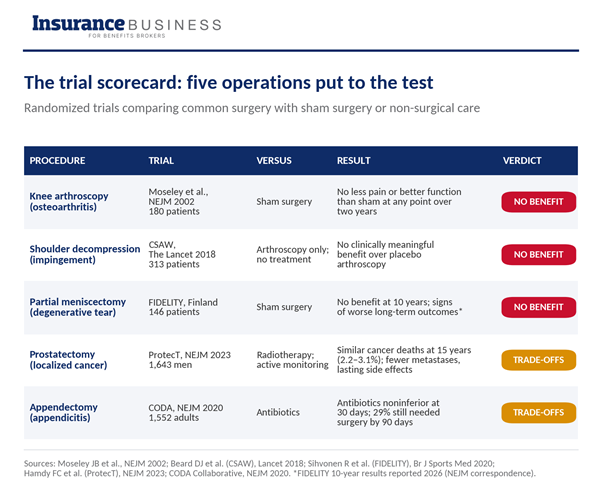
The latest evidence arrived in April. Finnish researchers published 10-year results from the FIDELITY trial in the New England Journal of Medicine. The trial followed 146 adults with degenerative meniscus tears who had been randomly assigned to one of the most common knee operations in the world, partial meniscectomy, or to a sham procedure.
After a decade, the real operation showed no advantage on any primary outcome. Patients who had it were doing slightly worse. X-rays showed osteoarthritis had progressed in 81% of the surgery group compared with 70% of the sham group, and more of them had gone on to need further knee surgery.
Teppo Järvinen, the University of Helsinki professor who led the trial, said in a statement that the findings suggest the procedure "may be an example of what is known as a medical reversal."
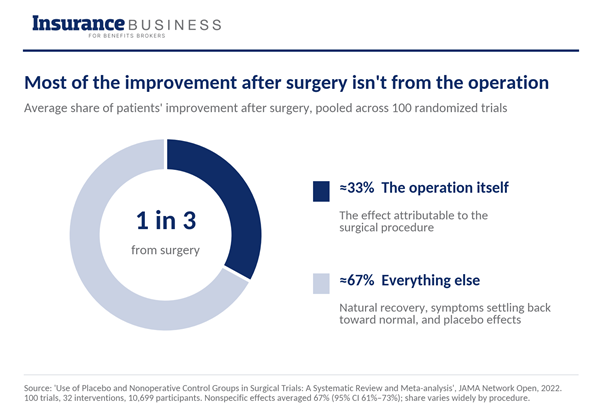
FIDELITY is not an outlier. Researchers pooled 100 randomized trials covering 32 surgical interventions and nearly 10,700 patients in a 2022 JAMA Network Open analysis. They found that, on average, about two-thirds of the improvement patients felt after surgery came from something other than the operation. The main contributors were natural recovery and the tendency of symptoms to settle back toward normal. The split varied widely by procedure. But for the typical operation studied, the scalpel accounted for a minority of the benefit.
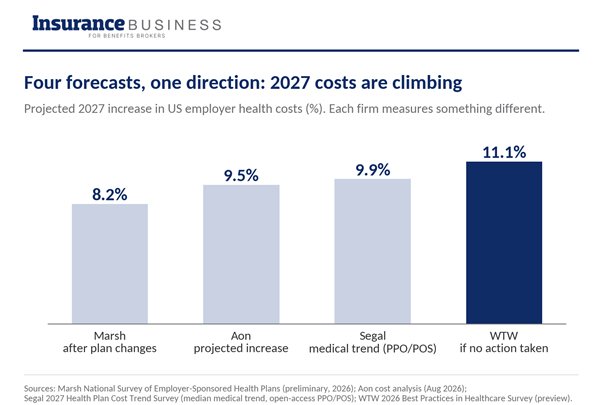
For employers, the timing is awkward. Preliminary survey data from Marsh puts the 2027 rise in employer health benefit costs at 8.2%, the largest in 24 years, even after employers make plan changes. WTW has warned costs could climb 11.1% for employers that take no corrective action.
Read next: Employers face 11.1% healthcare cost spike but balk at the fix
The trials that have done the most damage to orthopedic orthodoxy share one design feature: some patients received a fake operation.
In a Houston trial published in 2002, 180 patients with knee osteoarthritis were randomly assigned to one of three groups:
Over two years, neither real procedure produced less pain or better function than the sham.
Shoulders tell a similar story. The UK's CSAW trial enrolled 313 patients across 32 hospitals. It compared subacromial decompression, which shaves bone and soft tissue to relieve impingement, with diagnostic arthroscopy alone and with no treatment. Neither CSAW nor a parallel Finnish trial found a clinically meaningful difference between decompression and the diagnostic "placebo" surgery. A 2019 Cochrane review rated the evidence of no clinically important benefit as high certainty.
The questions extend beyond orthopedics, though the answers there are less clear-cut.
The UK's ProtecT trial followed 1,643 men with localized prostate cancer for a median of 15 years. Deaths from prostate cancer stayed around 3% or lower whether men had surgery, radiotherapy or active monitoring, with no statistically significant difference between the groups. Radical treatment did reduce the spread of cancer, but its urinary and sexual side effects lasted far longer than many patients were likely told to expect.
In the US, the CODA trial randomized 1,552 adults with appendicitis at 25 hospitals and found antibiotics were noninferior to surgery on 30-day health status. Still, 29% of the antibiotics group had their appendix removed within 90 days. For many patients, not all, surgery turned out to be one reasonable option rather than the only one.
The profession has not accepted all of this. According to Järvinen, the American Academy of Orthopaedic Surgeons and the British Association for Surgery of the Knee have continued to endorse partial meniscectomy. He called that an effective illustration of how hard it is to abandon ineffective treatments.
Surgeons also point out, fairly, that trial populations are narrowly defined. A procedure that fails for degenerative tears in middle-aged patients may still help a younger patient with an acute injury.
Read next: Employee benefits navigation gap is costing employers millions
Knowing a procedure underperforms and getting doctors to stop doing it are two different things.
England shows both the scale of the money involved and how fast practice can shift. With no robust trial evidence behind it, subacromial decompression rose 91% to 28,802 procedures a year by 2016/17, costing the NHS more than £125 million annually. Within six months of the CSAW results, NHS England added the operation to its list of procedures of limited value.
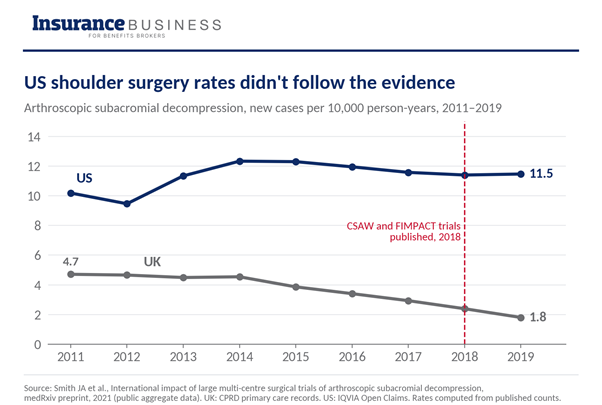
The US response has been harder to read. University of Oxford researchers found that UK rates fell steadily after 2011 while US rates showed no clear pattern.
By 2019, the US rate was roughly six times the UK's. That analysis was released as a preprint, and it conflicts with a separate study of US claims data that found a sizable decline between 2010 and 2018. Either way, the US has not matched Britain's retreat.
Part of the gap is structural. Unlike new drugs, surgical procedures don't have to clear a regulator's efficacy bar before they spread. In a fee-for-service market, every operation not performed is revenue not billed.
And many of the landmark sham-controlled trials were run by public health systems in Britain and the Nordic countries, which have a direct financial reason to find out what works. The US has few equivalents.
Read next: Benefits data moves to center of broker renewal talks
Individually, the operations in question aren't the most expensive claims a plan will see. Their cost comes from volume, wide price variation and what happens afterward.
An analysis of CalPERS, California's public employee benefits program, by researchers at the University of California, Berkeley, found that knee arthroscopy prices varied widely by setting:
|
Setting |
Median price for knee arthroscopy |
Price range |
|
Hospital outpatient departments |
$5,668 |
$1,280 to $15,503 |
|
Freestanding surgery centers |
$3,083 |
$604 to $10,803 |
When CalPERS capped its contribution for knee and shoulder arthroscopy at $6,000, the median price it paid fell 8.8% for knee procedures and 19% for shoulder procedures.
Reference pricing addresses what a plan pays for a procedure. The sham-surgery trials raise a bigger question: whether the procedure should be performed at all. The FIDELITY investigators' own economic evaluation concluded that partial meniscectomy was not cost-effective compared with placebo surgery. That was before the 10-year data showed more follow-up operations in the surgery group, which adds downstream imaging, rehab, repeat procedures and time away from work.
The exposure lands most directly on self-funded plans, and that group is growing well beyond large employers. According to KFF's 2025 employer survey, 51% of covered workers at firms with 10 to 199 employees are now in a self-funded or level-funded arrangement.
For those clients, the levers are within reach:
Fully insured clients have fewer direct options. Even so, a broker can ask carriers pointed questions at renewal:
Read next: Cancer claims and specialty drugs drive stop-loss cost surge: QBE
None of this means surgery is a bad deal. Plenty of operations work, and work well. The narrower point is that a meaningful share of elective orthopedic spending may buy outcomes that physical therapy, time or watchful waiting could deliver for less money and less risk.
How that's framed to employees matters as much as the policy itself. An employee told "your plan won't pay for that" hears rationing. An employee offered a second opinion and a fully covered course of physical therapy hears a benefit. The trial evidence supports the second message: in these cases, the conservative route isn't the budget option, it is often simply the better one.
Communication is where many programs fall down. Research from Aon, cited by Gallagher's John Tournet, found US employers spend up to $20,000 per employee on health plans but less than $10 explaining them. A second-opinion benefit that nobody knows about doesn't prevent any operations.
The audience for this argument is also changing. Finance chiefs are taking a closer interest in benefits spending, with a third of CFOs in one Marsh survey ranking health benefits among their top three operating-expense concerns. A strategy that cuts spending while sparing employees unnecessary operations is an easier sell to that audience than another round of deductible increases.
Read next: Cost over talent: Lockton survey shows sharp shift in employer benefits priorities