UnitedHealthcare has promoted a longtime Medicare executive to president. The move comes as its fully insured employer business keeps shrinking and group clients face some of the steepest cost increases in two decades.
Robert "Bobby" Hunter, who has spent about 15 years at UnitedHealth Group and most recently led its government programs business, announced on LinkedIn on Monday that he would become president of UnitedHealthcare, the group's insurance division. UnitedHealthcare covered 48.5 million people as of June 30. Tim Noel remains chief executive of the division, the company confirmed, according to Reuters.
Hunter said his priority would be to speed up the company's modernization work, with the aim of a system that is more connected and "easier to navigate and simpler to understand."
As of Monday, the company had not said which parts of the business will report to Hunter, or who will take over government programs.
Hunter joined UnitedHealth in 2011 from the investment bank Piper Jaffray and started in corporate development. He then held finance and product roles in Medicare Advantage and became president of the Medicare business in 2024. Most recently he ran government programs, where he announced last year's cutbacks, including UnitedHealthcare's exit from Medicare Advantage in 16 markets and a move away from PPO plans toward HMOs.
Read next: UnitedHealth to exit Medicare Advantage plans in 16 markets
Noel's career followed a similar path. He joined in 2007, led Medicare and Retirement, and took over UnitedHealthcare in January 2025 after the killing of Brian Thompson. With Hunter's promotion, both of the division's top executives come from the Medicare side of the company.
According to the company's fourth-quarter 2025 earnings release, the Employer & Individual segment generated $79.2 billion in revenue in 2025 and ended the year with 80,000 fewer members. Self-funded growth did not make up for losses in fully insured group and individual products.
In the first quarter of 2026 the segment gained 415,000 people, almost entirely from self-funded employers. The second-quarter results showed a net loss of 145,000, with both self-funded and fully insured products shrinking.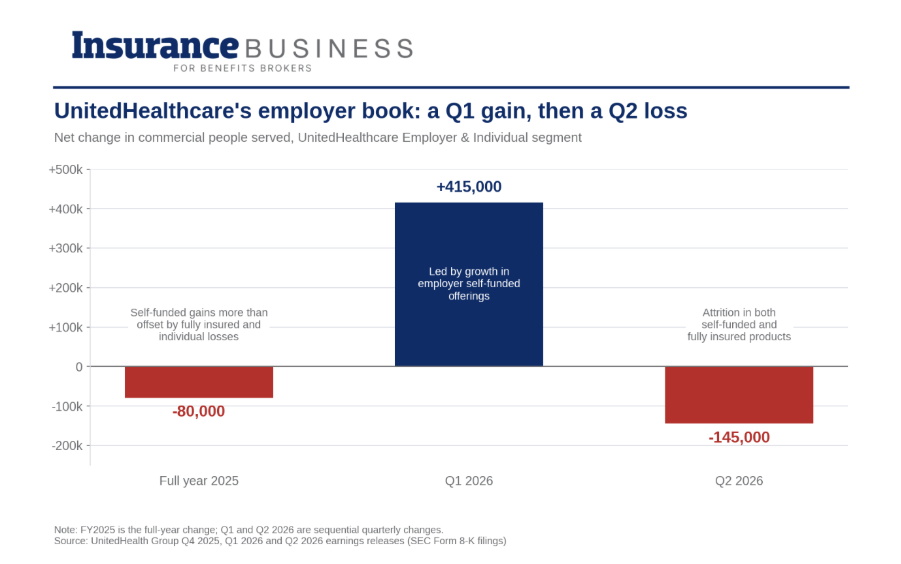
The full picture is more nuanced than the quarterly swing suggests. Self-funded, or fee-based, membership fell by about 75,000 in the second quarter but was still up roughly 780,000 for the year at the end of June. That is already above the 550,000 to 750,000 growth UnitedHealthcare forecast for all of 2026. Fully insured membership has fallen every quarter, from 8.17 million at the end of 2025 to 7.66 million in June.
On the company's July earnings call, Dan Kueter, chief executive of UnitedHealthcare Employer & Individual, said more intensive provider coding was the main driver of commercial medical costs.
He said coding in office visits and emergency rooms was pushing trend above both last year's level and the company's expectations. He also said some providers were exploiting the No Surprises Act's independent dispute resolution process.
Read next: Employer health costs near 15-year high as billing pressures mount
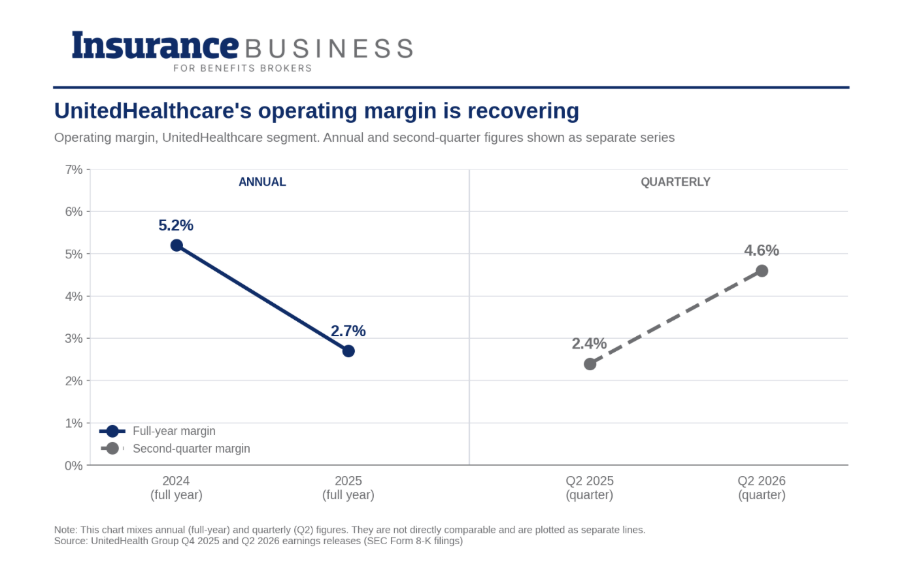
UnitedHealthcare's operating margin fell to 2.7% in 2025 from 5.2% in 2024. In the second quarter of 2026 it was 4.6%, up from 2.4% a year earlier but down from 6.6% in the first quarter. The company attributed the year-over-year gain to cost management, pricing discipline and benefit design changes. The parent company raised its full-year adjusted earnings forecast to $19.50 to $20 a share.
The company is openly citing pricing discipline as a source of profit. Brokers with UnitedHealthcare fully insured clients should plan their 2027 renewal conversations with that in mind.
Read next: UnitedHealth ranked fourth globally as earnings dropped and a breakup bill looms
Hunter's post did not say what modernization will involve, but in this day and age AI must be a substantial part of his plans. On the commercial side, the company's recent moves have leaned toward retail-style digital tools. In September 2025 it launched UHC Store, a marketplace in its app and website that offers discounts of up to 15% on some services in areas such as mental health, weight management and musculoskeletal care. The company presented it as a way for employers to give workers these programs without having to vet each vendor.
UnitedHealthcare's 2026 Health Trends Report for brokers identifies catastrophic claims, specialty drugs and changing utilization as the biggest cost drivers. There is no evidence yet on whether new digital tools will reduce those costs at renewal.
Preliminary figures from Marsh show employer health benefit costs rising 8.2% in 2027, the largest increase in 24 years, even after employers make plan changes. WTW puts the figure at 11.1% for employers that make no changes.
Read next: Health benefit costs to jump 8.2% in 2027, highest since 2003
In Washington, the bipartisan Break Up Big Medicine Act, introduced in February by Senators Elizabeth Warren and Josh Hawley, would bar insurers and PBMs from sharing ownership with certain medical providers. That would challenge UnitedHealth's model of combining an insurer with Optum's care and pharmacy businesses. The bill was referred to the Senate Judiciary Committee.
Brokers placing business with the carrier this fall may want to ask their account teams whether the commercial business reports to Hunter, whether any service or underwriting contacts are changing, and what the modernization plans mean for 2027 renewals.