Michigan's attorney general wants a federal judge to break the grip of the state's largest health insurer, and the theory behind her case reaches well beyond Michigan's borders.
Dana Nessel has sued Blue Cross Blue Shield of Michigan in the US District Court for the Eastern District of Michigan. Her office argues the Detroit-based nonprofit did not win its position on price or service but secured it through agreements with the rest of the national Blue Cross Blue Shield network to split up customers and territories and limit what each plan could sell. Nessel calls the arrangement the "Blue Conspiracy."
The complaint brings two counts under the federal Sherman Act, four under the Michigan Antitrust Reform Act, and claims for public nuisance and unjust enrichment. According to the attorney general's office, the state is asking for a permanent injunction, damages, disgorgement and civil penalties. None of the allegations has been tested in court.
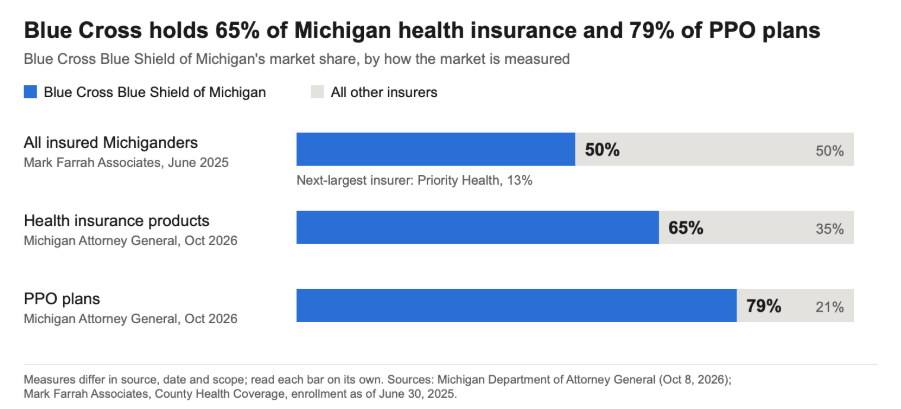
The state puts Blue Cross's share at 65% of Michigan's health insurance products and 79% of its PPO business. It also describes Michigan as having the fourth least competitive insurance market among the states.
That dominance, the complaint argues, worked in two directions at once. Buyers paid more: the lawsuit cites 2026 rate filings of roughly 24% for individual members and 11.2% for small groups. Providers were paid less: Michigan's reimbursement rates rank among the lowest in the region, the state says, sometimes below what it costs to deliver care.
The state is also suing as a customer. The complaint alleges the Blues' territorial rules kept rival carriers from bidding to administer Michigan's state employee health plans, which the state says allowed Blue Cross to overcharge it for years.
Read next: 'Simply not sustainable': Horizon BCBS to cut 242 jobs
Nessel's office points to hospitals and clinics as evidence of harm. Sturgis Hospital, near the Indiana border, closed entirely in June, citing inadequate reimbursement for rural care.
Earlier this year, Blue Cross and Michigan Medicine clashed after the insurer proposed a 30% cut in reimbursement rates, a dispute the state says could have forced nearly 300,000 residents to find new providers. The two sides reached a tentative agreement in late May. The Michigan chapter of the American Physical Therapy Association, quoted by the attorney general, said per-visit cuts approaching 20% over the past year have pushed clinics toward closure.
The filing also leans on affordability data. More than 40% of Michigan small business owners say rising health costs have them near a breaking point and weighing whether to drop coverage, according to the attorney general. Over 68% of adults surveyed in 2025 reported skipping or delaying care because of cost, and the state ranks 20th nationally for residents with medical debt in collections.
Read next: Blue Cross Blue Shield of Minnesota hit by $353 million loss
Blue Cross Blue Shield of Michigan said it had not yet been served and could not comment on the merits. In a statement, the company said it was blindsided by the announcement and rejected the idea of an uncompetitive market, saying strong local and national insurers compete with it every day. It added that it has covered Michiganders in every county for nearly 90 years.
The insurer's own results cut against any picture of a plan banking monopoly profits. Blue Cross reported a net loss of $246 million on $43.3 billion of revenue in 2025, after a loss of about $1.02 billion in 2024. Its core underwriting business lost $975.5 million last year, even after $420 million in administrative cost cuts, and membership held steady at about 5.1 million. Losses like these are common across the Blues system, from Blue Cross Blue Shield of Massachusetts' record $400 million operating loss in 2024 to similar shortfalls in other states.
The theory behind Michigan's case has been litigated before. The national network of independent Blue plans, which license the brand for exclusive service areas, has spent more than a decade fending off similar claims. In 2020 the plans agreed to a $2.7 billion settlement with subscribers who alleged the Blues divided markets to avoid competing, and they later settled a parallel provider case for $2.8 billion. The Blues denied wrongdoing in both. Blue Cross Blue Shield of Michigan has also faced the government before: in 2010 the US Department of Justice and the state jointly sued over most-favored-nation clauses in its hospital contracts.
What is new is the plaintiff. Rather than a class of customers or providers suing the whole network, a state attorney general is targeting one plan's dominance in its home market and tying it directly to state spending and public health.
Read next: State seeks $2 million refund from health insurer
Nothing changes for 2027 renewals yet; antitrust cases of this size usually run for years. But the stakes for Michigan's group market are real. Blue Cross says it covers more small-group members (employers with fewer than 50 staff) than any other Michigan plan, with 275,485 such members in 2025, and that is the segment where the complaint says premiums jumped 11.2% this year.
If the state wins an injunction against the Blues' service-area rules, out-of-state Blue plans and other carriers could, over time, find it easier to compete for Michigan employers. A ruling against the insurer could also encourage attorneys general in other concentrated markets to try the same approach.
In the meantime, expect clients to ask harder questions at renewal, and expect the case to sharpen a debate the industry has never settled: whether one carrier's leverage over hospitals and doctors actually reaches the employers paying the premiums.