For four straight years, the group ancillary benefits market did something insurance markets rarely do: it kept climbing. A tight labor market pushed employers to lean harder on voluntary benefits to keep workers from walking. Carriers wrote record premium, and brokers built books of business on the assumption that the good years would keep coming. In 2025, growth stopped, and the most recent LIMRA data suggests it isn't coming back quickly.
Workplace life insurance, which had set a sales record every year since 2021, pulled back for the year overall despite a strong finish. Supplemental health products (accident, critical illness and hospital indemnity, mainly) fell for three straight quarters after two years of growth. Disability insurance had the roughest start of the year before partially stabilizing. And in newer research published through mid-2026, LIMRA has gone further: it's now forecasting muted growth for workplace benefits through 2028, with rising health care costs squeezing both employers' budgets and workers' paychecks.
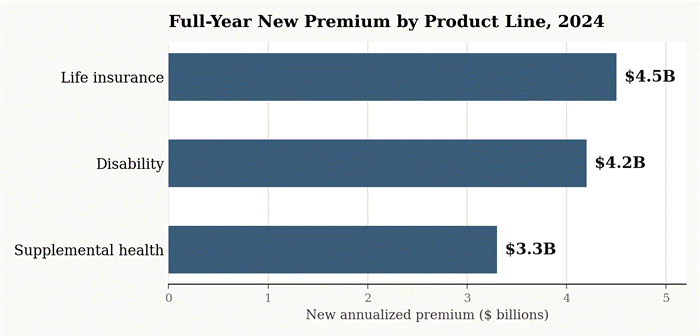
Start with the scale of what just ended. In 2024, workplace life insurance new premium reached a record of roughly $4.5 billion, up 8 percent from the year before, the fourth consecutive year of growth. Disability insurance new premium hit $4.2 billion, up 2 percent, and supplemental health products added $3.3 billion, up 8 percent. Altogether, carriers wrote roughly $12 billion in new group ancillary premium that year.
Source: LIMRA workplace benefits sales surveys, 2024 full-year results.
2025 opened with a hard landing. First-quarter workplace life insurance new premium fell 16 percent year over year to $1.8 billion, disability fell 15 percent to $1.6 billion, and supplemental health fell 11 percent to $1.3 billion. LIMRA's own researchers described it plainly at the time: after a couple of unusually strong years, workplace insurance sales were normalizing back toward pre-pandemic levels.
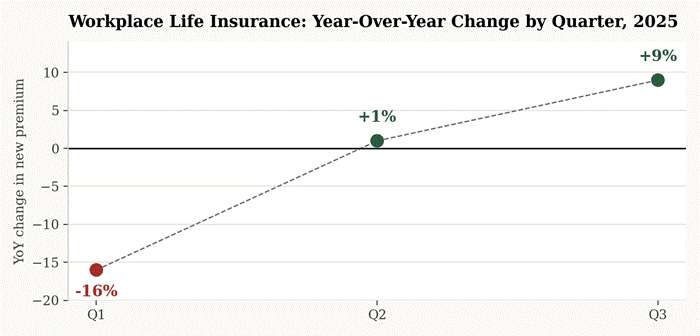
The two biggest ancillary categories told different stories for the rest of the year. Workplace life insurance turned positive in the second quarter, up 1 percent, then climbed 9 percent in the third quarter. For the first nine months of 2025, life insurance new premium was down just 3 percent, a big improvement on where the year started. Full-year 2025 life insurance sales came in around $4.4 billion, down only 2 percent from 2024's record.
Source: LIMRA quarterly workplace benefits sales releases, 2025.
Supplemental health didn't get the same second-half lift. Third-quarter sales were down 7 percent, on top of declines in the first two quarters, leaving nine-month supplemental health premium down 5 percent for the year. Disability landed in between: nine-month disability premium was down 5 percent, an improvement from the 15-percent first-quarter drop but not the rebound life insurance saw.
Source: LIMRA quarterly workplace benefits sales releases, 2025. Q2 figure calculated from LIMRA's reported dollar totals ($541M vs. $550M); not a LIMRA-published percentage.
Group sales fell faster than individual worksite sales through the first half of 2025, a sign of friction on the employer side rather than fading employee interest.
KEY TAKEAWAY, DRAWN FROM LIMRA'S Q1–Q2 2025 WORKPLACE BENEFITS SALES DATA
In the first quarter of 2025, group workplace supplemental health sales fell 12 percent while individual worksite sales fell only 3 percent; by the first half, the gap had narrowed to 6 percent versus 4 percent, but the pattern held. If employees were simply losing interest, you'd expect both channels to fall together. Something has been slowing decisions on the employer side, whether that's budget approval, enrollment logistics, or renewal timing, more than it reflects fading demand from workers.
The original version of this report treated 2025 as a pause after a sprint, on the theory that employer enthusiasm for benefits hadn't cooled even as sales had. Two pieces of research published since complicate that read.
First, in February 2026, LIMRA published a workplace benefits outlook forecasting muted growth for life and disability in-force premium through 2028, as the broader U.S. economy cools and employment growth slows. The driver isn't waning interest: 84 percent of employers now say benefits are critical to attracting and retaining workers, up from 70 percent in LIMRA's earlier research, and 83 percent of workers expect a wide variety of benefits to be available to them. The constraint is cost. LIMRA projects an 8 percent rise in health care costs in 2026 without plan design changes, and as health care eats a larger share of compensation budgets, employers are more likely to shift costs to workers or trim other benefits, according to Grace Rafferty, LIMRA's corporate vice president and director of workplace benefits research.
Second, LIMRA's Benefits and Employee Attitude Tracker study, fielded in January 2026 and released in June, found that workers are already responding to those cost pressures by reducing their own benefits elections. The same study pointed to a cooling labor market producing what researchers termed "job-hugging": workers staying put rather than switching jobs, alongside a notable gap between how satisfied employees actually are with their benefits and how satisfied employers assume they are.
That cost pressure is already reshaping the market brokers sell into. Insurance Business reported in 2026 that cost reduction has overtaken talent attraction as employers' top benefits priority for the first time in years, according to Lockton's 2026 National Benefits Survey, with 54 percent of employers now ranking cost first, up from 38 percent in 2025. For brokers, that changes the job: when cost becomes the only thing a client asks about, the broker's role can narrow to running RFPs and comparing quotes, work a client can increasingly benchmark without much help.
Even with sales growth slowing, carriers and general agencies have kept buying their way into the ancillary and small-employer benefits space, a sign that the long-term bet on this market hasn't changed even if the near-term numbers have. The Hartford agreed to acquire Equitable's employee benefits business in a deal covering roughly $500 million in premium, its second major small-and-midsize-employer benefits acquisition within a month, following Principal Financial Group's agreement to acquire Beam Benefits, a cloud-native dental, vision and ancillary platform serving more than 25,000 small businesses.
The distribution side is consolidating too. Insurance Business's coverage of the broker M&A market notes that employee benefits agencies with $1 million or more in revenue are now the highest-multiple category in the industry, trading at 9 to 12 times EBITDA, largely because group benefits books hold renewal retention rates of 92 to 96 percent. For an independent broker weighing whether to sell or hold an ancillary book, that's a real number to run against a real market, not a hypothetical.
None of the above changes because of one quarter, but it's worth noting that LIMRA's first look at 2026 is more encouraging than most of 2025 was. In an infographic titled "Workplace Benefits Sales Show Solid Start to 2026," LIMRA reports that new dental subscribers grew 15 percent year-to-date in the first quarter, language the report itself frames as reversing the negative momentum seen in 2025.
That single, confirmed data point is consistent with the broader signal in this report: 2025 looks less like the start of a permanent decline and more like a market correcting after an unusually strong run, with individual product lines recovering on different timelines. We'd rather report one clean number than force a full product-by-product breakdown out of a source that wasn't precise enough to support it, so we've left the rest of the Q1 2026 detail out of this piece for now. Expect an update once LIMRA's fuller first-quarter results are out.
How this piece was reported.
Sales figures come from LIMRA's published workplace benefits sales surveys and press releases (2024–2026), which LIMRA states represent more than 90 percent of the U.S. life, disability and supplemental health workplace premium markets. The Q2 2025 supplemental health year-over-year change was calculated from two dollar totals LIMRA published rather than a LIMRA-stated percentage, and is marked accordingly. Employer and worker sentiment figures come from LIMRA's February 2026 workplace benefits outlook and its 2026 Benefits and Employee Attitude Tracker (BEAT) study. The Q1 2026 dental figure comes from LIMRA's Q1 2026 workplace benefits sales infographic; that document's per-product dollar figures were not used here because the source layout made it impossible to confidently confirm which figure belonged to which product line. Market context on employer priorities and industry M&A comes from Insurance Business's benefits coverage, linked above. Full-year 2025 dollar totals for disability and supplemental health were not available in the sources reviewed for this piece and should be checked before reuse in client-facing material.