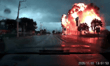
Image credit: Fox 13 Tampa Bay
A Learjet crash that killed all nine people aboard in Florida on Sunday has left investigators examining the aircraft’s final moments, while highlighting the passenger and ground-level exposures that aviation brokers must account for when arranging liability protection.
The Learjet 60 struck a roadway in Palm Beach County while traveling from Austin, Texas, to North Eleuthera in the Bahamas. The Federal Aviation Administration said it crashed near Cresthaven at about 12:50 p.m. on November 1. The National Transportation Safety Board is leading the investigation, supported by the FAA.
CNN reported that no injuries had been reported on the ground. The impact left a large crater near passing vehicles, bringing the potential consequences for people and property outside the aircraft into sharp focus.
Before the crash, the crew reported icing and moderate turbulence, according to air traffic control recordings described by CNN and flight-tracking service Flightradar24.
Flightradar24 identified the aircraft as N722BD, a Learjet 60 manufactured in 2004. Its account said the crew requested a climb to 37,000 feet after reporting precipitation, then reported a rapid descent and an overspeed condition.
The deaths aboard the jet and its impact on a public roadway illustrate how a single aviation accident can create liability exposures well beyond the loss of the aircraft. Brokers assessing those exposures also need to establish how a business uses private aviation, including flights it arranges on aircraft it does not own.
Companies chartering aircraft for employee travel can face liability arising from those flights, making the operator’s insurance arrangements an important part of the coverage review.
Read more: Two Florida crashes expose both ends of aviation risk
Aircraft hull insurance addresses physical damage to the aircraft, while aircraft liability insurance protects operators against third-party liability, according to Lloyd’s guidance. Crew personal accident coverage is another distinct category.
Separate exposures warrant separate questions for brokers: what protection applies to people aboard, and what responds to injury or property damage outside the aircraft? The answers depend on the actual policy and the circumstances of a claim.
Businesses can also have aviation exposure without owning the aircraft used by their employees. That is a broader coverage consideration, rather than an established feature of the Florida flight.
USAIG’s corporate non-owned aircraft liability offering covers legal liability arising from use of non-owned aircraft for bodily injury to people aboard or outside the aircraft and damage to someone else’s property. Physical damage coverage for the non-owned aircraft itself is also available.
The National Business Aviation Association recommends that companies chartering aircraft for business request additional insured status under the charter operator’s policy and obtain evidence through a certificate of insurance and the related endorsement.
Its guidance also calls for reviewing the operator’s underlying liability limits. A company’s own non-owned aircraft liability policy can provide excess protection, subject to the insurance arrangements.
These questions give brokers a reason to ask how clients arrange occasional flights, including travel booked outside a formal flight department. NBAA’s underwriting guidance asks about annual aircraft use, employee pilots and whether companies restrict the number of executives traveling together.
The FAA has assigned investigative updates to the NTSB; its initial announcement contains no determination of fault or insurance responsibility.