
French insurers are looking at a riot bill of up to €1.2 billion after nationwide protests on Saturday, Oct. 17, turned to looting and arson, according to DBRS Morningstar. The rating agency says that would cut into property and casualty earnings this year but would not, by itself, threaten the capital or credit ratings of France's largest carriers.
France passed a law in February creating compulsory riot cover backed by a government-guaranteed pool run by state reinsurer CCR, but the scheme hasn't started. These losses will therefore be shared among primary insurers, global reinsurers, specialty strikes, riots and civil commotion (SRCC) and political violence markets, and possibly the French state. That puts the reinsurance and specialty capacity behind French property risk to the test, and gives US multinationals with sites in France an early look at how the new rules could affect them.
France's big auto, homeowners and commercial writers will pay most of the claims up front, though DBRS says it's too early to say which companies are most exposed. How much they keep depends on where their reinsurance programs attach. Losses above those retentions pass to global reinsurers through excess-of-loss treaties, and large corporates with standalone SRCC or political violence policies bought in London will claim on those directly.
Insurers can also try to recover payouts from the French state, which French law makes liable for damage caused by violent crowds. Those claims are slow and uncertain, and they usually don't extend to lost income.
For retailers, insured losses will cover only part of the damage. Business interruption cover is optional in France and generally needs physical damage to trigger, and theft or looting is often capped. DBRS expects the full economic cost to run several times the insured figure.
Read next: What is behind the increased demand for strikes, riots and civil commotions insurance?
DBRS analysts Marcos Alvarez and Elisabeth Rudman argue that riots now resemble natural catastrophes for insurers. A burned-out store is rarely a large claim in isolation. When unrest spreads to several cities within days, though, a single event can produce thousands of claims across many lines of business at once, and that accumulation is what reinsurers price for.
US insurers know the pattern from 2020. The Insurance Information Institute estimated at the time that the protests after George Floyd's murder cost insurers $1 billion to $2 billion in roughly two weeks. DBRS groups the US with Chile and South Africa as markets where a single episode of unrest has produced more than $2 billion in insured losses, and expects SRCC cover to keep getting tighter and more expensive. In its view, civil commotion "can no longer be treated as an incidental property peril", especially in France.
Read next: Businesses should brace for rise in civil unrest - report
The violence broke out on Oct. 17, during nationwide protests over living costs and public services that drew more than half a million people. Interior Ministry figures show 2,397 arrests that day. Cars were burned, stores looted and the city hall in Limoges badly damaged by fire. Serge Papin, minister for commerce and small business, counts at least 3,000 stores hit and has promised a support fund. Trade body France Assureurs said insurers would stretch the five-business-day claims-reporting window to 30 days, with Axa and BPCE Assurances among those doing so. Prime Minister Sébastien Lecornu has promised a partial unemployment program, and Finance Minister Roland Lescure has announced aid for affected businesses.
France's riot bills have climbed steadily. DBRS puts the 2005 suburban riots at about €200 million and the 2018-19 "yellow vest" protests at about €220 million. The 2023 riots, which followed the police shooting of a teenager near Paris, cost three to four times as much: €730 million across about 15,600 claims by DBRS's count, or €793 million across some 16,400 on France Assureurs' latest tally. Roughly two-thirds of that came from commercial property and more than a quarter from municipal buildings. Unrest in New Caledonia, a French Pacific territory, added around €1 billion in May 2024.
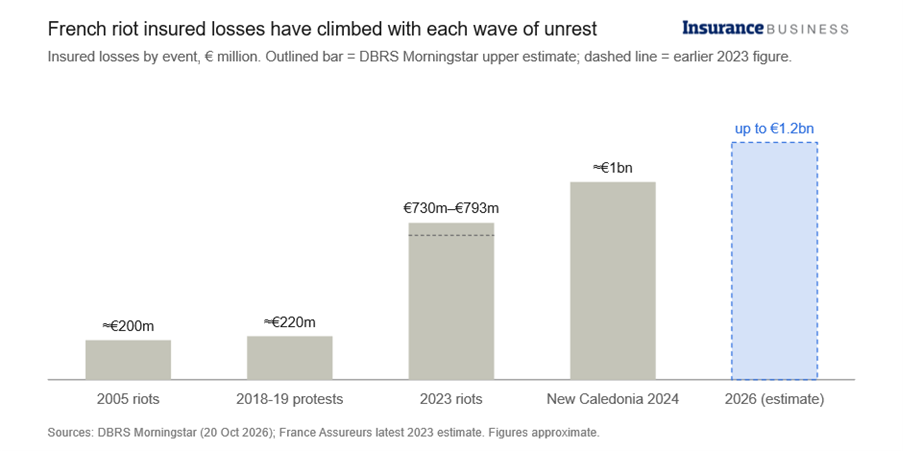
DBRS expects October's losses to be felt mainly by stores and public buildings, as in 2023. Business interruption claims are the biggest unknown in the final total, and the €1.2 billion ceiling assumes there is no further rioting.
Read next: Chubb releases report on civil unrest risk
After 2023 and New Caledonia, Paris concluded the private market couldn't carry riot risk alone. Some insurers in the overseas territories had withdrawn riot cover from certain policies, and some towns faced sharply higher deductibles. Its response is Article 171 of the 2026 Finance Law, signed on Feb. 19 after the Constitutional Council rejected a challenge to its place in the budget.
The law defines what counts as a riot and makes riot cover compulsory in qualifying property damage policies. No exclusions are allowed, and business interruption is included wherever a policy already carries it. Applicants refused cover over their riot exposure can turn to the Bureau Central de Tarification, which can compel an insurer to write the risk.
Risk then flows to a pool run by state reinsurer CCR, which pays back at least 90% of the riot losses insurers cede to it. Insurers fund it through a solidarity levy capped at 1.5% of relevant premiums, with the actual rate set by decree. The state guarantees the pool each year up to €4 billion (about $4.3 billion) or ten times its expected income, whichever is lower, and charges a fee for that. Insurers can still buy CCR reinsurance at market rates for riot risk they keep out of the pool.
None of it is live yet. A government decree must set the start date, no later than 12 months after the European Commission clears the scheme under EU state aid rules. France Assureurs officials are aiming for Jan. 1, 2027, and New Caledonia and French Polynesia would each need a separate agreement to join. DBRS says the October losses fall outside it.
The gap on this side of the Atlantic
France has legislated for a government riot backstop. The US has no equivalent. Riot is a standard named peril in most US commercial property forms, but the nearest federal equivalent, the Terrorism Risk Insurance Program, responds only to acts the Treasury Secretary certifies as terrorism, and it has never been triggered. TRIA itself runs out on Dec. 31, 2027. The House voted 373-15 in June to extend it through 2034, the Senate passed its own extension by unanimous consent in late September, and lawmakers still need to reconcile the two bills.
For US multinationals and their brokers, France's regime raises a more practical question. Once it takes effect, local French property policies will carry compulsory riot cover backed by CCR, and global programs will need to work out how their master policies sit on top of that layer.
Read next: APCIA backs House action on seven-year TRIA reauthorization