Every spring a London consultancy tries to put a price on something insurers spend billions building and almost never measure: the name on the policy.
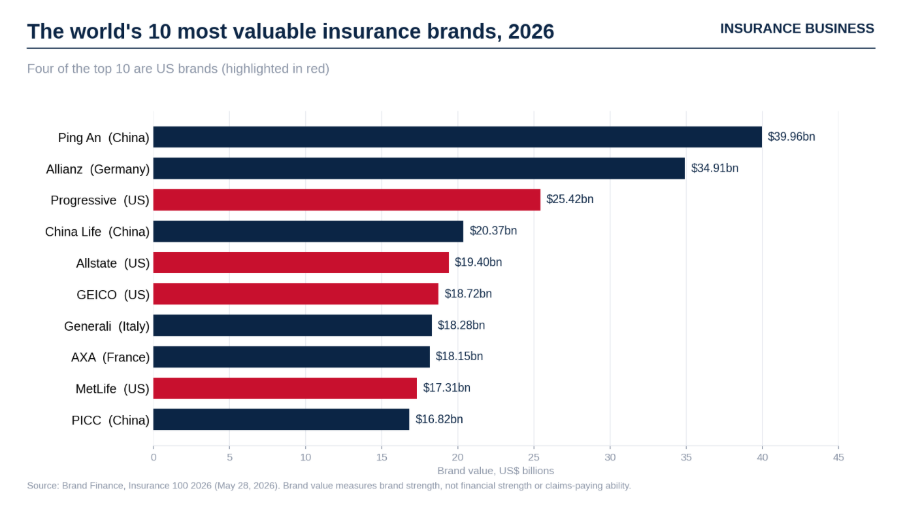
This year’s figure is large. Brand Finance’s Insurance 100 2026, released earlier in the year, values the world’s 100 leading insurance brands at a combined $606.7 billion, up 14% on the year and the sector’s quickest rise in five years. China’s Ping An held the top spot for a tenth straight year, with its brand value rising 19% to about $40 billion.
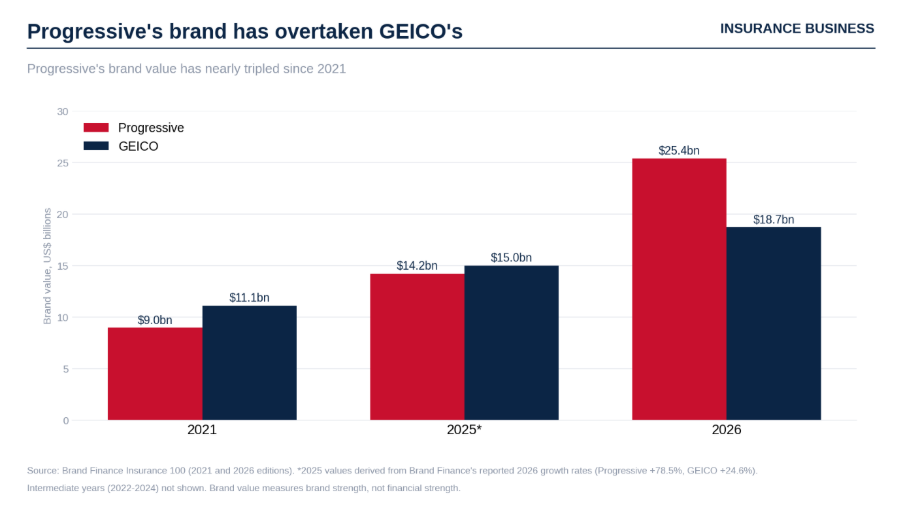
For American agents and brokers, the more interesting story sits further down the list. Progressive jumped to third place after its brand value rose 79% to $25.4 billion. Brand Finance credited the jump to fast growth in personal lines and much better profitability. Allstate and GEICO both made the global top ten. A published summary of the full ranking puts Allstate fifth at about $19.4 billion, up roughly 22%, and GEICO sixth at about $18.7 billion, up roughly 25%.
That raises two questions for anyone who sells insurance for a living. Does any of this matter at the kitchen table or the renewal meeting? And is the number itself any good?
The size of Progressive’s jump looks less mysterious once you see how the figure has been calculated by the company. Brand Finance uses a “royalty relief” method. It estimates the royalty a company would pay to license its own name, then applies that rate to forecast revenue and discounts the result to a present value.
The royalty rate comes from a Brand Strength Index scored out of 100, which combines marketing investment, stakeholder perceptions and business performance.
Put simply, revenue does much of the work. When a carrier’s top line grows quickly, its brand value tends to grow with it, even if nobody thinks about the brand any differently.
Progressive has had a lot of top-line growth to work with. Its 2025 annual report shows $83.2 billion in net premiums written, 12% more than in 2024, and 3.7 million more policies in force by year-end, a 10% increase. Its full-year combined ratio improved to 87.4.
Look back a few years and the change is striking. When Brand Finance published its 2021 list, Progressive’s brand was valued at roughly $9 billion and GEICO’s at about $11.1 billion. By my own arithmetic, Progressive’s figure has nearly tripled since then.
Read next: Progressive reports solid premium and earnings growth for Q1
Brokers will care more about market share than about royalty rates, and on that measure the rankings match what is happening in personal auto. S&P Global Market Intelligence estimated in May that Progressive had passed State Farm in US private auto market share over a trailing 12-month period for the first time. State Farm had held the No. 1 position since 1942. S&P’s figures show Progressive adding 187 basis points of share in 2025, while State Farm lost 13.
Progressive is also paying to keep that brand in front of people. An earnings summary of its first-quarter 2026 call reports media spending up 20% from a year earlier, the most the company has ever spent on media in a single quarter.
GEICO is the cautionary example on the list. Berkshire Hathaway’s 2025 results show GEICO’s pre-tax underwriting earnings falling to $6.8 billion from $7.8 billion, even as premiums written grew more than 5% to $45.2 billion. Its underwriting expenses climbed 34.2% to $5.5 billion. GEICO’s brand value still went up. That shows how weakly a brand score tracks underwriting profit in any one year.
The firm you won’t find in the global top ten is State Farm. That is notable, because by most operating measures it had the strongest year of any of them. The mutual reported 2025 net income of $12.9 billion and declared a $5 billion cash-back dividend to qualifying auto customers, the largest in its 103-year history.Jon Farney told reporters, “We don’t have shareholders; we don’t have a stock price to protect.” A method built mostly on public financial disclosures and analyst forecasts may not capture a policyholder-owned giant well. I could not confirm where State Farm sits in the full ranking.
Read next: State Farm outearns Progressive and Allstate in blockbuster 2025
Somewhat. Here is why.
Brand pull is real, including in the agency channel. Progressive is not only a direct writer. A Motley Fool analysis carried by Nasdaq reports its agency auto policies rising 10% while direct auto policies grew 14%. When a client asks for a name they have seen on television, the agent who can quote it starts with an advantage. The same advertising, though, also teaches consumers that they can skip the agent altogether. That tension won’t go away.
A “AAA” brand is not an A++ insurer. This is the point brokers most need to make to clients. Brand Finance gives each brand a rating of up to AAA+, and describes the format as resembling a credit rating. It does not measure claims-paying ability. A client who sees “AAA” next to a carrier’s name in a headline may reasonably assume otherwise. Solvency is the job of the financial strength rating agencies, and the producer is the one who has to explain the difference.
Commercial lines barely feature. The top of the table is dominated by personal lines writers and big composite insurers. For a mid-market commercial account, the things that decide placement are appetite, capacity, claims handling and financial strength. A brand score doesn’t measure any of them.
Trust is becoming part of the score. Brand Finance found that sustainability perceptions now drive 6% of brand consideration in insurance. Governance and transparency, especially around climate risk, carry the most weight. Brand Finance managing director Alex Haigh said that “trust, transparency, and consistent delivery remain critical” to turning financial results into lasting brand strength. Brokers who have had to explain a nonrenewal in a catastrophe-exposed ZIP code already know how fragile that trust is.
Read next: Driving change: How America’s auto insurance giants are rerouting for the future
It is better than many listicles that recycle it. Some caveats apply.
On the plus side, the method is standardized and has been applied consistently for years. Brand Finance says its valuations comply with ISO 10668 and its strength scores with ISO 20671, and that the US Marketing Accountability Standards Board has endorsed its approach. The firm also says it runs about 6,000 brand valuations a year, using original market research from more than 175,000 respondents across 41 countries.
The weaknesses are just as clear. Because the method depends so heavily on revenue forecasts, big swings like Progressive’s 79% mostly reflect growth. They say much less about how people feel about the brand. Brand Finance acknowledges in its own disclaimer that it relies on publicly available information and fills gaps with its own assumptions where data is thin. That matters most for mutuals and private carriers. Other brand rankings use different methods, so expect different orders from one league table to the next.
The fair reading is that this is a useful snapshot of which insurers are converting scale and marketing spend into recognition. It is not a guide to which carrier will pay a claim, or which one fits a client best.
Read next: State Farm declares record $5 billion dividend for auto policyholders
For most producers, the Insurance 100 tells you less about carriers and more about consumers. The brands climbing fastest are the ones advertising hardest and pricing most precisely in personal lines. That shapes what clients expect before they ever call an agent.
Change could also come soon. Berkshire’s new chief executive, Greg Abel, told shareholders the group will probably write less property and casualty business for a while. GEICO is reported to be increasing advertising in a bid to win back share. Next year’s rankings could look quite different.