Hurricane Lala triggered a $200,000 payment on a policy built to protect a natural asset rather than a building. For an industry still selling the promise of parametric coverage, it's a rare real-world proof point.
When Hurricane Lala hit the Big Island of Hawaii in mid-August as a Category 1 storm, its strongest winds moved over land even though the eye stayed offshore. The damage assessments that followed weren't only about homes, roads and crops. For the first time in the US, an insurance policy written specifically to protect a coral reef has paid out.
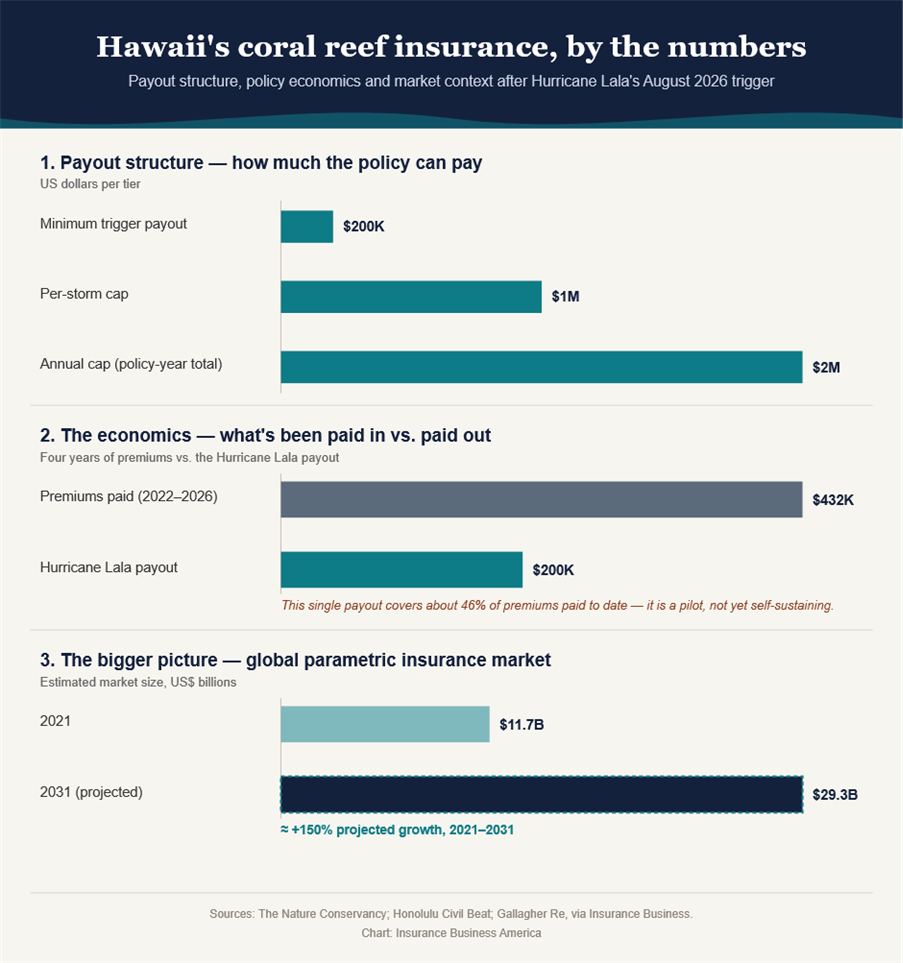
The Nature Conservancy confirmed this week that Lala's winds triggered the minimum payment under a parametric policy it holds with global reinsurer Munich Re: $200,000, released within days. The money is going to the Hawaiʻi Emergency Reef Restoration Network, a coalition formed to receive and deploy the funds, so crews can survey broken coral and cement fragments back into place before a second storm system reaches the islands.
It's a modest sum by catastrophe-insurance standards. But for a market that has spent years trying to prove nature itself can be underwritten like any other asset, it's a milestone worth a closer look.
The Hawaii reef policy isn't new. The Nature Conservancy first purchased coverage in 2022 through broker WTW, naming Munich Re as underwriter after a competitive placement process, in a deal Insurance Business covered at the time as the first of its kind written for a US reef. It followed a structure The Nature Conservancy had already piloted in Quintana Roo, Mexico, in 2019, where a similar policy paid out after Hurricane Delta struck in 2020.
Like most parametric products, the Hawaii policy skips loss adjustment entirely. It pays automatically once tropical-storm-force winds of 50 knots (roughly 57 mph) pass close enough to the reef, with payouts scaling from a $200,000 floor up to $2 million a year and capped at $1 million per storm, according to The Nature Conservancy's own renewal announcement. No adjuster inspects the reef before the check is cut. The wind speed recorded by government weather data is the claim.
That simplicity is the whole pitch, and it's also the product's main weakness. Because the trigger is wind speed rather than measured damage, the policy carries clear basis risk in both directions: a fast-moving storm could pass close enough to trigger a payout with only light reef damage, or a slow, wet system with weaker winds but heavy sediment runoff could badly harm a reef without tripping the trigger at all. Parametric buyers accept that trade-off for the speed of payment, but it's the same basis-risk debate playing out across the wider market, from event-cancellation cover for extreme heat to energy-revenue protection tied to weather indices, as Insurance Business has reported previously.
The economics only make sense once you factor in what a reef does for the coastline behind it. Healthy coral reefs can absorb as much as 97% of incoming wave energy before it reaches shore, according to Hawaii-based conservation researchers, acting as a natural breakwater that reduces flooding and erosion for the roads, resorts and homes sitting just behind it. When reefs are damaged and left unrepaired, that buffering effect degrades, and the properties insurers already cover become more exposed to the next storm.
Julia Rose, marine project manager for The Nature Conservancy in Hawaii, has framed the policy as a way to keep that natural protection intact long-term, telling Honolulu Civil Beat she hopes premiums become more affordable as the market for this kind of coverage grows. The Nature Conservancy has paid roughly $432,000 in premiums over the past four years, so this single payout doesn't come close to covering that outlay, let alone the full cost of the repair work now underway. Funding is subsidized in part through the Howden Group Foundation, the charitable arm of broker Howden, which points to how far this product still is from a self-sustaining commercial line.
Hawaii's insurance regulator has welcomed the concept. Insurance Commissioner Scott Saiki told Honolulu Civil Beat that healthy reefs provide meaningful protection for the state's coastlines and communities, and said his office is encouraged to see insurance capital deployed quickly to fund restoration after damaging storms.
Hawaii's policy sits inside a small but growing family of nature-insurance products. WTW's Climate and Resilience Hub and the Mesoamerican Reef Fund have built out similar parametric coverage across Mexico, Belize, Guatemala and Honduras since the original Quintana Roo pilot, and a separate Munich Re-backed policy covering sites across the wider Mesoamerican Barrier Reef triggered a roughly $175,000 payout after a 2022 storm hit Belize. Gallagher Re has cited market data putting the global parametric insurance sector at roughly $11.7 billion in 2021, projected to grow to about $29.3 billion by 2031, driven largely by climate volatility and better satellite and weather data making triggers easier to price.
For carriers and brokers, reef insurance itself will likely stay a niche line. The Hawaii policy pays out only on wind speed, so it does nothing for reef damage caused by coral bleaching, vessel groundings or the marine heatwaves behind Hawaii's major 2015 coral die-off, which followed a historic ocean-warming event and from which the state's reefs are still recovering. Some members of the restoration coalition have questioned publicly whether the premium cost is the most efficient way to fund the work, given how narrow the trigger is.
The bigger appeal for underwriters isn't reef premiums. It's proof of concept: a confirmed, government-data-triggered payout that reaches the ground within days, without the adjustment disputes that slow down traditional catastrophe claims. That's the kind of case study that gets cited in pitch meetings for parametric flood, heat and drought cover well beyond conservation. Munich Re has described its interest in these deals as tied to using insurance to support the resilience of ecosystems that also function as green infrastructure, a framing likely to resurface as more public agencies and NGOs look at risk transfer as a funding tool rather than just a backstop.
The Nature Conservancy and its partners are racing to assess damage and reattach broken coral before Hawaii's next storm system arrives. Rose and colleagues have said they expect the wind-speed data behind this payout to make future policy pricing easier to justify to funders. Whether that translates into cheaper premiums, wider coverage or interest from additional carriers willing to write similar risk will determine if this stays a one-off pilot or becomes a template for reefs, and for the parametric market more broadly.