Global insured losses from natural catastrophes topped $100 billion for the sixth straight year in 2025, Swiss Re Institute reported in March 2026 - and the industry absorbed that $107 billion bill without a major US hurricane landfall. Swiss Re puts a return to trend at $148 billion for 2026 and a peak-loss year at around $320 billion. Yet some primary insurers still price that exposure through catastrophe models they do not license directly, leaning on reinsurance brokers to explain what the models say.
That is the assessment of Karen Clark, CEO and co-founder of Boston-based Karen Clark & Company (KCC), one of the three main catastrophe model vendors whose wildfire models California’s Department of Insurance reviewed and approved in 2025. It creates costs and accountability gaps that she argues are avoidable.
Peter Bingenheimer, global head of business development for the Catastrophe and Risk Solutions team at Verisk, frames the stakes this way: “It’s important that the industry continue to apply rigor and discipline in how they manage risk and manage to what will happen and what we can expect to happen, as opposed to what has happened over the past handful of years.” Verisk estimates that frequency perils such as wildfire drive about two-thirds of global average annual loss, he said. The recent run of moderate catastrophe years reflects luck, not lower underlying risk.
Firas Saleh, director of wildfire and flood models for North America at Moody’s, sees a historical parallel. “Hurricane Andrew exposed the limitations of relying primarily on historical loss experience and helped increase demand for probabilistic catastrophe modeling,” Saleh said in written responses to Insurance Business. “Wildfire and cyber are creating similar pressure because historical experience alone is increasingly insufficient, but both risks are also highly dynamic.”
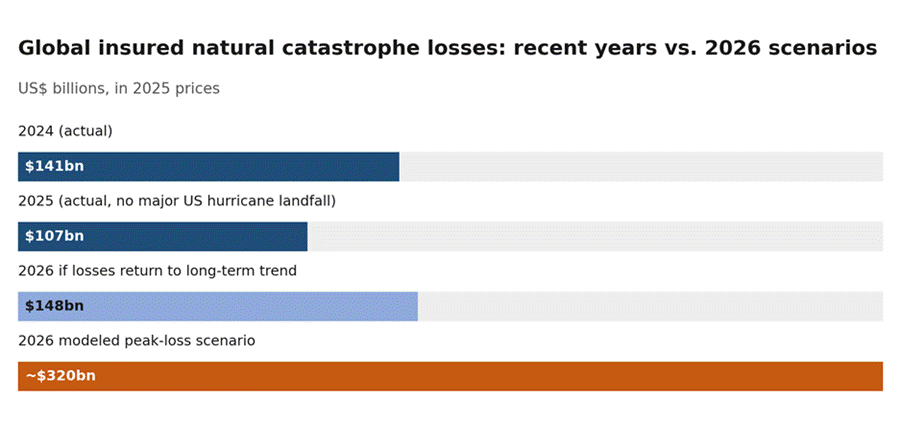
Source: Swiss Re Institute, sigma 1/2026 (March 19, 2026)
A decade ago, many companies - reinsurers especially - ran several models side by side, Clark said, until cost collided with low confidence in first-generation wildfire results. “What’s the point of adding that cost of having multiple models if we’re not really seeing the benefit in terms of better loss estimates?” she said. Most carriers now license one model and adjust it toward a proprietary view of risk. Clark expects reinsurers, the heaviest licensors, to say they run no model as delivered. “They have to develop their own proprietary view, aka fix the models,” she said.
Saleh offered an alternative case for consolidation that does not depend on dissatisfaction with the models themselves. “One well-understood model, supported by strong governance, quality exposure data, sensitivity testing, and an informed internal view of risk, may be more useful than several models that are treated as black boxes,” he said.
Clark traces the broker workaround to opacity in how models are updated. Updates to the traditional models can shift loss estimates 20% to 30%, she said, so brokers run location files through each version to isolate what changed and share results with ceding companies, while reinsurers repeat the work in-house on top of rising licence fees. “It takes a lot of time and money - people time - to investigate and interrogate these models, because the modeling companies don’t make it easy,” Clark said.
For brokers who regularly interpret catastrophe model outputs on behalf of carriers, the governance question matters beyond the cost. Saleh identified the boundary: “Outsourcing the analysis can be efficient. Outsourcing the understanding and accountability creates a much greater governance challenge.” A broker who translates model results without the carrier understanding the underlying assumptions creates a chain of reliance that breaks down when a model is updated, challenged by a regulator, or proves wrong after a major event.
Bingenheimer disputes Clark’s framing of the modelling companies. “Over the past decade, there’s been a major paradigm shift in the amount of transparency that we provide about underlying data, underlying assumptions, underlying science that drive the models,” he said. He added that cloud hosting and automation have lowered adoption barriers, letting carriers run models inside underwriting and pricing systems. Verisk said it sees dozens of companies a year, including managing general agents and regional carriers, bringing its models in-house for the first time - though the claim is the company’s own and not independently verified.
Clark’s practical advice for carriers evaluating models cuts across the vendor question: look for models that expose hazard, vulnerability functions and secondary uncertainty, and that can be checked against the carrier’s own claims data after each event.
On staffing, Bingenheimer declines to rank actuarial, scientific, engineering and analytical skills; the mix depends on a carrier’s maturity. “I really don’t know that I can say that one is more important than the other,” he said, noting that larger carriers tend to keep scientists and engineers on staff.
Clark’s baseline is quantitative analysts rather than data scientists, since the job is evaluating models rather than building them. For specialty books - solar energy or marine risks, for instance - a scientist or engineer who can customise a model’s vulnerability functions becomes more valuable. “That’s something that is a very productive use of resource, to be able to customize the model in that way,” she said.
The hire is becoming more consequential as AI enters the modelling process. Insurers use aerial imagery and AI to capture roof condition and defensible space, Clark said, and modellers use AI to represent the winds that drive large-loss wildfires. Both developments mean models will update more frequently, which raises the bar for staff who need to explain why a number moved and whether the movement reflects genuine risk change or a modelling revision.
In 2025, the California Department of Insurance completed reviews of wildfire models from Verisk, KCC and Moody’s, and requires insurers that use them to write and maintain coverage in wildfire-distressed areas. Clark said insurers representing 50% of California’s property premium volume have won rate approvals based on KCC’s wildfire model.
For carriers still without models in-house, Bingenheimer frames the case for change as a question of control: pricing for what could happen rather than what has, holding capital for severe events, and testing risk-transfer options without leaning on a third party. Clark adds a caveat that applies to any modelling hire, however the technology evolves. “AI models have to be trained, and they have to be trained on high-quality data - and a lot of high-quality data,” she said.