For years, the standard explanation for underinsured homeowners has been that they chose it, trimming limits to save on premium. A new analysis of California claims data argues that explanation mostly doesn't hold. It says the bigger problem sits with the replacement-cost estimates insurers hand customers when they buy a policy.
Kenneth Klein, a law professor at California Western School of Law and a consumer representative to the National Association of Insurance Commissioners, obtained aggregated data from the California Department of Insurance through a series of public records requests.
The data cover 74,070 fire claims on owner-occupied homes from 2018 to 2023, from minor house fires to total wildfire losses. He published his findings in the Lewis & Clark Law Review.
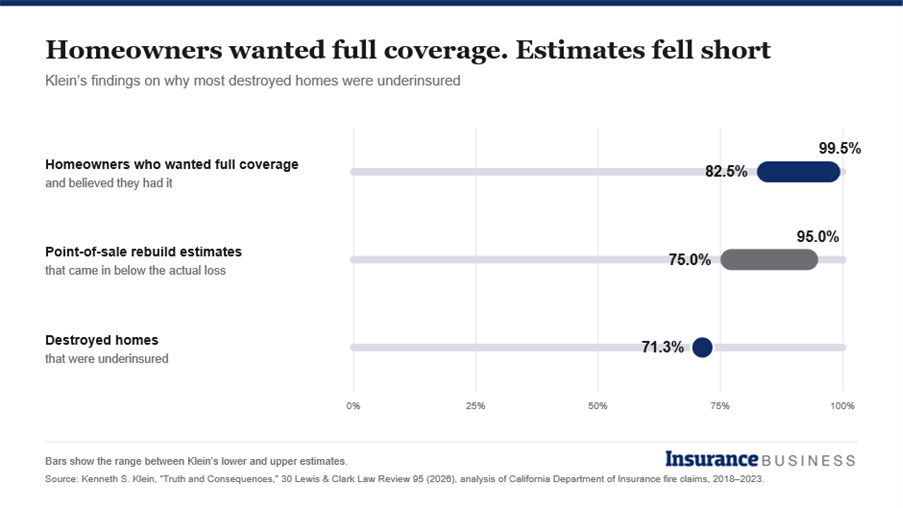
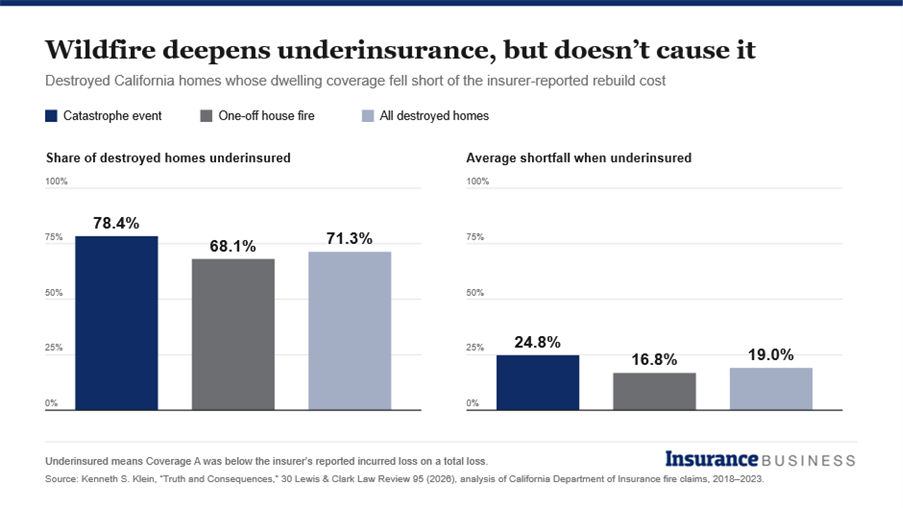
Klein defined underinsurance as a destroyed home whose dwelling coverage fell short of the insurer's own reported incurred loss. By that measure, 71.3% of destroyed homes were underinsured, by an average of about 19%.
Wildfire made the problem worse but didn't create it. Homes lost in catastrophe events were underinsured 78% of the time, with an average shortfall near 25%. Homes lost to one-off house fires were underinsured 68% of the time, by about 17% on average.
"Wildfire isn't the problem," Klein writes. Homeowners are underinsured even for an ordinary house fire.
Klein's central finding concerns the point-of-sale reconstruction cost estimate that insurers typically use to set Coverage A. Across the data, he found that estimate came in below the eventual incurred loss between 75% and 95% of the time. The average shortfall was more than 30%.
Klein argues that matters well beyond California, because carriers nationwide rely on the same small group of estimating tools. His earlier research found that challenger vendors had made little headway against Verisk and CoreLogic in that market.
His conclusion is that if the algorithms run low in California, they likely run low everywhere. In his words, the U.S. is "a nation of unwitting, underinsured homeowners."
The paper also challenges the claim that customers bring the problem on themselves. By Klein's methodology, somewhere between 82% and 99.5% of the policyholders in the data wanted full coverage, were willing to pay for it and believed they had it.
He also questions whether demand surge, the spike in labor and material prices after a disaster, explains the gap. Roughly 90% of policies in the data carried extended or guaranteed replacement cost. Among those with extended replacement cost, 150% was the most common level. Even so, most homes destroyed in catastrophes still came up short.
One detail is likely to catch carriers' attention - insurers' reported incurred losses routinely exceeded policy limits. Klein reads that as a sign that insurers know, in most total losses, that their policies are underinsuring.
The figures fit a wider pattern. The American Property Casualty Insurance Association has estimated that about two in three U.S. homes may be underinsured, as a recent survey on widespread underinsurance among US homeowners showed.
Read next: Survey shows widespread underinsurance among US homeowners
Klein cautions that his data are backward-looking and California-only. They also rely on insurers' self-reported figures and exclude flood, wind and FAIR Plan claims. But early evidence from the January 2025 Los Angeles fires suggests the numbers may understate the problem.
A year after the fires, a survey of 675 households by the consumer group United Policyholders found:
According to that survey, underinsured total-loss households were on average 36% short in the Eaton Fire and 46% short in the Palisades Fire. Separately, estimating firm e2Value told Klein its study of nearly 10,000 homes in Altadena's 91001 ZIP code found that Coverage A understated reconstruction value by about 35%.
Rising costs make any stale estimate worse. A January 2025 Federal Insurance Office analysis of the homeowners marketfound that replacement costs for property and casualty losses rose about 45% between 2020 and 2023.
Read next: Nine in 10 homeowners worry about protecting their homes but lack insurance knowledge – The Hanover
Klein highlights Colorado as one possible model. Since Jan. 1, 2025, insurers there must offer law and ordinance coverage equal to 20% of the dwelling limit, and extended replacement cost of at least 50%, before issuing or renewing a replacement-cost policy. The offer must come with an explanation of what those coverages do and cost.
California may follow. SB 876, authored by Sen. Steve Padilla and sponsored by Insurance Commissioner Ricardo Lara, has cleared the Legislature and awaits Gov. Gavin Newsom's decision. The bill would bar insurers from issuing or renewing a residential policy without offering extended replacement cost of at least 50% above the dwelling limit, plus a guaranteed replacement cost option. It would also extend rebuild-estimate requirements to the California FAIR Plan. Insurers that fall short on those estimates could be liable for up to the full replacement cost after a loss.
Klein floats tougher options too:
He acknowledges that every one of these would push premiums higher. He argues that current policy puts "a priority on affordability over adequacy."
None of Klein's figures include flood, which standard homeowners forms exclude. Only about 4% of U.S. homeowners carry flood coverage, as recent reporting on the nation's flood protection gap found.
The National Flood Insurance Program is again running on a stopgap. Congress extended it only through Dec. 11, its 36th short-term reauthorization since fiscal 2017.
With a strong El Niño forecast, Lara this week urged Californians to review their coverage. He noted that most homeowners and renters policies don't cover flooding and that flood policies typically carry a 30-day waiting period.
Read next: Only about 4% of US homeowners have flood insurance – despite billions in annual losses
For agents and brokers, the practical takeaway is that the carrier's replacement-cost figure is a starting point, not an answer. That means:
Clients appear to want that help. A recent Hub International survey found 88% of policyholders want their provider to flag when coverage no longer fits. Yet 56% said they hadn't heard from their provider proactively in over a year, or weren't sure they ever had, according to findings on claimants whose coverage fell short.
The pattern isn't limited to California. After the 2023 Gray and Oregon Road fires near Spokane, Washington regulators found that many claims paid out to policy limits, as the Spokane underinsurance findings showed.
Read next: One in three claimants say their coverage fell short, survey finds