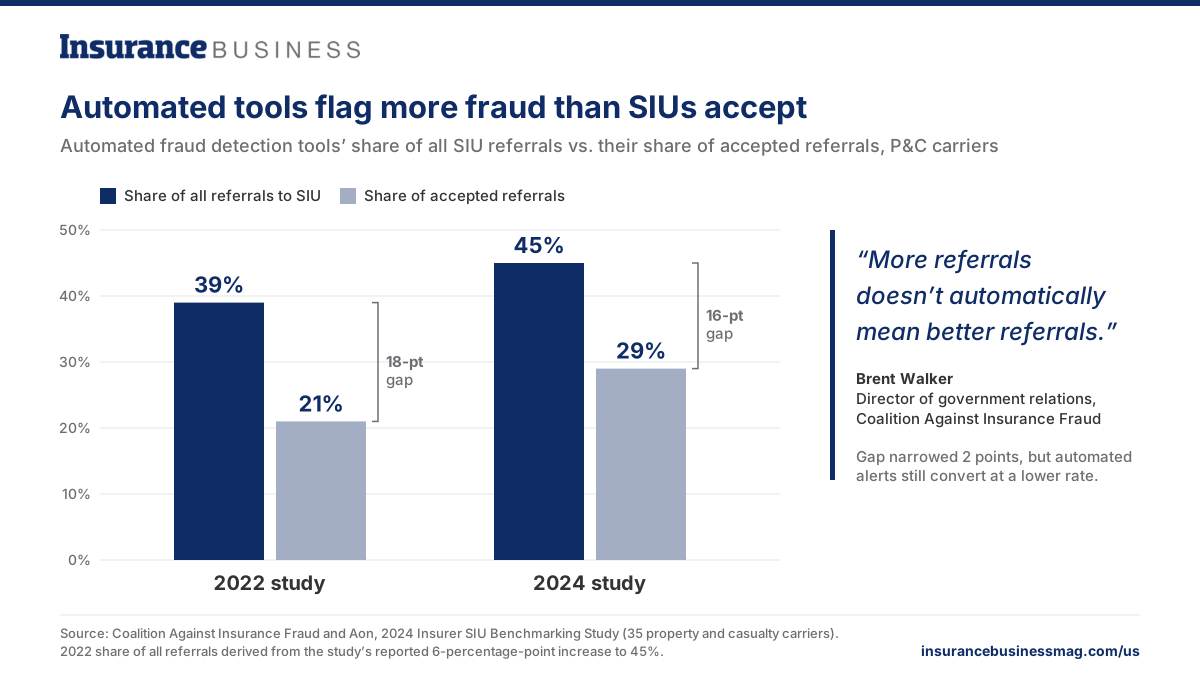
Automated fraud detection tools now generate 45% of all referrals to insurers' special investigation units (SIUs), up six percentage points from 2022. SIU staffing, meanwhile, grew an average of just 0.5% in 2024, according to the Coalition Against Insurance Fraud's 2024 Insurer SIU Benchmarking Study. Aon's Strategy and Technology Benchmarking group conducted the study with the Coalition across 35 property and casualty carriers. The Coalition began a 2026 edition with Aon in January.
The stakes are large. The Coalition estimates that insurance fraud costs the US $308.6 billion a year across all lines.
Staffing is barely growing just as AI makes fraud easier to commit, according to Michelle Rafeld, executive director of the Coalition, a Washington, D.C.-based alliance of more than 300 insurers, consumer groups and government agencies.
"Before, those who were using technology to commit fraud had to have a degree of sophistication," Rafeld said. "With AI being what it is today, that degree of sophistication is gone. You can ask the system to come up with ways in which you can defraud insurance carriers and do it for you."
Coalition leaders said that shift requires carriers to change both the automated tools they deploy across claims, underwriting, call centers and payments, and the people inside the SIU who decide how those tools are applied.
Celeste Dodson, the Coalition's director of member relations and initiatives, built and led regional and national SIU operations at State Farm before joining the Coalition.
"They're utilizing AI, predictive analytics, image analysis, network analysis to identify their traditional fraud schemes that we've seen for so many decades, and the emerging fraud schemes that you see attached to the organized fraud or the transnational fraud: account takeovers and synthetic IDs," Dodson said.
"It really starts with the legacy systems they already have in place and the business putting in business rules that they can manage on their own and adjust as needed," she continued. Carriers then layer predictive models on top to catch fraud at policy acquisition or first notice of loss.
Brent Walker, the Coalition's director of government relations, who held senior SIU roles at two major carriers, said rules-based detection still performs well against single-claim fraud, especially in personal auto and property.
A newer layer, he said, comes from banking. "Network analysis, link analysis, know your customer, entity resolution – that's all something that the banking industry has been doing for a while, and I think we're learning from that sector," Walker said.
"We find some of the same fraudsters who commit banking fraud are committing insurance fraud," Dodson said. Many fraud-detection vendors now sell into both sectors, she added.
Organized and transnational groups probe the whole enterprise, not just claims files. Rafeld said these groups exploit the insurance licensing process, run employee infiltration schemes and reuse data stolen in cyberattacks to commit fraud later.
That means locking the windows as well as the front door. "It (company security) has to span not just the claims or the underwriting department, but call centers and payment processing," Walker said.
Rafeld called it a data problem. "Taking down the silos to get at the data that can help connect the dots is very key in being able to effectively fight it," she said.
Automated tools accounted for 29% of accepted referrals in 2024, up from 21% in the Coalition's 2022 study. That is well below their 45% share of all referrals, which suggests automated alerts are less likely than other referrals to be accepted for investigation. Walker cautioned against reading volume as success.
"More referrals doesn't automatically mean better referrals," he said.
He recommends tiers: low-weight hits stay with a claims professional or underwriter, mid-tier hits go to desk or field investigators, and the most complex go to major case units. Investigators' outcomes then feed back into the model.
"That feedback has to go back into the model so it can learn and get better and stay accurate and ensure there's no bias involved as well," Walker said.
That design changes who sits in the SIU. "You need that human in the loop," Rafeld said. "But the type of human in the loop you may need may also need to change." She pointed to data analysts, data scientists and IT staff inside the unit, and called for investment in staff education.
Regulators also require a human role in certain decisions about consumer benefits, Rafeld said. That echoes earlier IB reporting that evidence gathering is claims AI's safest first win.
"No matter how many great tools you have, no matter how much analytics you can gather, the (staffing) element is really important," Dodson said.
The Coalition's 2024 State of Insurance Fraud Technology Study found insurers running a mix of internal and vendor-driven tools, with limited IT resources a common barrier. "I think it's really a hybrid approach," Dodson said. Carriers keep their own rules and legacy systems and bring in vendors where they lack expertise.
Walker listed the vendor field: private investigators, data analytics firms, engineering firms and an AI layer across claims and underwriting. "The carrier, I think, needs to start with where their risks lie before they start thinking about a vendor to partner," he said.
Rafeld added that regulators demand transparency and bar certain data from models. Carriers should "ask those important questions (of vendors), to ensure that the carrier doesn't later find themselves in a predicament where they're in violation of state insurance laws, because of the vendor not being up to date on the regulations," she said.
The Coalition leaders' message for claims and SIU leaders is that a fraud-technology dollar that only adds alerts buys little. In their view, the return comes from connecting data across the enterprise, and from analysts who decide which alerts deserve an investigator