For years, the case for the excess and surplus lines market lived and died on appetite. If the standard market wouldn't write a risk, E&S would. Dan Law (pictured) thinks the bigger advantage today is the clock.
"Speed is the name of the game, and it's way more pronounced now than it has been in my recent memory," Law, head of cyber practice at HSB, the Munich Re-owned specialty insurer, told Insurance Business.
The culprit, he said, is artificial intelligence, along with a cyber threat landscape that refuses to sit still and is dominating the headlines. Cyber policies now have to be reworked quickly as new attack methods emerge. That is a pace the admitted market, with its state form and rate filings, was never built for. "It's not designed to adapt to," Law told us.
On the non-admitted side, the timeline looks very different. Law said HSB can take a coverage concept developed with a broker partner and get it to market in three to four months. Doing the same through admitted channels, he said, simply isn't realistic.
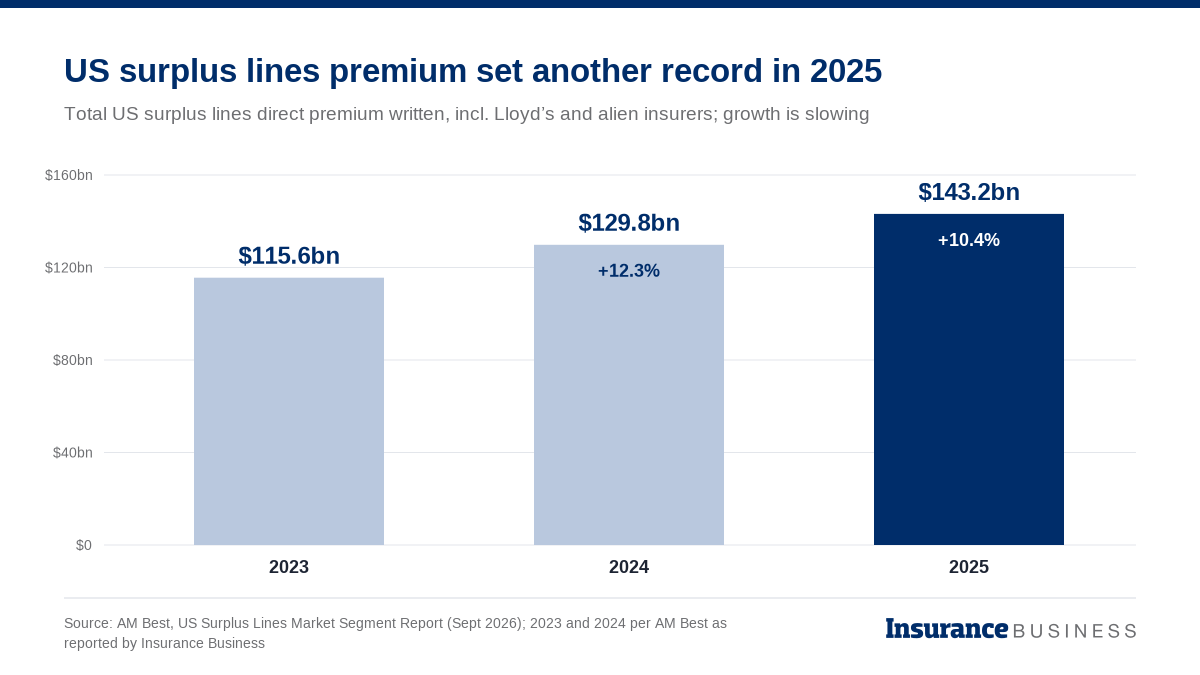
US surplus lines premium reached a record $143.2 billion in 2025, up 10.4%, according to AM Best's annual segment report. That same analysis describes cyber splitting into two markets: surplus lines carriers writing most standalone primary and excess cyber policies, and admitted carriers largely handling cyber endorsements attached to broader commercial packages.
AM Best's Associate director David Blades said the surplus lines market is currently the main route to affirmative, specialized AI coverage, because it can use "its freedom of rate and especially its freedom of form".
And it seems that this speed and flexibility is winning the race for market share with surplus lines carriers now accounting for nearly two-thirds of US cyber premium.
Read next: The cyber market has grown up. But staying in your lane still matters
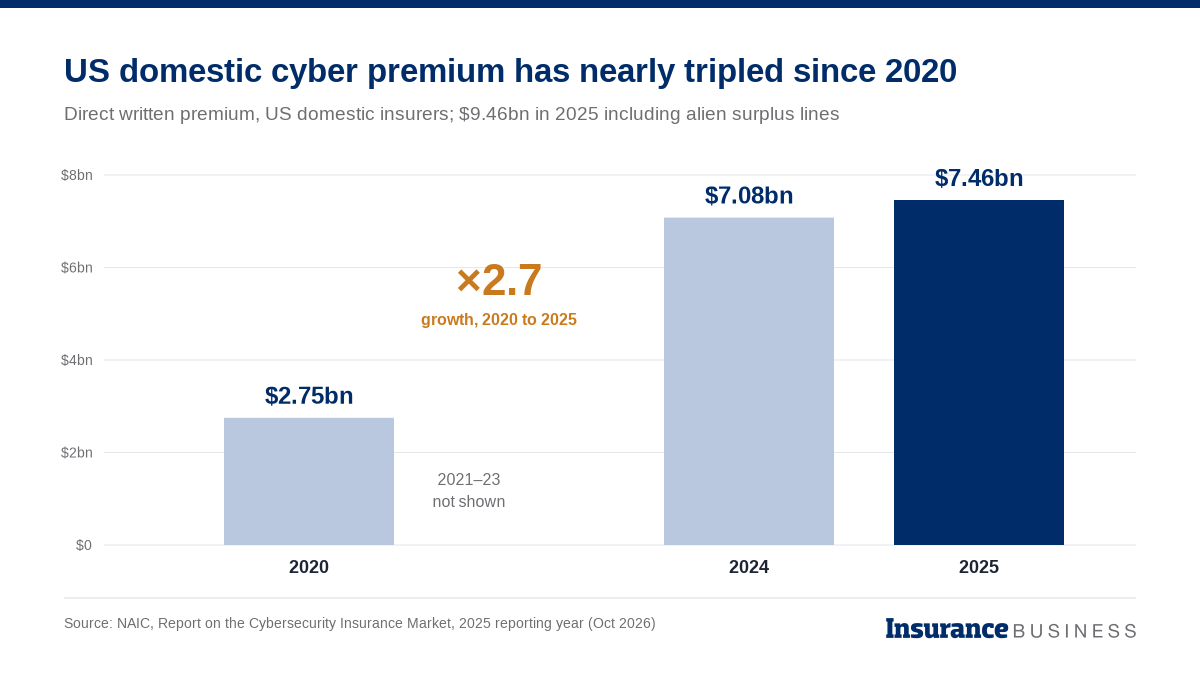
The National Association of Insurance Commissioners' latest Report on the Cybersecurity Insurance Market found US domestic cyber direct written premium nearly tripled between 2020 and 2025, from $2.75 billion to $7.46 billion. Including alien surplus lines insurers, the total was $9.46 billion. Reported claims rose 20% to 56,323 over the year.
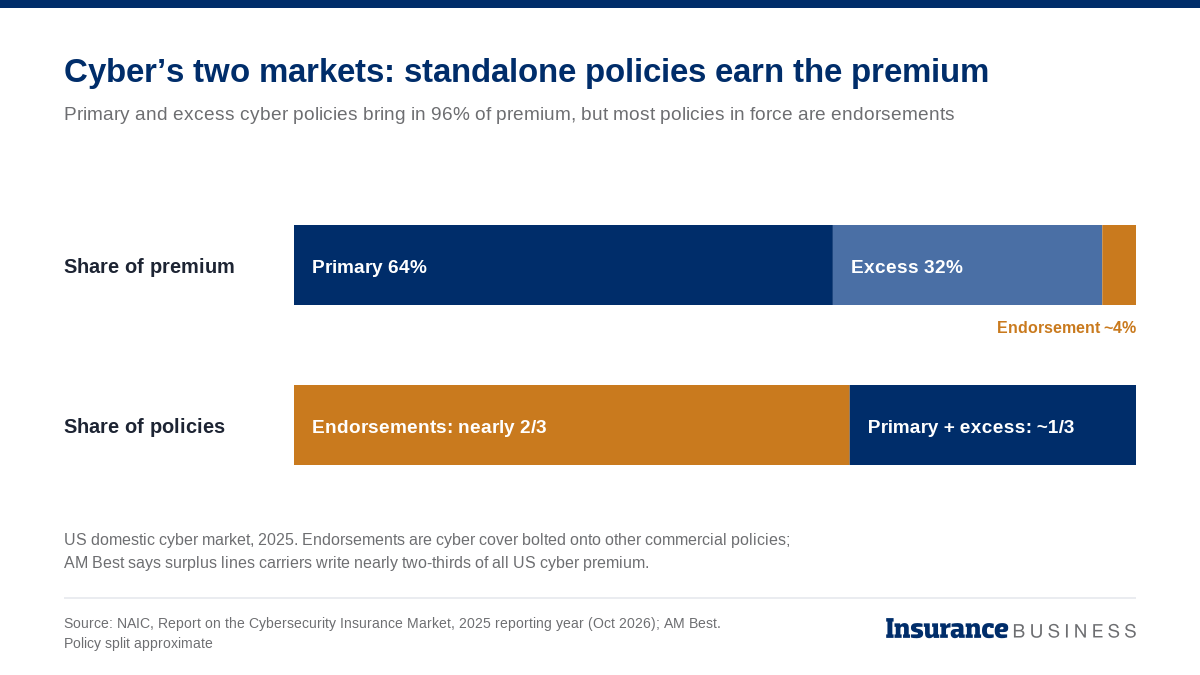
Much of the growth in policy count came from endorsements, which now make up nearly two-thirds of the 5.84 million domestic cyber policies in force. For buyers who need more than a bolt-on, that leaves the specialist, standalone end of the market in E&S hands.
Primary cyber policies account for about 64% of domestic cyber premium and excess for about 32%, leaving endorsements with roughly 4%. The NAIC now describes US cyber as becoming two distinct sub-markets, with surplus lines writing the standalone policies and admitted carriers focused on endorsements.
Law speaks about retail brokers from experience. He spent close to 20 years as a retail broker in California before moving to the carrier side and joined HSB after serving as chief commercial officer at cyber insurtech Cowbell.
The retail job, he said, carries an awkward double expectation. "You're called on to be a generalist, but also have answers at your fingertips," he said. "In a lot of cases, the clients aren't going to wait for you."
His advice on when to bring in wholesale help is less about the placement stage and more about self-awareness. Retail brokers, he said, should be clear about where their own expertise ends and call in a carrier or wholesale partner "when you don't know what you don't know." That outside specialist can help the client understand what cover it actually needs and tailor the policy accordingly.
Read next: Your clients think cyber covers their AI risk. Most of the time, it doesn't
Not everyone thinks the handoff solves the problem on its own, and that you should keep growing your own skills and knowledge. WTW cyber specialist Jennifer Wilson has warned that expertise on AI exposures varies widely among wholesalers as well as retailers, and that retail brokers should keep asking questions after a risk goes to market.
Asked what the next generation of wholesale brokers needs to look like, Law said the industry is doing a good job of developing people. But he also said that the role itself is changing.
"Gone are the days when it was focused on the transaction itself," he said, describing an era built around securing "the lowest price for the most amount of coverage you could get."
The value now, in his view, lies in expertise: tracking a shifting threat landscape, knowing which wordings are current and matching coverage to what a specific client needs. "The market is changing so fast," he said. "There are new coverages being developed daily." Wholesalers, he added, should lean on every carrier and partner in the space for training.
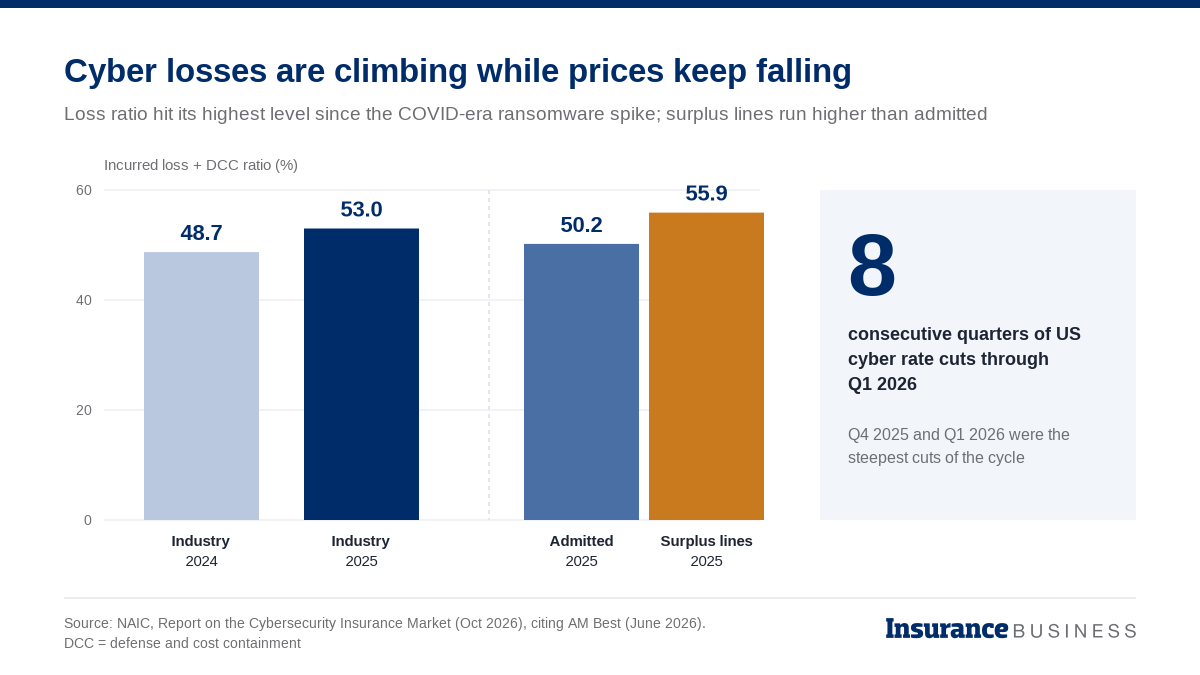
And knowledge really matters when there is a battle for maket. According to the NAIC, the first quarter of 2026 was the eighth straight quarter of US cyber rate cuts. Over the same stretch, the industry's loss and defense cost ratio rose from 48.7 in 2024 to 53 in 2025, its highest since the COVID-era ransomware spike. A market that charges less for rising losses rewards the broker who reads the wording, not just the quote.
Read next: Why Gen Z is skipping insurance careers – and what wholesale leaders can do about it
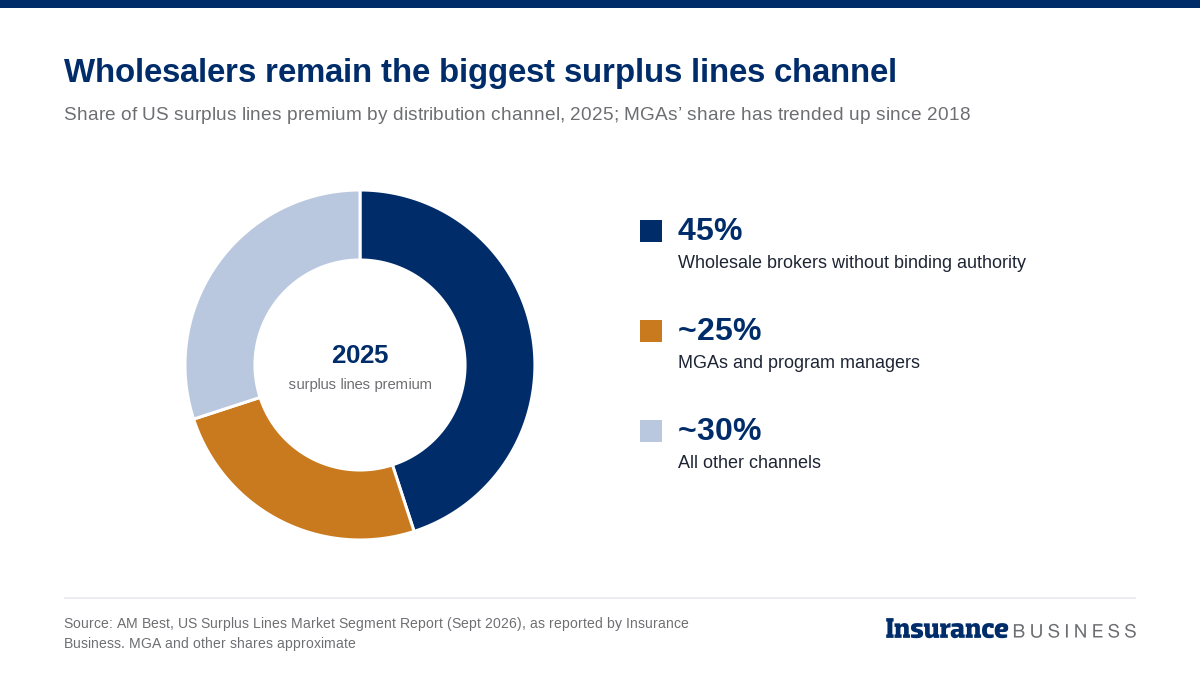
Wholesale brokers without binding authority handled 45% of surplus lines premium in 2025, while MGAs and program managers generated nearly 25%. AM Best's analysis suggests that wholesalers and MGAs with genuine class-specific expertise are pulling away from the rest. That theme also ran through this year's Top Specialist Wholesale Brokers list, which singled out wholesalers as interpreters of complex risk rather than simple conduits for it.
And knowledgeable brokers are getting in shorter and shorter supply. As many as 400,000 US insurance professionals were projected to retire by the end of this year, according to analysis of Bureau of Labor Statistics data. The specialist knowledge Law describes is exactly what risks leaving with them.
Law has argued separately that AI-driven attacks belong inside cyber policies rather than being carved out. His latest comments suggest the people placing that cover will need to move as fast as the threats it responds to.
Read next: Property softens, liability hardens: what E&S midyear data means for brokers