
Private equity has a cash problem. Buyout funds are sitting on portfolio companies they can't easily sell, in a market where exits have slowed to a crawl, and investors who put money in years ago are still waiting to get it back. So dealmakers have started looking somewhere unexpected for relief: the balance sheets of insurance companies.
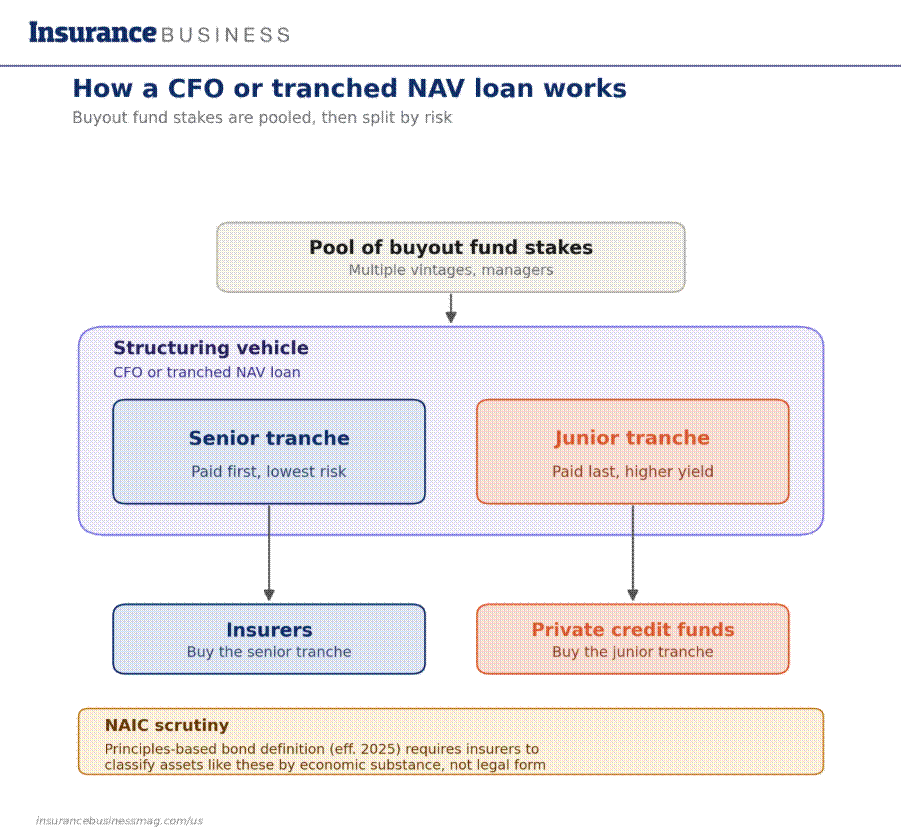
The mechanism they’re using is a form of structured debt that splits a pool of assets into slices, or "tranches," each with a different level of risk and a different price, the diagram below shows the basic shape of it.
It's the same idea that underpinned mortgage-backed securities before the 2008 financial crisis (remember how that ended?), though the assets involved here are stakes in aging buyout funds rather than home loans.
The top slice gets paid first and carries the lowest risk; the bottom slice absorbs losses first but pays a higher return. That structure lets an insurer buy only the safest portion, while a hedge fund or private credit firm takes the riskier end for a bigger payout.
Read next: US life insurers' private credit push is creating liquidity and concentration risks, Moody's warns
Two structures are driving the trend. The first, collateralized fund obligations (CFOs), package up stakes in buyout funds and issue bonds against them, a technique that has existed for two decades but has recently found a much bigger audience.
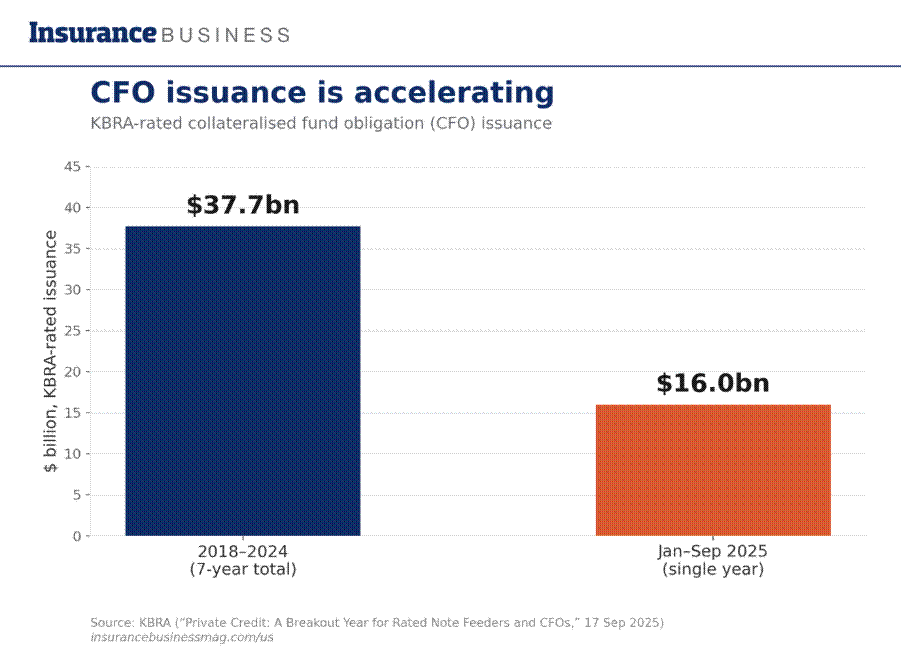
Between 2018 and 2024, ratings agency KBRA rated 152 tranches across 67 of these deals, worth a combined $37.7 billion, according to KBRA's published research. Issuance has kept accelerating since: KBRA-rated CFO volume hit a record $16 billion by September 2025 alone, on pace to outstrip the prior seven years combined within a single year. The chart below shows the scale of that jump.
The second structure is newer. So-called net asset value (NAV) loans let a fund borrow against the value of its own holdings rather than sell them outright. That’s useful for returning cash to investors or funding fresh purchases without a full exit. Fund managers have now started tranching these loans too, carving them into senior portions rated highly enough to appeal to insurers and junior portions aimed at private credit firms with a bigger appetite for risk.
According to Thomas Speller, co-head of funds ratings at Kroll Bond Rating Agency, structuring like this has picked up noticeably over the past year as issuers try to reach "investors with different risk tolerances," a shift he described to the Financial Times.
The scale of the money involved isn't small. Two of the biggest names in the secondaries business where funds buy up existing stakes in other private equity vehicles, have recently gone to market with CFOs of their own. Blackstone was reported in June 2026 to be exploring the sale of more than $2 billion in fund stakes through its Strategic Partners unit, with the securities aimed partly at insurance buyers, according to the Financial Times and other outlets at the time.
In August, Franklin Templeton closed its first CFO - a $1.5 billion deal combining secondaries exposure from its Lexington Partners arm with US middle-market loans from Benefit Street Partners. The firm's statement named insurance companies among the target investors, alongside pension funds and family offices.
Read next: Private credit now dominates life insurer bonds as NAIC rewrites the rulebook
For US life insurers, this fits a pattern that's been building for years rather than arriving out of nowhere. Nearly half of all bonds held by US life insurers were privately placed at year-end 2025, up from 37.4% five years earlier, and private and illiquid bond holdings have grown to $807 billion roughly 20% of the industry's $4 trillion fixed-income book according to Moody's Ratings and S&P Global Market Intelligence data reported by Insurance Business.
Private-equity-affiliated carriers such as Apollo-backed Athene and KKR-backed Global Atlantic are among the most exposed, which matters here specifically because those are exactly the kinds of institutional buyers a CFO or tranched NAV loan is built to reach.
Read next: Warren presses insurance regulators for answers on private credit ties as Walter probe widens
Regulators aren't ignoring this. The NAIC's principles-based bond definition, which took effect January 1, 2025, requires insurers to classify assets by economic substance rather than legal form specifically to stop structured instruments from getting bond-like capital treatment they don't merit.
According to an analysis by professional services firm Forvis Mazars, the project was originally centered on concerns about collateralized fund obligation investments years before it became a broader overhaul of insurer bond reporting, which makes the current wave of insurer-targeted CFOs and NAV loans a fairly direct test of the rule it inspired. Carrie Mears, an investment specialist with the Iowa Insurance Division who sits on the NAIC's new commissioner-level Invested Assets Task Force, has said the task force is designed to make oversight more "nimble and responsive" as these kinds of structures multiply.
NAIC President Scott White has separately named transparency around complex, illiquid insurer holdings as a top regulatory priority for 2026 — a concern that lines up closely with what critics of these structures have been raising about CFOs and tranched NAV loans specifically.
Layering debt on top of buyout funds that are often already leveraged at the portfolio-company level adds to that concern, since losses can stack up in ways that are harder to see from the outside. A handful of secondaries managers reportedly began tranching their own NAV loans to reach insurers only this year, according to a private credit executive who spoke to the FT, meaning underwriters and capital teams are being asked to get comfortable with a fairly untested corner of structured finance rather quickly, right as the NAIC's own reporting overhaul is still bedding in.
There's also a banking angle here. Some lenders have reportedly been selling off the riskiest slices of the NAV loans they extend to private credit funds as a way of freeing up their own capital with buyers including private credit shops themselves. That's a pattern insurers evaluating these deals may want to understand before assuming a senior tranche is as insulated as its rating implies.
Read next: US life insurers boost private credit amid lending shift – AM Best
None of this is likely to slow the trend. Private equity firms need liquidity, and insurers are sitting on trillions in long-term capital that has to go somewhere. What's changed is the sophistication of the products being built to connect the two and the speed with which they're moving from niche financing tool to mainstream fixture of the secondaries market, right as US regulators build the reporting infrastructure meant to keep pace with them.