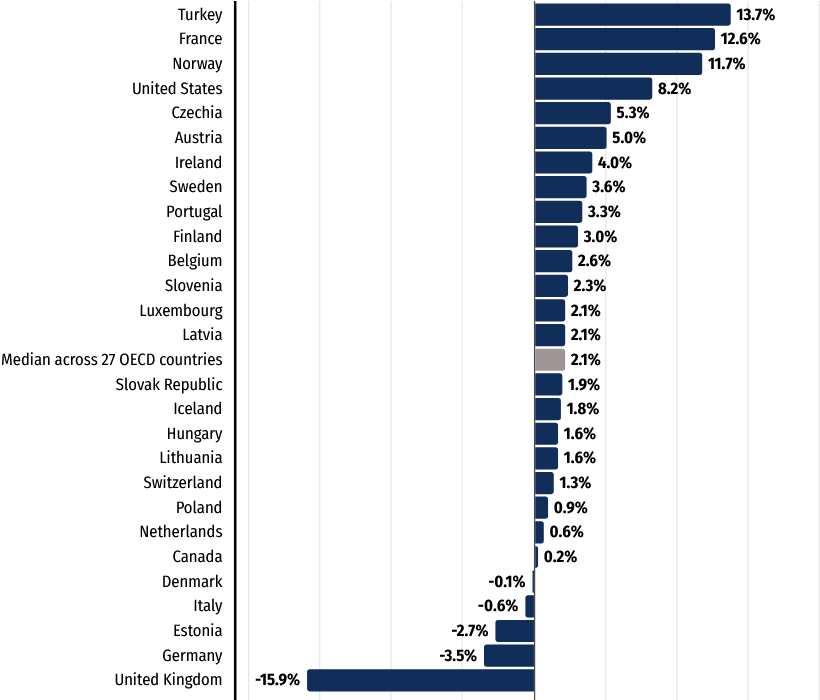
US home insurance premiums rose at nearly four times the median rate across 27 Organisation for Economic Cooperation and Development (OECD) member states in 2025, according to the OECD’s Global Insurance Market Trends 2026 report.
The US recorded an 8.2% year-over-year increase in nominal home insurance premiums, against a median of 2.1% across the 27 markets analyzed. Only Turkey, France, and Norway posted larger gains, at 13.7%, 12.6%, and 11.7%, respectively – the only three to record double-digit rises.
Czechia ranked immediately behind the US at 5.3%, followed by Austria at 5% and Ireland at 4%. Sweden, Portugal, and Finland saw more modest gains of 3.6%, 3.3%, and 3.0%. Of the 27 countries in the analysis, 22 recorded increases in 2025.
Read more: E&S growth exposes widening split in US homeowners market
The sharpest contrast in the OECD data is with the UK, where home insurance premiums fell 15.9% – leaving a 24-percentage-point gap with the US. Germany, Estonia, Italy, and Denmark also recorded declines, but all were small. The UK’s drop was more than four times larger than Germany’s.
The OECD noted that because non-life policies typically renew annually, premium changes often lag underlying cost movements by a full policy cycle. Some of the increases recorded in 2025 reflected claims costs and inflation from prior years. Local competition and regulatory conditions also shaped how quickly carriers passed those costs through to customers.
The sustained premium run-up has produced a sharp improvement in carrier results. The US homeowners segment posted a $16.5 billion underwriting gain in 2025, the first annual profit in the line since 2019, reversing a $1.3 billion loss the year before, according to AM Best’s Market Segment Report: A Myriad of Factors Lead to Markedly Improved Homeowners Results, published September 2026.
“Insurers have consistently pushed for higher rates to address their calculated rate level needs, and overall, homeowners’ insurers are doing a much better job of matching rate to risk, with greater dependence on recent loss trends than historical loss trends,” said David Blades, associate director at AM Best.
The average approved rate increase fell from 13.5% in 2024 to 7.6% in 2025, dropping further to 4.3% through the first half of 2026, AM Best reported. Rate filing activity slowed in the second half of 2025 and has continued to ease into 2026, the firm said, reflecting improved underwriting results and a stabilizing reinsurance market.
Read more: Homeowners rate increases slow to 4.3% as insurers bank first underwriting profit in six years
That improving carrier picture has not yet translated into relief for homeowners. The Consumer Federation of America’s (CFA) April 2025 report, Overburdened, found that typical US homeowners premiums rose 24% between 2021 and 2024 – with increases recorded in 95% of US ZIP codes. The collective additional cost to American homeowners over that period was approximately $21 billion.
The OECD data partly explains why the US diverged so sharply from peers. In markets where premiums fell, competition intensified and regulatory oversight tightened. In several US states, the opposite occurred – carriers retrenched from high-risk markets, reducing competition and removing consumer choice at the moment costs were rising fastest.
For brokers managing property books, the rate moderation visible at the national level is uneven across states and has yet to reach clients who renewed at peak rates in 2023 and 2024. The more immediate question for client conversations is whether existing coverage levels have kept pace with rising rebuild costs – and in constrained markets, whether adequate coverage remains accessible at all.