Mortgage insurers and title underwriters are the latest targets of the White House's pre-election push on housing costs.
President Donald Trump on Oct. 22 signed an executive order, Decreasing Housing Costs for the American People, that leans on the Federal Housing Finance Agency to squeeze costs out of the mortgage process. Two of its four main provisions deal with insurance: a pilot to cancel mortgage insurance premiums ahead of schedule, and a permanent version of FHFA's experiment letting some refinances skip the traditional lender's title policy, according to the White House fact sheet.
The rest of the order sets up a federal task force on factory-built housing and tells the Agriculture and Veterans Affairs departments to cut rates on their direct home loans.
FHFA Director Bill Pulte called it "the greatest Housing Executive Order in History" on X. The fact sheet, however, sets no equity thresholds, no start dates and no estimate of how many loans would qualify, so mortgage insurers, title underwriters and agents can't yet tell how much business is at stake.
Read next: Why home insurance prices are quietly becoming a 2026 midterm flashpoint
The mortgage insurance piece would have Fannie Mae and Freddie Mac use automated valuation models to recheck home values on loans they own from time to time, then drop the coverage once a borrower appears to have built enough equity, according to Mortgage Professional America's breakdown of the order. Servicers would have to tell borrowers when cancellation might be possible.
The pilot covers only loans originated after it launches. Borrowers already paying premiums would not benefit directly.
Mortgage insurers point out that borrowers already have cancellation rights. Under the federal Homeowners Protection Act, borrower-paid coverage on a conventional loan must end automatically once the balance hits 78% of the home's original value, and borrowers can ask to cancel at 80%, with some able to qualify on the strength of home price gains if conditions are met, according to U.S. Mortgage Insurers (USMI), the trade group whose members include Enact, Essent, MGIC, National MI and Radian.
USMI President Seth Appleton welcomed the focus on costs and said the industry was already lowering them. "Private MI is designed to be temporary, and the system already works much the way the order envisions, because when MI is cancelled, a borrower's monthly payment goes down," he said in the group's statement. USMI's statement describes the order as telling FHFA to consider a pilot, not to launch one.
The group says premium rates have fallen 25% since 2017, that more than 800,000 buyers used private coverage in 2025, two-thirds of them first-timers, and that its members insure more than $1.6 trillion in mortgages. Insurers have paid over $62 billion in claims since 2008 that would otherwise have hit the government-sponsored enterprises, lenders and investors, USMI said.
The pilot could also affect pricing. Mortgage insurance is priced on how long an insurer expects to keep collecting premiums. Some industry voices warned that a program clipping off late-life, low-risk loans could push insurers to build that lost income into pricing on new business, MPA reported.
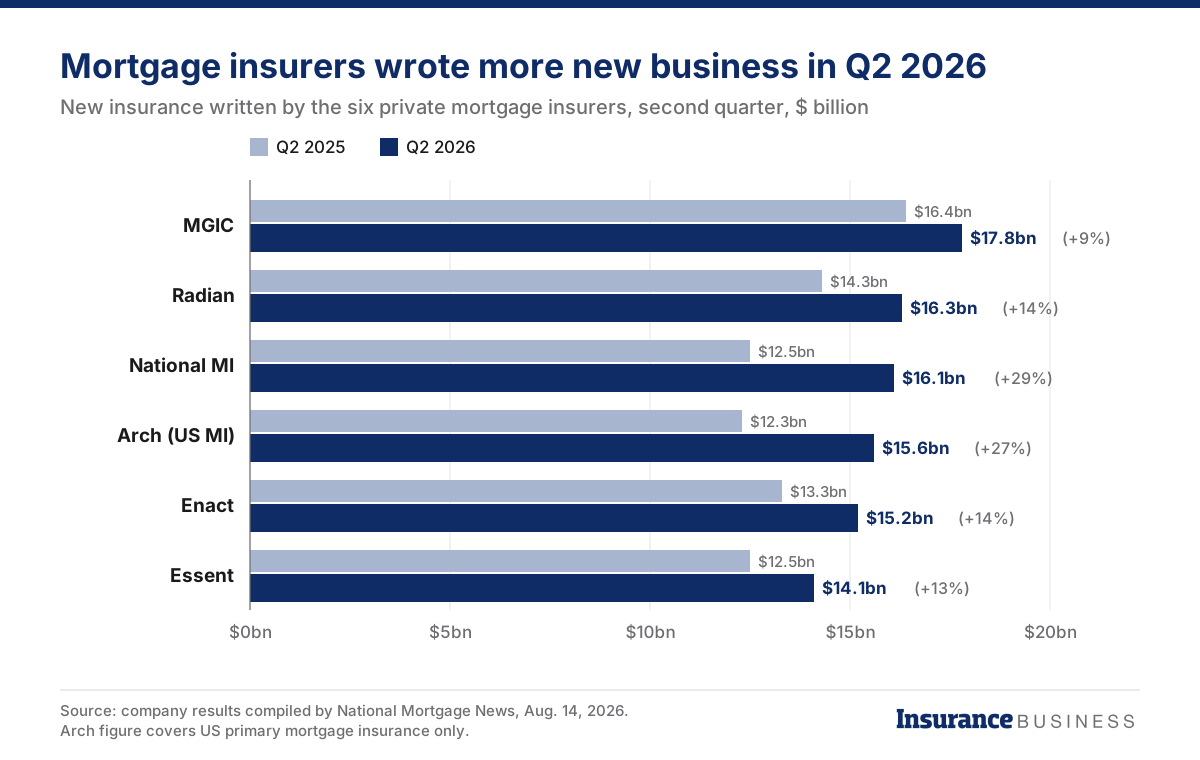
The order comes during a strong year for mortgage insurers. New insurance written across the six active private insurers (Arch, Enact, Essent, MGIC, NMI and Radian) hit a multi-year high in the second quarter of 2026, with strong credit performance, according to Milliman's quarterly market update.
Read next: Old Republic prevails as Massachusetts court rejects title coverage expansion
For title underwriters, the order expands a program their trade group has opposed since 2024.
The title acceptance pilot dates to March 2024, when the Biden-era FHFA approved waiving the lender's title policy, or an attorney opinion letter, on certain low-risk refinances where there is confidence the property is free of prior liens, according to a statement from then-Director Sandra Thompson. Fannie Mae launched it in November 2024 with Doma Title Insurance and added Westcor Land Title Insurance Co. in July 2025. Pulte said in June that Fannie would grow it.
The order would make the program permanent and broaden it. The order directs FHFA to lift the current 80% loan-to-value cap on eligibility, bring in more title-assessment providers and scrap the geographic limits, according to MPA's reading of the text. It also calls for waiving appraisals and income re-verification on limited cash-out refinances that cut a borrower's monthly payment.
The American Land Title Association responded the same day, warning that any cost-cutting push must keep protections for homeowners and their property rights in place rather than shift risk to consumers and taxpayers. In 2024, ALTA called the original pilot a political gesture that offered a false promise of savings.
Analysts expect a limited effect for now. Analysts at Keefe, Bruyette & Woods wrote in an Oct. 21 note that refinances account for only about 7% of title premiums, so the earnings hit should be modest while the program stays refi-only. They said the risk would be greater if the waiver ever reached purchase loans, where there is no scalable substitute for a title policy.
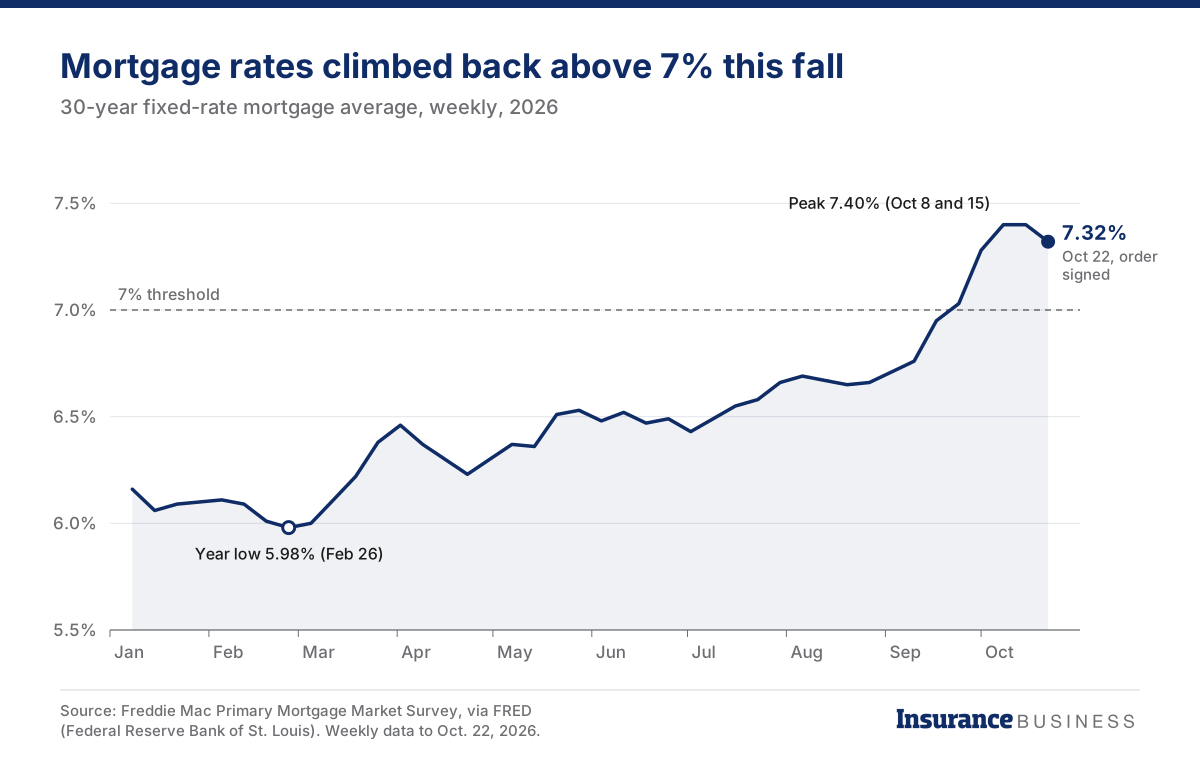
Refinance volume is low with 30-year rates above 7%, but a rate drop would quickly enlarge the pool of loans eligible for a waiver, and the order would also remove the program's geographic limits.
Read next: First American hits title agency with suit over alleged rebrand scheme
The order arrived less than two weeks before the Nov. 3 midterms and is the latest in a string of housing moves this year, including a January order curbing large institutional investors from buying single-family homes and two March orders on mortgage credit and construction rules, according to the White House.
Mortgage rates remain high. The 30-year fixed rate averaged 7.32% in the week to Oct. 22, down from 7.40% a week earlier, in Freddie Mac's weekly survey, as tracked by the St. Louis Fed, after crossing 7% in late September for the first time since early 2025. High rates keep refinancing low, which limits how many loans the title waiver can reach in the near term.
FHFA is responsible for carrying out both insurance provisions. The fact sheet gives Pulte broad direction but no deadlines on either insurance provision; the only firm clock in the order is 180 days for the manufactured housing task force to report back, MPA noted. Until FHFA and the enterprises publish eligibility rules, carriers can't size the impact with any precision.
KBW analysts suggested mortgage insurers could cushion any earnings drag from faster cancellations through share buybacks, according to HousingWire. Title underwriters, already contending with Fannie and Freddie's acceptance of attorney opinion letters as a substitute for a lender's policy, a long-running threat to premium volume, will watch whether the waiver stays limited to refinances.
The order does not address homeowners insurance, which lenders also require. Insurify projects the average annual premium will top $3,000 by the end of 2026, up from $2,948 at the end of 2025. For agents, home insurance premiums are likely to remain the main cost concern clients raise.