A New Jersey township that lost about $26 million to fraudulent wiring instructions is now counting on insurance to cover a loss that its policy limit may not reach.
Cranbury Township, in Middlesex County, sent the money on Sept. 28 to close on land for its affordable housing obligations. Police Chief Giuseppe DeChiara said the township had been given false wiring details as it prepared for the closing, MyCentralJersey.com reported. Law enforcement has frozen about $17.3 million. The other $8.7 million has been moved through multiple accounts and transactions, DeChiara said in a statement on the township website. Nobody has been charged.
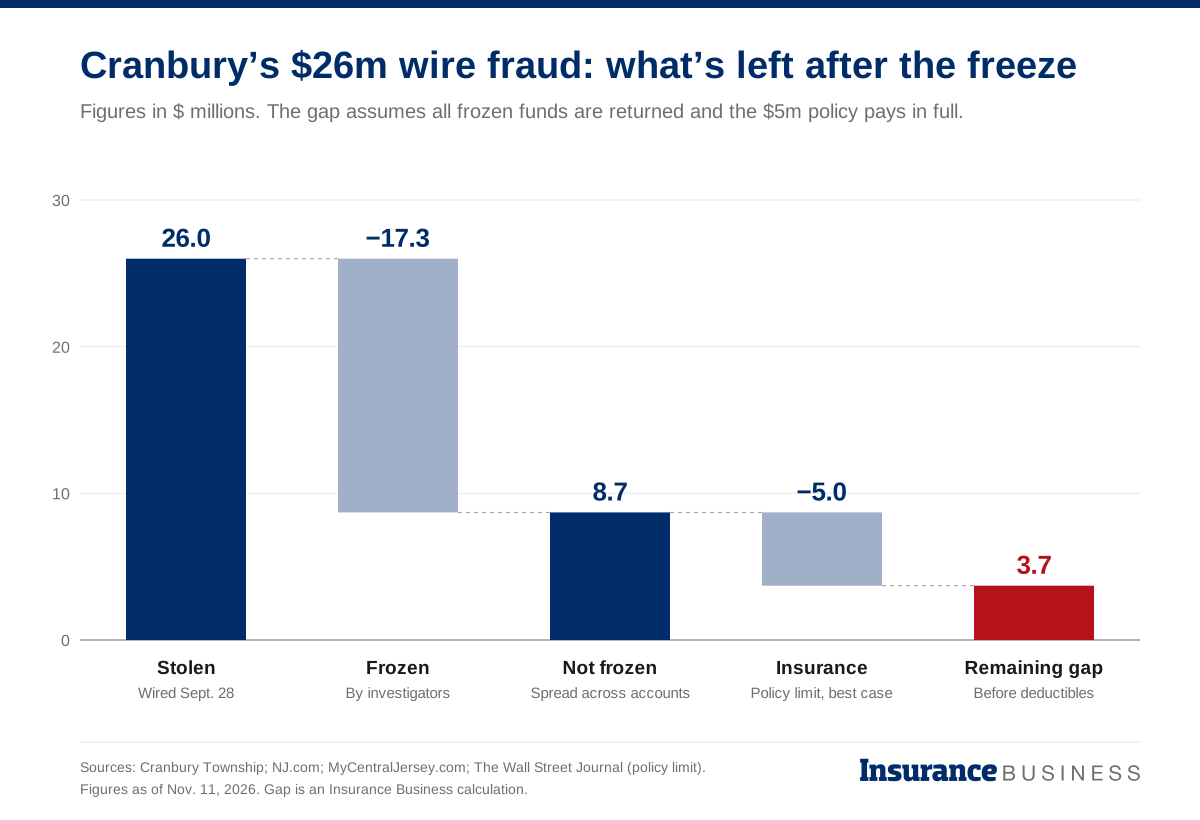
The township’s policy has a $5 million limit, according to The Wall Street Journal. Cranbury says it is working with its carriers to establish the terms and amount of any coverage.
Township attorney Stephen Goodell told residents on Monday that an insurance payout would let the housing plan go ahead on a delayed schedule even if the missing $8.7 million is never recovered, NJ.com reported. Even in the best case, with all frozen funds returned and the full $5 million paid, the township would be about $3.7 million short. Any deductible or sublimit would widen that gap.
Read next: US cyber losses hit $20.9bn in 2025: Public entities face significant cyber risk gap
DeChiara said officers reached Town Hall six minutes after the fraud was flagged, and that the FBI was his first call. He then told staff and elected officials not to discuss the case publicly, fearing the money would be moved if the thieves knew it was being traced. The township announced the theft on Nov. 6.
Freezing roughly 67% of the stolen amount is a better outcome than the national average. The FBI’s Recovery Asset Team runs the Financial Fraud Kill Chain, which works with banks to stop fraudulent transfers. In 2025 it handled about 3,900 incidents involving $1.16 billion in attempted theft and froze $679 million, or 58%, according to the FBI’s 2025 Internet Crime Report. Fast action matters on the insurance side too, because cyber claims are often won or lost in the first hour.
The disclosure came three days after a local election. Some residents say officials held the news back for political reasons. DeChiara has said the timing was his call alone and was made to protect the investigation.
The township has not said how the false instructions arrived. That will matter to the claim, because payment-instruction fraud can be covered under either cyber or crime policies, and the answer often turns on who moved the money.
Alyssa Orschel, cyber and fidelity claims leader at HUB International, has explained how wire fraud exposes the gaps between cyber and crime coverage. When an employee is tricked into sending funds, social engineering coverage generally applies. When a criminal gets banking credentials and makes the transfer directly, funds transfer fraud provisions may apply instead.
Social engineering cover often carries a sublimit far below the policy limit. Some wordings also require staff to confirm changed payment details through a separate channel, such as a phone callback, and skipping that step can put coverage at risk.
Read next: Business email fraud drives bulk of US cybercrime losses: Analysis
Cranbury has not said where its coverage comes from. Most New Jersey towns insure through regional joint insurance funds that sit beneath the statewide Municipal Excess Liability Joint Insurance Fund, which serves about 70% of the state’s municipalities. Members of those funds adopt tiered technology standards to qualify for cyber coverage. In nearby North Brunswick, the town’s 2023 joint fund coverage summary listed fraudulent impersonation as new crime coverage that year.
Since 2010, the same employee has served as Cranbury’s administrator, chief financial officer and finance director. That employee is retiring, NJ.com reported. Resident Tom Beatty told the committee that combining the roles had “created a systematic vulnerability.”
The township has introduced ordinances creating an assistant administrator and an assistant CFO, with a final vote due Nov. 23. It has also hired the accounting firm PKF O’Connor Davies. For now, the mayor says, no township money can move without police oversight.
Underwriters ask about segregation of duties on crime and cyber applications. Orschel has also warned that forensic reviews can find controls that did not match what the insured described on its application.
The FBI received 24,768 business email compromise complaints in 2025, with about $3.05 billion in reported losses. Only investment fraud cost victims more. Most BEC losses moved by wire.
A cyber claims specialist has told Insurance Business that US banks generally verify only the account number on a wire, not the account holder’s name. As a result, one changed digit can send a payment to a criminal’s account without the bank noticing.
Read next: US cybercrime losses hit $21bn as SMB coverage gap persists
Brokers with public sector clients should start by comparing the social engineering sublimit with the client’s largest payments. A land closing or a bond-funded project can be many times the size of a routine invoice. Any callback or verification step the policy requires should be written into the client’s own payment procedures. No single employee should be able to both approve and release a large wire. And clients need a plan that sends the first calls to the bank, the FBI and the insurer.
Cranbury residents want to know whether the missing money will show up in their property tax bills. The township has not yet said.