
For an industry that has spent the better part of a decade watching cannabis insurance stay stuck in a legal gray zone, this week brought a familiar kind of déjà vu.
On September 16, Representatives Nydia Velázquez (D-NY) and Warren Davidson (R-OH) reintroduced the Clarifying Law Around Insurance of Marijuana (CLAIM) Act in the House, a bill designed to stop federal agencies from going after insurers, brokers and agents simply because they choose to write business for state-licensed cannabis operators.
It is the fourth consecutive Congress in which some version of this measure has surfaced, dating back to a 2019 bill Velázquez filed with then-Representative Steve Stivers.
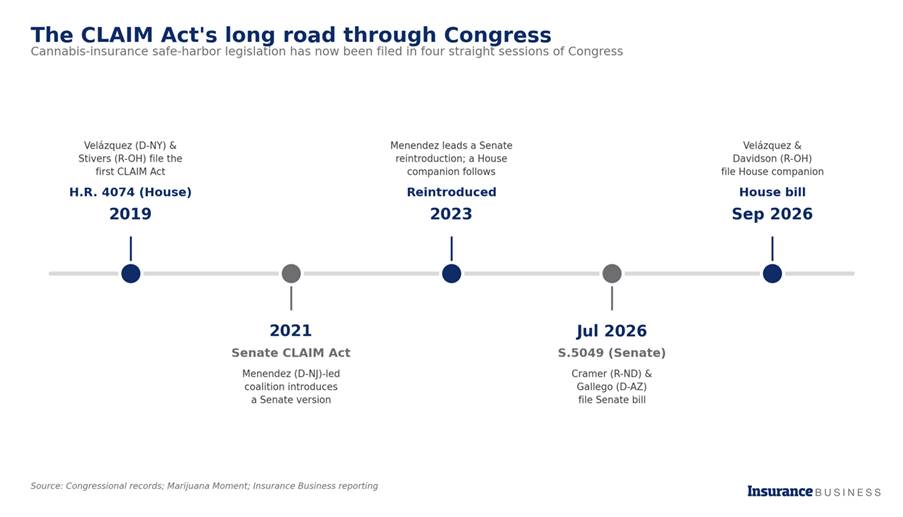
What's different this time is timing. A companion bill, S.5049, was already filed in the Senate in July by Senators Kevin Cramer (R-ND) and Ruben Gallego (D-AZ) and referred to the Banking, Housing and Urban Affairs Committee, meaning the House sponsors aren't starting from zero, they're trying to build momentum around a measure that's already moving through the upper chamber.
Read next: Senate bill would shield insurers covering legal cannabis
Strip away the politics and the CLAIM Act is a fairly narrow piece of drafting. It would prevent federal agencies from prohibiting, penalizing or "otherwise discouraging" an insurer from doing business with a "cannabis-related legitimate business," or with a state, tribe or local government that regulates one. It would also stop regulators from leaning on insurers to cancel, downgrade or otherwise limit coverage purely because a policyholder touches the cannabis supply chain cultivating, manufacturing, transporting, dispensing or selling it.
Notably, the bill doesn't force anyone's hand. No insurer would be required to write cannabis risk under the CLAIM Act; it simply removes the federal exposure for those that already want to. It also leaves the McCarran-Ferguson Act and Dodd-Frank untouched, a detail worth flagging for compliance teams, since it means state insurance regulators rather than Washington would remain firmly in charge of how these policies are actually priced and sold, as Insurance Business reported when the Senate version dropped.
Tucked into the bill is also a directive for the Government Accountability Office to study the specific barriers such as licensing hurdles, access to capital and insurance access that women and minority entrepreneurs face trying to break into the cannabis industry, then report the findings back to Congress.
Velázquez framed the bill that without coverage, a single fire or storm can wipe out a cannabis operator that has no way to recover. Davidson's pitch leaned more on federalism, that Washington shouldn't be second-guessing which lawful businesses a state has chosen to license.
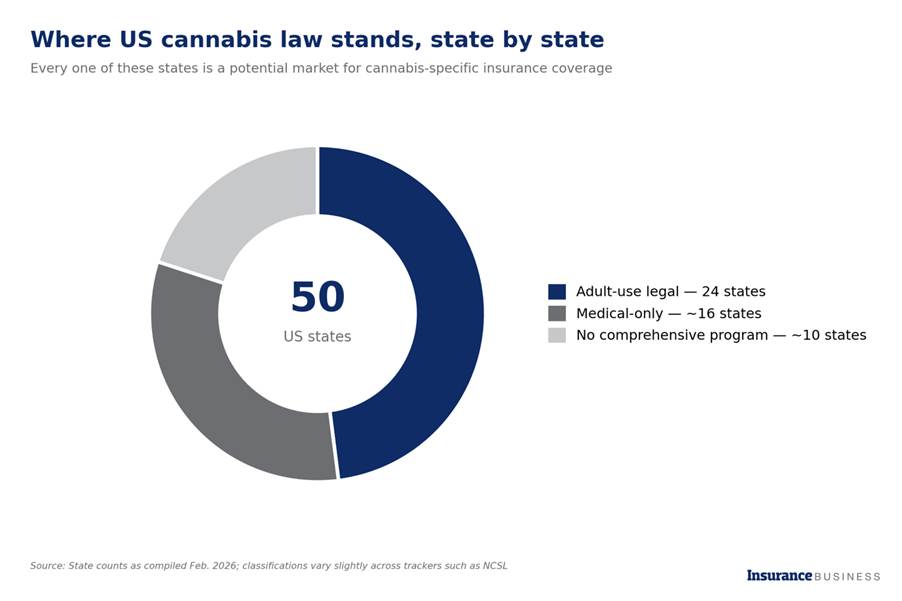
But the more interesting audience for this bill isn't state legislatures, it's the carriers, MGAs and wholesalers who've spent years pricing cannabis risk in a market still dominated by surplus lines players. Under current federal law, cannabis is classified as Schedule I for adult use and Schedule III for medical use which means two different federal buckets, both still short of full legality.
This is exactly the kind of split classification that makes broad, admitted-market underwriting uncomfortable. Many large carriers have simply avoided the space, wary that comprehensive cannabis coverage could expose them to federal money-laundering or racketeering theories despite the rescheduling activity insurers have been watching closely.
That hesitation has a real-world price tag, but it may already be easing. Mike McGee, a vice president at Arizona-based Crest Insurance who works with cannabis operators, told Phoenix public radio station KJZZ that he's "running into fewer and fewer cannabis businesses that don't have insurance" already, and that passage of the CLAIM Act would likely draw more carriers into the space.
"More and more carriers are going to be willing to offer coverage," he said. "And that breeds competition. And that in the end will start to make insurance premiums go down, not up." Separately, a 2026 analysis from personal-finance site MoneyGeek put typical dispensary insurance costs at roughly 35% above the broader retail average - a gap that reflects thin capacity more than claims history, according to brokers in the space.
Read next: Aon-owned NFP expands into cannabis insurance with Frontier Risk deal
A coalition of nine national associations spanning property-casualty, life, title and reinsurance interests, including the American Property Casualty Insurance Association, the American Council of Life Insurers, the American Land Title Association, the Reinsurance Association of America and the Wholesale & Specialty Insurance Association wrote to the bill's sponsors on September 8 backing the measure, arguing the industry remains exposed to liability created by the mismatch between state and federal cannabis law.
That's a notably broad coalition for a niche line of business, and it suggests the industry views the current legal ambiguity as a genuine liability problem for carriers and distributors, not just a missed growth opportunity.
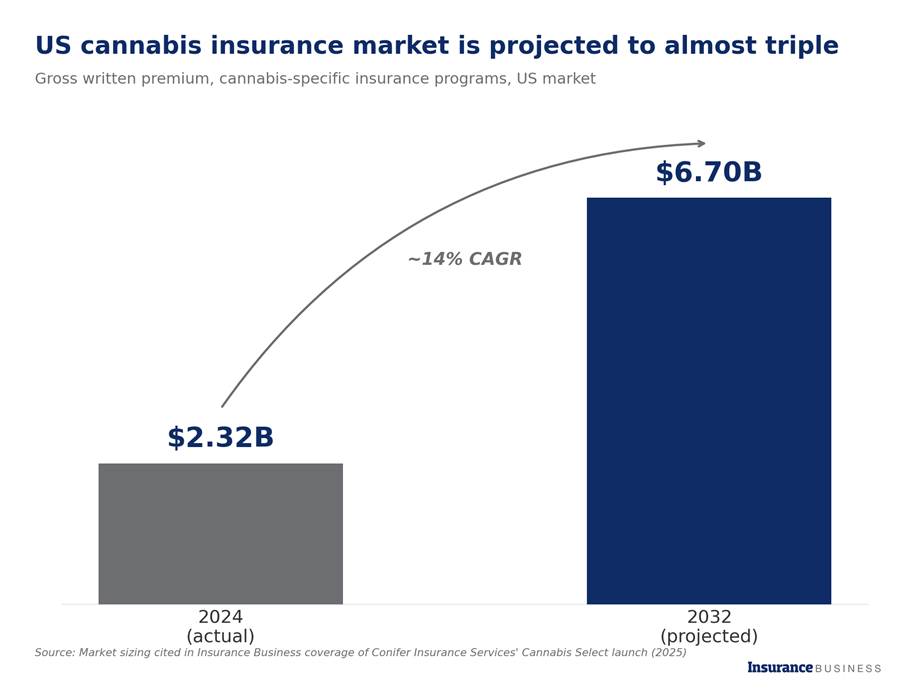
And the growth opportunity is real, even if it's been slower to materialize than some expected. The cannabis insurance segment was valued at roughly $2.32 billion in 2024 and is projected to climb to about $6.7 billion by 2032, a compound annual growth rate of roughly 14%, according to market sizing cited in Insurance Business's coverage of Conifer's Cannabis Select program launch. Whether that growth accelerates likely depends less on marketing and more on exactly the kind of federal liability shield the CLAIM Act is proposing.
Read next: Navigating highs and hazards in the cannabis insurance market
Here's the catch worth flagging to clients and colleagues who might see headlines and assume the problem is already solved: this bill has failed to pass in three previous Congresses.
There's nothing in this reintroduction that guarantees a different outcome, and the Senate companion is still sitting in committee with no floor vote scheduled. For agents and brokers advising cannabis clients today, the practical guidance hasn't changed as coverage still needs to be sourced primarily through surplus lines markets and specialty MGAs built for the space, not assumed to be newly available through standard admitted carriers.
What has changed is the broader direction of travel. Between the rescheduling process working through federal agencies, a parallel push on the banking side through the SAFE Banking Act, and now insurance-specific legislation advancing in both chambers with unusually broad trade-group support, the pieces of a more normalized cannabis financial-services market are, at minimum, being assembled in parallel even if none of them has crossed the finish line yet.
The House bill has been referred to committee. No hearing date has been set.