Perth has been identified as the Australasian city with the most dangerous weather for motorists, according to a global driving weather risk index that carries implications for motor insurance pricing and claims exposure across the country.
The study, compiled by UK-based comparison platform MoneySuperMarket, analysed meteorological data from 138 cities over three years. Each city was scored on four categories worth up to 25 points each: Cold Weather Risk, Hot Weather Risk, Wet/Windy Weather Risk, and Erratic Weather Risk.
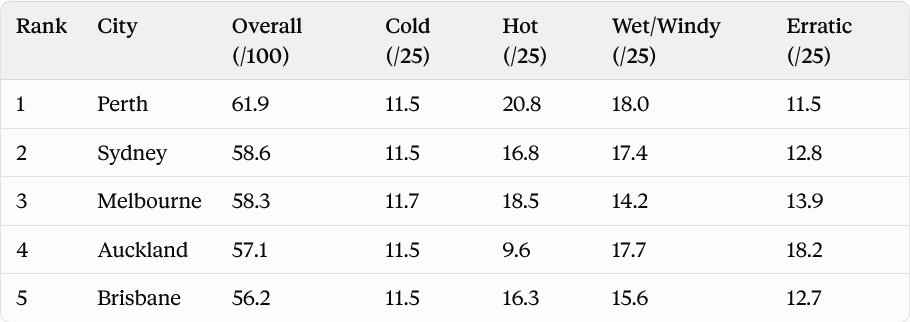
Perth recorded the highest overall Risk Score on the continent at 61.9 out of 100, with the top Hot Weather Risk Score (20.8) and the top Wet/Windy Weather Risk Score (18.0) of any Australasian city.
Bureau of Meteorology data confirms Perth’s heat exposure. The agency’s 2025 annual climate summary for Greater Perth recorded a peak temperature of 43.6°C on January 20, 2025, with mean daily maximums running 0.6°C above the long-term average. Perth Airport recorded the largest anomaly at 1.9°C above average.
The findings come against a backdrop of rising motor claims costs. The Insurance Council of Australia (ICA) reported that insured losses from extreme weather events reached 4.8 billion in 2025, a 727% increase on the prior year. Insurers handled approximately 294,000 claims, with the average cost per claim rising 39% to $16,471.
Motor hull damage accounted for 14% of insured losses from the October 2025 storm sequence alone, according to PERILS AG, the Zurich-based independent catastrophe insurance data firm. The ICA noted the damage extended from “dents on car roofs and smashed windscreens” through to destroyed homes.
Andrew Hall, CEO of the Insurance Council of Australia, said: “Storms and hail are complex events that often have a long tail, meaning claims continue to grow months after the event.”
The Australian Securities and Investments Commission (ASIC), in its Report 838 published in August 2025, found that motor premiums increased more than 42% between 2019 and 2024, with a further 8% rise in the 12 months to July 2025.
Richard Klipin, CEO of the National Insurance Brokers Association (NIBA), told a Senate inquiry into climate risk assessment in September 2025 that the industry was seeing “rising premiums, reduced affordability, and, in some cases, limited availability of insurance,” with pressures “projected to grow as climate change increases both the frequency and severity of extreme weather events.”
Read more: Car insurance premiums: why motor claims costs keep climbing in Australia
Sydney placed second with a score of 58.6, followed by Melbourne at 58.3. Melbourne recorded a higher Hot Weather Risk Score (18.5) than Sydney (16.8), but Sydney scored higher for Wet/Windy Weather Risk at 17.4 compared with 14.2.
Auckland, the only New Zealand entry in the top five, placed fourth at 57.1. Its Hot Weather Risk Score of 9.6 was well below the Australian cities, but its Erratic Weather Risk Score of 18.2 was the highest of the five. Brisbane rounded out the rankings at 56.2.
Cold temperatures were virtually a non-factor across the region. The study measured scenarios including days when wind gusts reached at least 72km/h, when temperatures hit at least 35°C, or when freezing temperatures followed a day of rainfall.
Perth’s combination of high heat and wet/windy risk differs from Melbourne, where erratic conditions are the more prominent factor.
The ICA’s 2025 figures showed Queensland bore more than $4.1 billion of the $4.8 billion national total from extreme weather. The November 2025 storms alone generated approximately 93,000 claims worth $1.78 billion.
Australian Prudential Regulation Authority (APRA) data for the March 2026 quarter showed net claims incurred in domestic motor rose 22% over two years, from $2.34 billion to $2.86 billion. The Bureau of Meteorology confirmed in August 2026 that eastern Australia’s severe thunderstorm season has opened.
Read more: $1.5 billion October storm bill pushes 2025 weather losses to $4.8 billion
In the global rankings, Dallas topped the index at 72.5, followed by Osaka (70.0), Houston (68.9), Bucharest (68.5), and Florence (68.3). Fewer than 10 points separated the top 15 cities worldwide.
Alicia Hempsted, car insurance expert at MoneySuperMarket, said: “The overarching trend in the top global cities with potentially dangerous driving weather is that there is not much trend at all. There is no recurring distribution pattern among the four different weather scenario categories; each city in the top 15 has got there based on a completely unique score combination.”
She added: “There are fewer than 10 points separating the top cities’ overall score, which shows how difficult driving conditions brought about by severe weather are a widespread global issue, rather than something only felt by a handful of cities.”