Millions of Australians have spent years treating their credit card as a substitute for travel insurance. That long-held assumption is now falling apart, and it hands the industry a rare, time-limited opening: a large pool of travellers who think they're covered and aren't, right before their next overseas trip.
With the Reserve Bank's ban on card surcharges landing on 1 October, the big four banks have spent the past few months cutting back the complimentary travel insurance bundled with their rewards cards, some so aggressively that the benefit barely resembles what it was a year ago. For brokers, every one of those cuts is a prompt to have a conversation a client hasn't had yet.
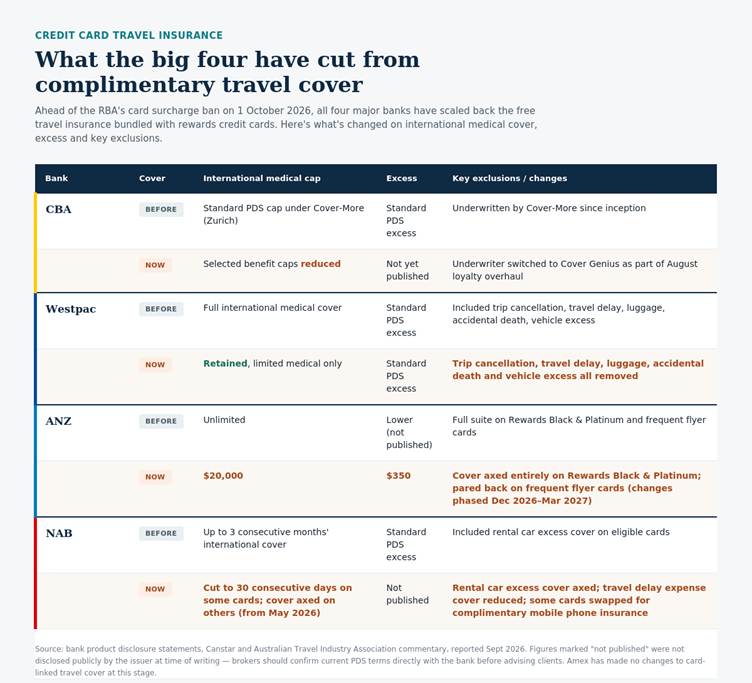
NAB began phasing out complimentary travel cover on several cards back in May, replacing it in some cases with complimentary mobile phone insurance instead. ANZ has introduced a three-tiered structure for its rewards cards, cutting some benefits altogether and, on others, slashing the international medical cover cap from unlimited to $20,000 while lifting the excess to $350. Westpac has stripped trip cancellation, travel delay, luggage and accidental death cover from its international benefit, leaving only limited medical protection. CBA has gone further still, moving its underwriting from Cover-More to Cover Genius as part of a wider loyalty overhaul. A full breakdown of what each bank has cut is in the comparison table below.
Read next: Card payment reform puts travel insurance distribution under pressure
This is all in response to the regulator taking a fat source of profits away from the big Banks. The RBA's Conclusions Paper, released in March, confirmed that surcharge income, long a quiet subsidy for card issuer margins, will disappear from October, taking an estimated $660 million a year in interchange revenue with it. Banks flagged the likely response themselves during consultation: thinner rewards, shorter interest-free periods, and fewer complimentary extras. Travel insurance was one of the first things on the chopping block, and unlike a lost frequent flyer perk, a gap in medical cover is the kind of thing that becomes ridiculously important the moment something goes wrong overseas.
Canstar's Sally Tindall says the changes catch out anyone who assumed their card still covers them the way it used to. "You shouldn't assume the policy you had last year will still provide the same protection now," she says. That's exactly the sentence a broker can turn into an outreach email: clients who booked a trip on the strength of last year's PDS have no reason to know the goalposts have moved.
Read next: Travel insurance reckoning: why the old product won't cut it anymore
Most major issuers still require a minimum prepaid spend, typically $500 for CBA, NAB, Westpac and HSBC, $250 for ANZ, charged to the eligible card before departure, or there's no cover at all. Book a flight on the wrong card, split the spend across two, or redeem points instead of cash, and a client who believes they're protected may not be.
That's not a hypothetical risk a broker has to invent to make the sale; it's already sitting in the fine print of a product millions of people hold.
Dean Long, chief executive of the Australian Travel Industry Association, has long argued cardholders were over-relying on a product most never fully understood. "There was always a level of confusion for consumers about how you activate it," he says, and he expects that confusion to deepen rather than clear as the changes bed in over the next six months. For an industry that spends real money chasing leads, six months of rising confusion among a mass-market audience is a long runway.
Read next: Australians hold cover they can't navigate – and few know it
American Express, for now, is the exception. It has made no changes to its card-linked travel benefits and says it continues to review the regulatory implications, but that's unlikely to hold. With foreign-card interchange caps due in April 2027 and further RBA scrutiny of buy-now-pay-later and digital wallets flagged for mid-2027, this is unlikely to be the last round of cuts to hit the sector.
The practical takeaway for brokers is simple: don't wait for clients to find out the hard way. Anyone who books international travel is a candidate for a quick policy check, and the banks have just handed the industry a specific, dated reason to make that call, before 1 October rather than after a claim gets knocked back.