Global property and casualty insurers have just posted their best underwriting result in two decades. Claims and expenses ate up only 88 cents of every premium dollar collected this year, the lowest combined ratio since before the 2008 financial crisis, driven by a rare run of light catastrophe losses layered on top of several years of steep premium increases.
For an industry that has spent much of the past decade absorbing cyclones, bushfires and inflation-driven repair bills, that ought to be a moment to celebrate. Instead, as reinsurers and brokers gather in Monaco this year to open talks on 2027 pricing, the tone from the top of the market is closer to caution than champagne.
Lloyd's chief executive Patrick Tiernan told the Financial Times that prices in the London market are "coming off faster than we think is rational" — a comment that captures the mood among underwriters watching years of hard-market discipline erode within a handful of renewal seasons.
Howden Re's David Flandro made a similar point in the same reporting, noting that reinsurers are coming off record highs after a run of comparatively low catastrophe losses. His warning was blunter: any celebration is likely to be short-lived, given how expensive the previous down-cycle turned out to be.
Read next: The man who invented modern reinsurance just had his name deleted
Many of us in insurance have seen this pattern before. A big loss event, whether a cyclone, a flood or a bad bushfire season, pushes prices up and drives out weaker capital. Those higher prices then attract new entrants and cheaper capacity, competition erodes margins, and premiums get whittled down until the next large loss resets the cycle.
Fitch Ratings shifted its global reinsurance sector outlook to "deteriorating" in late 2025 and reaffirmed that call in a mid-2026 review, pointing to record capital supply from both traditional balance sheets and alternative capital outpacing demand from insurers buying cover.
Andreas Berger, chief executive of Swiss Re, summed up the risk succinctly: the market remains profitable, but staying disciplined on pricing matters more than ever precisely because everyone has seen this movie before.
The same softening is playing out much closer to home. Broker Howden Re says loss-free property catastrophe business in Australia and New Zealand renewed 10% to 15% cheaper at the 1 July 2026 renewal, extending a softening trend already visible across the region's insurance and reinsurance renewals earlier in 2026 as overseas reinsurance capital piles into the ANZ market. Gallagher Re has reported a similar story, with loss-free catastrophe layers in the region falling by as much as 17.5% at the same renewal.
Local insurers are feeling the benefit. Suncorp used the improved pricing to extend the top of its main catastrophe reinsurance tower to $6.4 billion for the 2027 financial year, on top of a five-year aggregate reinsurance arrangement it had already added earlier in 2026 to soften the blow of frequent, smaller loss events rather than just single mega-catastrophes.
Read next: How to tell which insurers will hold rate when the market softens
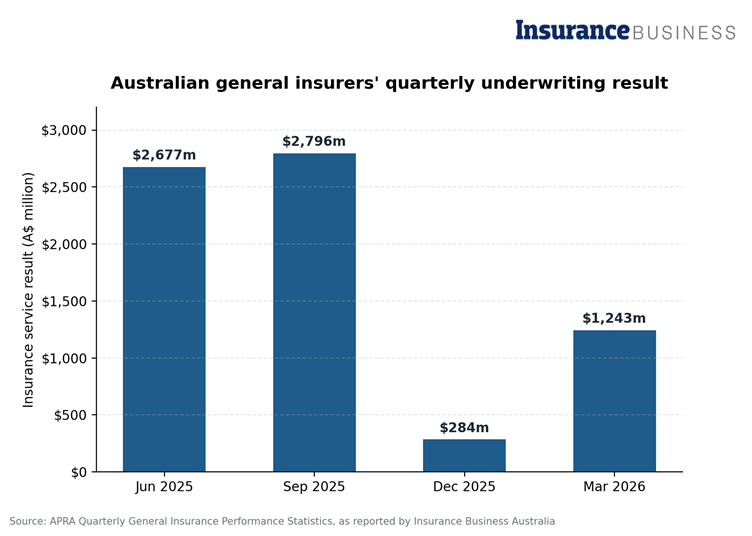
Underwriting profitability, though, remains choppier than the global headline numbers suggest. APRA's latest quarterly statistics show the general insurance industry's after-tax profit swinging from $134 million in the December 2025 quarter to $634 million in March 2026, a recovery that's still a long way short of the $2.265 billion booked in September 2025.
Short-tail property classes alone flipped from a $696 million loss to a $657 million gain over the same two quarters, a reminder of how sensitive Australian underwriting results still are to weather and reserving swings even in a broadly benign year, as reported in Insurance Business's coverage of the APRA data.
Globally, the softening market is pushing insurers to chase growth wherever they can find it, and a good deal of that growth is running through channels regulators are watching closely. Moody's has warned that insurers relying more heavily on delegated underwriting, where authority to bind and price business is handed to managing general agents (MGAs) and coverholders that don't carry their own insurance licence, risk weaker underwriting control as competition intensifies and growth targets get ahead of the oversight meant to keep pace with them. That tension is already playing out in the UK market, where governance has become a defining issue for MGA growth.
Australia's underwriting agency sector is growing through the same softening conditions, if more cautiously. Steadfast's underwriting agencies arm lifted gross written premium 3% to $1.2 billion in the first half of 2026, but earnings before interest, tax and amortisation dipped slightly, a sign that growing volume and protecting margin are getting harder to do together as broker networks navigate a tougher, more tech-driven market.
Carriers are also moving into newer territory: data centres, semiconductor depreciation and financial exposures such as bank loan defaults. The data centre boom alone is reshaping how insurers think about property risk. Allianz Commercial expects the global data centre insurance market to more than double, from around US$11 billion today to over US$24 billion by 2030, as AI infrastructure spending accelerates and pulls insurers into underwriting assets with limited loss history and heavy concentration risk if a single facility, or a single power grid, goes down. S&P Global Ratings has made a similar point about the scale of the opportunity, estimating new data centre premium could reach around US$10 billion in 2026 alone, roughly twice the size of the entire global aviation insurance market, a shift QBE and other carriers are moving quickly to capture.
That doesn't add up to an imminent crash. Reinsurers are still trading well above their cost of capital, and the capital buffers built up over the hard market years give the industry room to absorb a real shock. But the message from Monaco, from Fitch, and from Australia's own renewal season points the same way: pricing power has shifted back to buyers faster than many expected, and the fastest-growing parts of the market right now (delegated authority, emerging risk classes, aggressive new capacity) are the same areas that have historically caused the most trouble.
For brokers and underwriters here, the real work over the next 12 months is telling the difference between risks that are properly priced and risks that are just cheap because everyone else has stopped asking hard questions too