
The Best Insurance Brokers in Canada
Jump to winners | Jump to methodology
Claims over click
See how Canada’s best insurance brokers turn claims handling into client loyalty
By Kim Champion
Digital insurance shopping is booming. Trust in Canada’s best insurance brokers is holding just as strong.
The insurance broker was supposed to be obsolete by now. Canada’s best brokers didn’t get the memo.
Sixteen seconds of dashcam footage. A 3:30 a.m. call about a hotel fire. A single Greek letter that once split a church in two – these are the moments this year’s best insurance brokers in Canada point to when asked what actually earns a client’s trust. Direct-to-consumer digital channels are now the fastest-growing distribution channel in Canada’s insurance market, expanding at roughly 5.12 percent annually as more consumers research and buy coverage online, according to Custom Market Insights’ Canada Property & Casualty Insurance Market report. Brokers and agents still held 58 percent of the market as of 2025.
Insurers are investing heavily in AI-driven, self-service tools built around that shift, part of a broader move toward AI-driven automation reshaping brokerage operations across Canada, and the assumption running through much of the industry is that the traditional broker relationship is under growing pressure.
Insurance Business Canada data, gathered from its own survey of readers who nominated this year’s top insurance brokers, points to something else. Preference for speaking with a broker instead of buying coverage online has barely moved in three years, even as clients have grown measurably more price-conscious over that same span.
IBC’s survey data demonstrates that client preference for speaking with a broker over buying coverage online is:
-
2024 preference score: 4.85 out of 5.00
-
2025 preference score: 4.84 out of 5.00
-
2026 preference score: 4.87 out of 5.00
Whatever is pulling other buyers toward digital-first insurance shopping, it hasn’t touched the group whose broker made this year’s list.
Shara Bierman, COO and principal broker at Strong Roots Insurance Brokers in Stratford, Ontario, points to what separates a top insurance broker in Canada from a search engine. Clients today have more information available to them than ever, she says, but what they’re missing is someone to help them use it.
“Where I see the strongest brokers differentiating themselves is in proactive advice,” she says. “They are helping the customers understand what has changed, why it matters, and how they can improve their risk.”
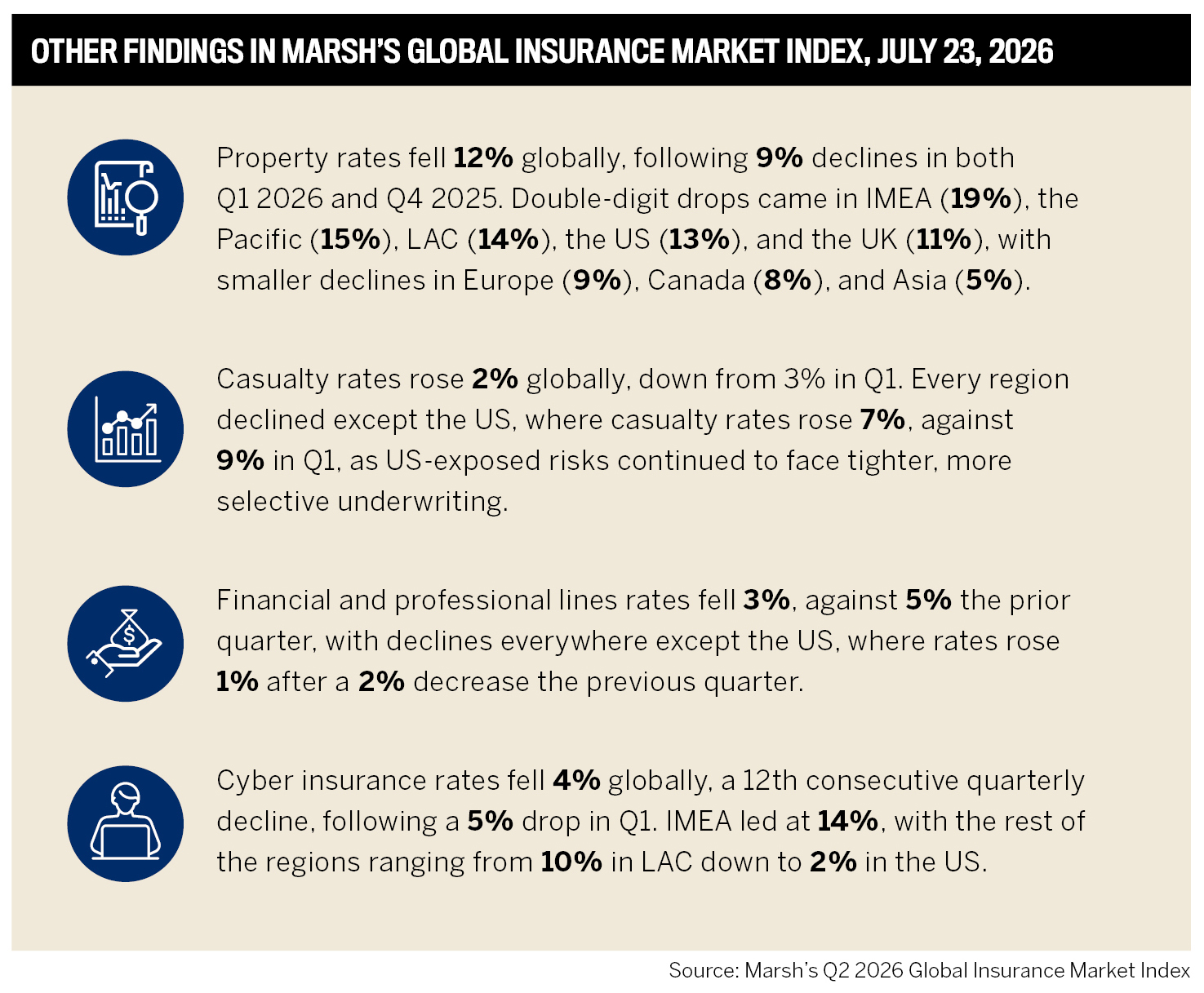
That trust is being tested in a different way this year, too. Canadian commercial insurance composite rates fell 7 percent in the second quarter of 2026, part of an eighth consecutive quarter of declining global rates, according to Marsh’s Global Insurance Market Index.
A softer market often narrows the conversation to price. Katie Pollock, head of broker distribution at BOXX Insurance Services in Toronto, Ontario, says the brokers pulling ahead right now are using that same room to do the opposite.
“A softening market changes the incentive structure in a subtle way,” she says. “It becomes easier to place a book at a lower premium and call it a win, so the brokers who stand out are the ones who use that same room to go deeper.”
This report profiles five of Canada’s top insurance brokers for 2026, now in its fourth year, drawn from a pool of 20 winning brokers nominated by their own clients between June 1 and 26 and rated on six key service criteria, with those averaging a score of four or higher named Top Insurance Brokers.
Recognition here is based not on revenue but on the service brokers provide to the clients who nominated them. The report also looks at three years of survey data behind those ratings, what Canadian clients say matters most to them, how much say they take in choosing their own insurer, and where price pressure is beginning to change their expectations.
Read together, the data and the winners make the same point from two different directions. Even in a market being reshaped by digital convenience and softening rates, the brokers earning the strongest client loyalty are the ones leaning hardest into the parts of the job no algorithm can do.
What Canadian insurance clients want from their broker, and why the gap is widening
Understanding of coverage needs has become the single quality Canadian insurance clients value most in a broker, edging past personalized service to take the top spot in this year’s IBC survey.
But the more striking finding sits at the bottom of the list. Being proactive about additional coverage, a quality respondents rated third most important of six back in 2024, has fallen to dead last by 2026, the steepest decline of any criterion measured over the three-year period.
Every one of the six qualities IBC asked readers to rate has declined in stated importance since 2024, from personalized service (down from 5.00 to 4.80) to fast communication (down from 4.90 to 4.78). But the pattern beneath that overall softening matters more than the softening itself.
In 2024, all six criteria sat within a tight 0.22-point band, suggesting readers saw little daylight between what mattered most and least. By 2026, that band had widened to 0.31 points, split cleanly into a top tier of relationship-driven qualities and a bottom tier of two, dealing with claims and proactive advice, that clients now weight noticeably lower than the rest.
Those same two criteria, dealing with claims and proactive advice, also posted the steepest percentage declines of the six between 2024 and 2026, down 4.6 percent and 7.9 percent, respectively, confirming that what clients now value least is also what has fallen fastest.
Dealing with the headache of claims held the lowest ranking of the six criteria in 2024. By 2026, it has been joined at the bottom by proactive advice, whose fall from mid-tier to dead last is the steepest of any criterion measured. Two different failures now sit at the bottom of the list, which raises a real question about what Canadian brokers are being asked to deliver most and whether the industry is keeping pace.
Key insights
-
Understanding of coverage needs ranks as the most valued broker quality among Canadian clients in 2026, scoring 4.84 out of five.
-
Being proactive about additional coverage dropped from third most important in 2024 to last place by 2026, the sharpest decline measured.
-
Dealing with the headache of claims has ranked as the lowest priority of six broker qualities in every survey year since 2024.
-
All six criteria Canadian clients rate their brokers on declined in stated importance somewhere between 2024 and 2026.
Clients are pulling back from letting their broker fully choose the insurer
IBC also asked respondents how much say they take in choosing which insurance company underwrites their coverage, whether they leave that decision entirely to their broker, decide together, choose the insurer themselves, or let it depend on their circumstances.
The clearest trend across three years is a move away from full delegation. The share of clients who say they always rely on their broker’s recommendation dropped from 45 percent in 2024 to 35 percent in 2026, a 10-point decline. Over the same span, clients who say the decision depends on their circumstances nearly tripled, climbing from four percent to 11 percent.
The middle ground held steady throughout. Discussing options with a broker and deciding together remained the largest single group in every year measured, sitting at 50 percent in both 2024 and 2026 and 52 percent in 2025. Collaborative decision-making, not full delegation and not full self-direction, is the norm among Canadian insurance clients, even as full delegation loses ground.
Key insights
-
Only 35 percent of clients say they always rely fully on their broker’s recommendation to choose an insurer, down from 45 percent in 2024.
-
The share of clients who say their insurer choice depends on circumstances nearly tripled, rising from four percent in 2024 to 11 percent in 2026.
-
Half of Canadian insurance clients discuss options with their broker and decide together, the largest and most stable group across all three years measured.
Clients are growing more price-conscious, but their preference for a broker over buying online hasn’t moved
IBC’s survey also asked respondents to rate how accurately six statements described their own insurance buying behaviour, on a scale of 1 (least accurate) to 5 (most accurate). Two statements shifted more than any others measured across the entire three-year dataset in this report, and both moved upward.
Agreement that price is their primary decision factor climbed from 3.41 in 2024 to 4.01 in 2026, up 0.60. Agreement that they prefer buying from insurers they recognize by name climbed even further, from 3.20 to 3.84, up 0.64, the single largest movement of any statement tracked in this survey.
That rising price sensitivity appears to be coming at a direct cost. Agreement that respondents are happy to pay more for greater peace of mind fell from 4.08 in 2024 to 3.86 in 2026, a decline of 0.22, moving in the opposite direction of the price and brand-recognition statements over the same span.
One statement barely moved at all, and it happens to be the highest rated of the six in every year measured. Agreement that respondents prefer speaking with a broker over buying coverage online sat at 4.85 in 2024, 4.84 in 2025, and 4.87 in 2026, a swing of just 0.03 points across three years. Even as price pressure and brand preference both climbed, the preference for a human broker relationship over an online purchase hasn’t shifted.
Key insights
-
Agreement that price is a primary decision factor climbed from 3.41 in 2024 to 4.01 in 2026, the second largest shift measured in this survey.
-
Preference for insurers recognized by name rose from 3.20 to 3.84 over three years, the single largest movement among the six statements tracked.
-
Willingness to pay more for peace of mind fell from 4.08 to 3.86 over the same period that price sensitivity was climbing.
-
Preference for speaking with a broker over buying coverage online barely moved, holding at 4.87 in 2026 against 4.85 in 2024, the most stable statement measured.
What sets the best insurance brokers in Canada apart
Before turning to this year’s featured winners below, the fuller picture is worth a look. Twenty individual brokers cleared this year’s qualifying bar of an average score of four or higher (out of five), and the pattern behind that list says almost as much about where Canada’s strongest client relationships are being built as any single profile could.
Half of this year’s top-scoring nominees, 10 of 20, are based in Ontario. Saskatchewan is the next most represented province with four, followed by Alberta with three. British Columbia, Manitoba, and Québec each placed one broker among the top scorers.
What stands out most is how tightly this group performs across the board. Scores range from 4.33 to a perfect 5.00, a spread of well under a single point, and five of the 20 honorees, one in four, posted a flawless average across all six criteria.
Understanding of coverage needs is the strongest single category for this group, averaging 4.98 out of five, followed closely by personalized service at 4.96, the same two qualities Canadian clients say matter most to them.
Even the weakest-performing criterion among this elite pool, dealing with claims, still averaged 4.84, well above what most brokers nationally are likely delivering on that front.
One pattern is worth flagging on its own. Only one in four honorees, five of 20, scored a perfect 5.00 average across all six specific criteria. Yet 11 of 20, more than half, received a perfect overall rating of 10 from their client, well over double the share with flawless criteria scores.
That gap suggests a client’s overall sense of trust in a broker often runs ahead of the literal math on the individual metrics, and it’s a fitting note to close on before meeting the five brokers below whose clients gave them exactly that kind of confidence.
Key insights
-
Ontario is home to half of this year’s top-scoring nominees, 10 of 20, with Saskatchewan and Alberta the next most represented provinces.
-
One in four top-scoring nominees, five of 20, achieved a perfect average score of 5.00 across all six survey criteria.
-
Understanding of coverage needs is the strongest-performing criterion among top-rated brokers this year, averaging 4.98 out of five across the full nominee pool.
-
More than half of nominees, 11 of 20, received a perfect overall rating of 10, over double the share who scored a flawless 5.00 across all six criteria.
on all six criteria
When the claim comes in, that’s where Canada’s best insurance brokers earn their place
IBC’s data points to exactly where trust in brokers has eroded. Dealing with the headache of claims and being proactive about coverage are now the two lowest-rated of the six criteria that matter most to clients, with claims falling from 4.78 in 2024 to 4.56 this year and proactive advice falling further still, from a mid-tier score to dead last. Readers increasingly expect less from their broker in the moments that matter most.
The five brokers who made this year’s list are the exception to that trend, not the rule. Every one of them scored at or near a perfect five on claims handling, the same criterion the broader market has grown most skeptical of. Their answer to why is remarkably consistent. A claim is not a problem to hand off. It’s the moment a broker either proves their worth or loses the client for good.
Top Insurance Broker 2026: Mike Peristerakis
Senior Commercial Account Manager, La Salle Insurance, Manitoba
Senior Commercial Account Manager, La Salle Insurance, Manitoba
A history degree taught him that one word decides who pays and who doesn’t
The claim
Mike Peristerakis has a degree in history and classics, and he brings that training directly into how he reads a policy. He points to the Council of Nicaea in 325 AD, where a single letter, the Greek iota, separated two doctrines and split the early Christian church in two.
“One word in the wording, one endorsement is usually what decides whether a claim gets paid or not,” he says. “It comes down to one iota.” That conviction shaped how he handled a major loss for a hotel client.
The insurer’s appraisal was completed 10 months after the date of loss. In that window, construction costs had climbed sharply, and the insurer argued the property was now underinsured against its 90 percent coinsurance clause. They offered to settle, holding back a clawback of a couple of percentage points, a figure that still amounted to tens of thousands of dollars on a multimillion-dollar asset.
Peristerakis refused. He prorated the inflation calculation back to the actual date of loss and produced an independent evaluation showing the original coverage limits had been adequate all along. The insurer reversed course and granted a full 100 percent waiver.
“Empathy doesn’t rebuild commercial properties,” Peristerakis says. “Technical work does.” He sees the industry’s claims trust gap as structural rather than personal, a byproduct of brokers under pressure to move volume and treat placements as finished the moment the premium is collected.


His view of the job itself is just as exacting. “I treat the wording as a contract I’m prepared to defend with hard data, not a transaction that I’ve finished.”
Staying ahead
That same close reading caught a serious gap on a commercial construction file he inherited from a previous broker. The client was building new phases of an apartment complex directly connected to an existing, already-occupied structure, but the prior placement treated the project as a standalone builder’s risk policy, missing that the new work was physically tied to the live building next door.
There was no existing property endorsement and no permission to occupy in place. Left as it was, a loss on the new construction could have voided coverage on the existing property, and coverage on each newly finished phase would have lapsed the moment it was occupied, before the whole project was even complete.
Peristerakis restructured the placement, added the missing endorsement, locked in permission to occupy so coverage wouldn’t drop as phases went live, and extended the completed operations tail to bridge the gap between phases. “You can’t catch something like that with automated software,” he says. “You have to do the line-by-line reading.”
Keeping it personal
Clients notice that habit directly. “Mike reads the fine print, understands how my business physically runs,” is what he hears back most often, he says. He credits staying personal as his client list grows to treating every account like an individual case file rather than a line on a spreadsheet, backed by detailed notes and a meticulous calendar so nothing gets lost between conversations.
Top Insurance Broker 2026: Jamil Karimani
Managing Vice President, BFL CANADA, British Columbia
When a client’s worst day becomes a broker’s greatest opportunity to deliver
The claim
When a longstanding client experienced a significant flood loss at one of their properties, Jamil Karimani immediately recognized that the situation involved far more than physical damage. The client was facing difficult decisions surrounding business interruption, employee impacts, operational continuity, and the long-term implications a claim could have on future insurance costs.
Rather than simply referring the matter to the claims department, Karimani took a hands-on approach from the outset. He visited the site personally, coordinated the adjuster and restoration team, and guided the client through both the immediate and strategic considerations before any decisions were made.
“During a claim, clients need more than technical expertise,” says Karimani. “They need confidence, clarity, and reassurance. Our role is to reduce uncertainty and help them make informed decisions during what is often a very challenging time.”
For Karimani, claims advocacy represents one of the most important responsibilities of a trusted broker. The claim was ultimately resolved successfully, but the lasting result was a strengthened relationship built on trust. The client knew they had an advocate standing beside them every step of the way.

Staying ahead
Karimani believes that delivering value requires continuous education and a proactive understanding of an evolving risk landscape. Rather than limiting strategic discussions to renewal periods, he remains actively engaged with industry associations, market developments, and regulatory updates.
This approach helps clients stay informed about emerging risks, coverage innovations, and shifting market conditions, whether related to cyber threats, communicable disease exposures, supply chain considerations, environmental liabilities, or other evolving risk challenges.
“It is our responsibility to provide clients with the information and insights necessary to make informed decisions about their risk transfer strategies,” says Karimani. “Understanding what risks to retain and what risks to transfer is a critical component of effective risk management.”
Keeping it personal
Karimani has remained committed to a highly personalized service model. He rejects a one-size-fits-all approach to client management and instead tailors his advice, communication style, and risk strategies to the unique needs of each organization.
“There is no standard formula for managing clients,” he says. “Every business faces different challenges, opportunities, and risk considerations.”
Regular engagement extends well beyond renewal discussions, creating ongoing opportunities to educate clients, share insights, and support their broader business objectives.
“I view our relationships as partnerships built on trust and education rather than transactions. At the end of the day, clients remember how you made them feel and whether you were there when they needed you most.”
Top Insurance Broker 2026: Bob Dailey
Commercial Broker, All Insurance, Alberta
Sixteen seconds of dashcam footage saved a trucking client’s driving record
The claim
Bob Dailey’s client, a trucking operator, was rear-ended while pulling out from a stop, and the incident should have ended there. The third party admitted fault on site. But once a claim was logged, it landed on the client’s carrier profile regardless, threatening rates the client had spent years building toward.
Dailey didn’t accept the paperwork at face value. Because the client lived close to the intersection, Dailey had them go back to the location and film several similar trucks completing the same manoeuvre, stopwatch in hand. Sixteen seconds. He took that figure back to the third party’s insurer with a direct question: how could 16 seconds of a truck pulling out fail to give an oncoming vehicle enough time to react? The claim was rescinded, and the incident was removed from the client’s record entirely.
“Claims are the big reason people buy insurance,” Dailey says. “The main reason.” He’s blunt about why the industry has lost ground on this criterion specifically.

His own approach leaves no room for that. “We’re holding their hand through that,” he says of the claims process. “We’re with them every step of the way, in the event of a claim, for sure.”
Staying ahead
Dailey traces his proactive streak to how much he front-loads with a new client. “I’ll ask a billion questions,” he says, learning a client’s operation well enough to build coverage around where the business is headed, not just where it stands today.
The clearest example he points to is the aftermath of COVID-19-driven lumber and construction cost spikes, when replacement costs for buildings jumped sharply and, in his telling, plenty of brokers stayed on autopilot and missed it entirely.
His team reviewed client property valuations at minimum annually, cross-checking against the same tools insurers use so no client was caught underinsured. “Nobody’s happy to hear that,” he says of flagging an undervalued property. “But nobody wants to pay more either, so it creates a fun conversation.”
Keeping it personal
Staying personal at scale, for Dailey, comes down to structure rather than charisma. His team operates horizontally rather than through him alone. “I’m not me without the team,” he says, and every client is introduced to that whole team early, sometimes developing direct relationships with specific staff rather than routing everything through him.
Top Insurance Broker 2026: Karim Chandani
Managing Director, Real Estate and Hospitality, North America, Armour Insurance Brokers, Ontario
A 3:30 a.m. call about a hotel fire became a $12 million test of trust
The claim
Karim Chandani’s phone rang at his local time of 6:30 a.m., with a hotel owner mid-crisis three hours behind in another time zone. Someone had set a fire outside the building, and smoke was already filling the interior. The fire department was on its way.
Chandani assured the panicked owner on the spot that his coverage applied even if the fire had been set intentionally, then alerted his own claims department immediately and stayed in constant contact with the client as the scale of the damage became clear. What started as an expected loss under $100,000 grew into $12 million once smoke damage had spread through the property.
The hotel’s property value was fully covered and repaired, business interruption losses were paid in full, and the property reopened, fully operational and refreshed, after about 11 months.

He points to specific habits behind that philosophy: staying copied on every email between the adjuster and the client, attending site meetings in person, and bringing in an independent control adjuster on large losses so the client feels they have someone in their corner who isn’t the insurer itself.
Staying ahead
Chandani’s proactive work operates at a larger scale than most. After winning two major accounts – a portfolio of 30 hotels and a separate group of more than 20 seniors living in and commercial buildings – he found that both had been juggling multiple brokers and staggered policy expiry dates, dealing with insurance renewals almost monthly.
He consolidated each onto a single master policy with one effective date, a change that stretched their business interruption coverage window from 12 months to 18 or 24 months and forced a full review of building values against current replacement costs, using the Altus guide as a benchmark.
He also added cyber and directors and officers coverage as part of the same review. “This client only realized there was a problem when a claim happened,” he says.
Keeping it personal
His approach to communication is simple and consistent. “Responsiveness and quick communication are probably the biggest thing,” Chandani says, meeting clients on whichever channel they prefer, including text, and sending an immediate message if he can’t take a call right away. “It shows that I care and I am quick to respond.”
Armour Insurance describes its own approach in similar terms. Its strength rests in its diversified, knowledgeable, and courteous staff. Company leaders note its top priority is to advocate for clients while protecting their assets with a high degree of professionalism, empathy, and respect.
Top Insurance Broker 2026: Kathy Dang
Insurance Advisor/Broker, Surex, Ontario
Showing up matters more than having every answer right away
The claim
Kathy Dang doesn’t point to one dispute or one dollar figure when she talks about claims. She points to what a client needs from her in that moment, and most of it has nothing to do with insurance expertise at all.
“One of the most rewarding parts of being a broker is being there for a client when they’re experiencing one of the most stressful moments of their lives,” she says. When a claim happens, she becomes more than the person who sold the policy.
“I become their point of contact and advocate. I take the time to understand what happened, explain the process in simple terms, connect them with the right people, and stay involved throughout the claim.”

On why claims handling has become the industry’s most fragile criterion, Dang points to confusion over roles rather than any single failure. “There can also be confusion around the different roles of the broker, insurance company, and adjuster,” she says. “Clients don’t always know who to call or what happens next.” She tries to set that expectation from the start of the relationship. “I’m here not only when things are going well, but especially when they’re not.”
Staying ahead
Dang’s approach to spotting a coverage gap starts with treating a renewal as a conversation rather than a formality. “I ask questions about what has changed in their life, their home, family, business, assets, travel, or future plans, because those changes can create new exposures,” she says.
More than once, that conversation has surfaced coverage a client didn’t know they were missing. “Sometimes clients don’t know what they don’t know,” she says. “My job is to ask the questions that help uncover those blind spots before they become a problem.”
Keeping it personal
The word Dang hears most often from her own clients is simple. “Caring,” she says. “Clients tell me they appreciate that I genuinely listen and that they don’t feel like just another policy number.”
She’s deliberate about protecting that as her client list grows, staying accessible and explaining things in plain language rather than insurance jargon. “Technology helps with speed, but I don’t think technology should replace the human relationship,” she says. “My goal is to use technology to make communication faster while still making the experience feel personal.”
How Canada’s best insurance brokers are preparing for what’s next
If the past three years have taught Canadian insurance clients anything, it’s that the ground underneath their coverage keeps shifting. And the brokers heading into 2027 with the clearest advantage are the ones treating that complexity as their job rather than a burden to manage around.
Karimani, broker at BFL Canada Risk and Insurance Services in Vancouver, sees a marketplace where risk itself is compounding.
“The biggest pressure points are a continually evolving and increasing risk complexity marketplace,” he says, pointing to cyber threats, natural catastrophes, inflationary costs, trade tensions, and supply chain disruption as forces converging on clients at once.
He expects insurers to keep asking clients to absorb more of that risk themselves, which puts pressure squarely on the broker to move fast. “You’re having to be fast,” he says. “In today’s turnaround time, people are expecting answers, you know, same day.”
Peristerakis, broker at La Salle Insurance in Winnipeg, points to the same complexity playing out differently by sector, climate volatility in hospitality, supply chain risk in manufacturing, and tightening capacity in construction.
“Regulation is shifting fast, and wordings are getting more restrictive,” he says. “General oversight doesn’t really cut it anymore. I’d say every sector demands a real technical depth.”
Dailey, broker at All Insurance in Edmonton, sees the pressure building from a different direction entirely: the courts, where litigation funding is raising red flags for Canadian insurers. “We’re already navigating a world with increasing liability suits, whatever they may be, and the payouts related to those suits are skyrocketing,” he says. “That’s going to challenge how our clients do business.”
He expects that pressure to flow directly back onto brokers, who will need a sharper understanding of a client’s exposures and the insurers still willing to underwrite them. “I look to the US, and I see the numbers are just astronomical on some of those suits,” he says. “We’ll get there, I hate to say, but we have to be very aware of that.”
For Chandani, broker at Armour Insurance in Toronto, the pressure point closest at hand is pricing. “With the soft market, the biggest challenge is going to be handling the issues around price increases as rates increase,” he says.
He’s already telling clients not to get comfortable with today’s rates. “You can take advantage of the soft market, but prices will go up, and you should be prepared for that,” he says, adding that insuring properties to their current replacement value will only grow more important as inflation continues to push those costs higher.
Dang, insurance advisor at Surex in Mississauga, sees the pressure landing squarely on affordability. “I think affordability, changing risks, and the increasing complexity of insurance will continue to be major challenges,” she says. “Clients want good protection, but they also want coverage that fits within their budget.”
Asked what they’d tell a newer broker about handling a client’s worst day well, several winners converged on a strikingly similar answer despite very different specialties.
For Karimani, it starts with recognizing what the client is actually afraid of. “A client’s worst day is rarely about insurance,” he says. “It’s about uncertainty. We are the professionals that bring that level of certainty to what they do.”
Peristerakis frames it as a discipline rather than a mindset. “You can’t defend a wording you’ve never actually read,” he says. “When a claim goes sideways, sit down, open the text line by line, and learn the math of the risk. Be an unyielding advocate. That’s the job, essentially.”
Dailey’s advice is the simplest of the four, and he says it’s the one that gets overlooked most. “Just shut up and listen,” he says. “You’ll learn more that way, and then you can respond in a much more educated, proper manner.”
Dang’s version of that same advice is the most direct. “Don’t disappear when the client needs you most,” she says. “Anyone can be there when you’re quoting a policy or delivering good news. The real test of the relationship is what you do when something goes wrong.”
Her advice comes down to a short list. “Listen first. Don’t make assumptions. Communicate, even when you don’t have all the answers yet. And most importantly, treat the client like a person, not a claim number.”
Taken together, the pressure points these brokers describe – rising complexity, emerging specializations, litigation exposure, and a pricing cycle that won’t stay soft forever – all point toward the same conclusion.
The brokers best positioned for the next two years are the ones already doing the deep, unglamorous work behind this year’s ratings, reading the fine print, sitting with the client’s fear instead of past it, and treating every renewal as more than a number on a page.
Two experts on what makes the best insurance broker in Canada
Katie Pollock
Head of Broker Distribution, BOXX Insurance Services, Ontario
Katie Pollock joined BOXX Insurance, a cyber insurance and protection company, as head of broker distribution in October 2025, bringing over a decade of business development and underwriting experience from Coalition, Berkley, and Travelers to her role overseeing broker relations for the Canadian cyber insurtech – work that sits squarely inside how cyber insurance is evolving heading into 2026 and 2027.
Q: What qualities are you looking for in a top insurance broker in 2026?
A: Technical knowledge and relationship skills are very important, but the quality I’d point to is whether a broker can be both an educator and translator. Clients rarely know exactly what they’re buying until something goes wrong, so the broker who wins isn’t necessarily the one who gets the best premium; it’s the one who sits a business owner down and walks through what a funds transfer fraud claim actually looks like before it happens.
It’s also the broker who understands the operational realities of a client’s industry well enough to spot exposures and who can navigate the nuances between different policy wordings.
Q: Beyond technical knowledge, what soft skills or client-facing qualities do the best brokers bring to the table?
A: One I’d highlight that doesn’t get talked about enough is comfort with saying, ‘I don’t know; let me find out,’ without losing credibility. In a fast-moving line like cyber, no broker has every answer, and the strongest ones build trust by being upfront about the edges of their knowledge. I’d also point to pattern recognition from client conversations. The best brokers I’ve worked with can take an offhand comment, like a business owner mentioning a vendor outage, and connect it to a coverage gap the client didn’t know to ask about.
Q: How does Canada’s provincially licensed brokerage model shape the way brokers compete with each other and with larger, global carriers?
A: Provincial licensing creates real friction that shapes who can compete where. Quebec is the clearest example; getting licensed there is notoriously difficult compared to other provinces, given the province’s distinct regulatory and language requirements under the Autorité des marchés financiers. That barrier alone means a broker’s national footprint isn’t as simple as it looks on paper, and it gives an edge to brokerages that have already done the work to get established in Quebec over those trying to expand in from elsewhere.
Q: Where is technology, digital platforms, automation, or AI actually changing how brokers work today, and where is adoption still lagging?
A: It’s changed the back office more than the client conversation so far. Quoting and binding for smaller commercial risks has genuinely sped up, and automation is absorbing a lot of the documentation load. Where adoption is still catching up is ongoing risk communication between renewals; most brokerages are still building out a real system for pushing timely, relevant risk education to clients outside the annual renewal cycle. That gap is where I think the next differentiation happens, and it’s more about content and cadence than about AI.
Shara Bierman
Principal Broker, Strong Roots Insurance Brokers, Ontario
Shara Bierman, FCIP, CAIB, RIBO, brings over two decades of experience in the insurance industry and served as the Insurance Brokers Association of Ontario’s president for 2025/2026 before continuing on the association’s board as chair for 2026–27.
Q: What separates a top broker from an average one heading into 2026?
A: Today, skills need to encompass more than just insurance knowledge and research prowess. A top broker today needs to be curious and genuinely want to understand the full scope of the client’s needs. They need to ask good leading questions and be able to ask them in a way that promotes openness and honesty from the client.
They need to be able to take the information they’ve received and recognize the insurance exposures that exist. It’s also important they can translate those exposures into an understandable conversation with a client so the client not only understands the risk but also the nuances of the insurance that protects that risk.
Q: What client-facing habits set the best brokers apart from the rest?
A: A great broker will certainly listen more than they talk. But efficiently multitasking is just as important. While listening, they must be able to pull out questions to prompt more discussion, take accurate notes, do the research required to be able to answer all questions accurately and efficiently, and then take the action the call requires. There’s a lot being asked of brokers, and a top broker will be able to continue on with this cycle, call after call, email after email.
Q: Canada’s brokerage licensing is handled province by province. How does that shape competition with larger, global carriers?
A: Canada is an interesting market because insurance distribution is largely provincial. Broker licensing and market conduct sit at the provincial level. That does add to the complexity for organizations looking to scale nationally, but I think it preserves one of the strengths of the Canadian broker model, and that is our proximity to the customer.
Local or regional brokers tend to understand the community and the industries operating within it in a way that’s difficult to replicate from a centralized national or global platform.
At the same time, scale increasingly matters; large brokerages have larger technology budgets, specialty expertise, and significant market leverage. The advantage for provincially licensed brokerages is to lean into their local knowledge and relationships and pair that with technology and insurance options that meet the needs of these local communities.
Q: Where is AI actually reshaping day-to-day broker work right now, and where does adoption still lag?
A: The biggest impact today is probably happening behind the scenes rather than in the dramatic ways people imagine. From transcribing phone calls and creating to-do lists to packaging up information and translating it, our tech stacks are taking care of a lot of AI behind the scenes, freeing up the front-line broker to spend more time advising clients.
I think we’re still early in the adoption and uptake of AI. It’s a difficult balance to utilize the efficiencies of AI without compromising data. I think brokers could also get stuck trying to sort through the volume of options available and coupling that with the integration of these options into workflows.
Why the best insurance brokers in Canada keep earning client trust
What sets this year’s top insurance brokers apart isn’t any single skill so much as a shared refusal to treat the job as finished once a policy is placed. Each of the winners profiled here treats a client’s claim, not the sale, as the moment that defines the relationship, and each does the unglamorous technical work personally rather than delegating it to a template or an automated system.
They read the wording before a client ever needs them to. They flag a coverage gap before a client thinks to ask. They pick up the phone instead of routing a stressed client through a call centre.
None of that shows up on a rate sheet, and none of it can be replicated by a quoting engine, which may be exactly why, in a year when digital insurance shopping grew faster than ever, the clients behind these five brokers never once considered going anywhere else.
The Best Insurance Brokers in Canada






- Angie Cancian, RIBO
Morison Insurance - Bobbee-Jo Wood
Atlas York Insurance - Debbie-Jo Zardo
Morison Insurance - Edith Kernerman
FiduSure Financial - Fardin Ahmed
Link Insurance - Fran Luchenski
Tom Agencies - Irene Gomes, RIBO
Morison Insurance - Karim Zein
HUB International - Leah Jurgens
Atlas York Insurance - Lindsay Fennessy
Billyard Insurance Group - Mandy Vesentin, RIBO, CAIB
Morison Insurance - Mathieu Huard
HUB International - Melanie Dumont, RIBO
Morison Insurance - Sabrina Draper
Western Financial Group - Shelby Swiderski
Atlas York Insurance
Insights


FAQs
What is Insurance Business Canada’s Top Insurance Brokers award?
Top Insurance Brokers is IBC’s annual, reader-nominated recognition of the best insurance brokers in Canada, now in its fourth year, chosen for exceptional client service rather than revenue. Winners are chosen based on client ratings across six service criteria rather than revenue or book size, and the award specifically celebrates the brokers doing right by the clients who nominated them.
What do Canadian insurance clients value most in a broker?
According to IBC’s 2026 survey data, understanding of coverage needs is the single quality clients value most in a broker, scoring 4.84 out of five, narrowly ahead of personalized service at 4.80. Both qualities have declined in stated importance since 2024, though they remain the two highest-rated criteria of the six measured.
Why is claims handling considered the toughest area for brokers to get right?
Dealing with the headache of claims and being proactive about additional coverage are the two lowest-rated of the six criteria measured by IBC, with proactive advice falling to dead last by 2026 and claims close behind. Despite that, this year’s top-rated brokers scored at or near a perfect five on claims handling specifically, suggesting the brokers who invest in that area stand out precisely because so few others do.
Are digital insurance platforms replacing brokers in Canada?
Not based on current data. Direct-to-consumer digital channels are Canada’s fastest-growing insurance distribution channel, but brokers and agents still held 58 percent of the market as of 2025, and IBC’s own survey shows client preference for speaking with a broker over buying coverage online has barely changed in three years, holding at 4.87 out of five in 2026 versus 4.85 in 2024.
Will Canadian insurance clients become more price-sensitive in the coming years?
Recent data suggests that trend is already underway. Agreement that price is a primary decision factor when choosing insurance rose from 3.41 out of five in 2024 to 4.01 in 2026, and Canadian commercial insurance rates have been softening for an eighth consecutive quarter heading into 2026, a trend several of this year’s top brokers say won’t last and are already preparing clients for.
Do Canadian clients still rely fully on their broker to choose an insurer?
Less than before. The share of clients who say they always rely on their broker’s recommendation to choose an insurer fell from 45 percent in 2024 to 35 percent in 2026, while the share who say the decision depends on their circumstances nearly tripled over the same period, from four percent to 11 percent.
Methodology
Insurance Business Canada conducted its fourth annual search for the Top Insurance Brokers to discover the best brokers who act in their clients’ interests. From a diverse cross-section of insurance professionals, the IBC team had the opportunity to spotlight remarkable examples of passion, dedication, and commitment.
From June 1 to 26, the IBC team undertook a rigorous marketing and survey process, leveraging its connections to thousands of readers across the country. Readers were asked to nominate their brokers and rate them on six key criteria.
The most voted-for brokers that received an average score of 4 or higher were named Top Insurance Brokers, who were recognized based not on revenue but rather on the service provided to their clients.