London's marine war-risk underwriters arrive at this week's International Union of Marine Insurance (IUMI) annual conference in Rotterdam bringing with them a pretty big number. Somewhere between $1.5bn and $2bn in claims from roughly 70 vessel casualties since the Gulf conflict began. One broking estimate suggests the final bill could yet exceed an entire year's global premium income for the class.
That figure comes from IUMI secretary general Lars Lange, ahead of a conference that was opened by IUMI president Frédéric Denèfle. The conflict began with US and Israeli strikes on Iran on February 28 and is now closing in on seven months old.
For the Lloyd's Market Association (LMA), which represents the underwriters pricing this risk, the position hasn't shifted much since it started: the market has stayed open throughout, but the price reflects a war with no clear end.
Neil Roberts, the LMA's head of marine and aviation, has repeated the same line whenever asked why ships were avoiding the Strait of Hormuz: there was always sufficient capacity, with cover available for a price. The LMA has resisted the suggestion, made at points by government and shipping-industry figures, that unaffordable or unavailable insurance rather than crew safety was keeping vessels in port.
The price itself has moved a long way. Hull war-risk rates for Hormuz transits started the conflict at around 0.15%–0.25% of vessel value. They spiked as high as 10% during the worst fighting and now sit at roughly 5% for the most exposed voyages. On a $150m tanker, that's a $7.5m bill for a single transit.
Read next: Hormuz war-risk rates surge again as ceasefire collapses
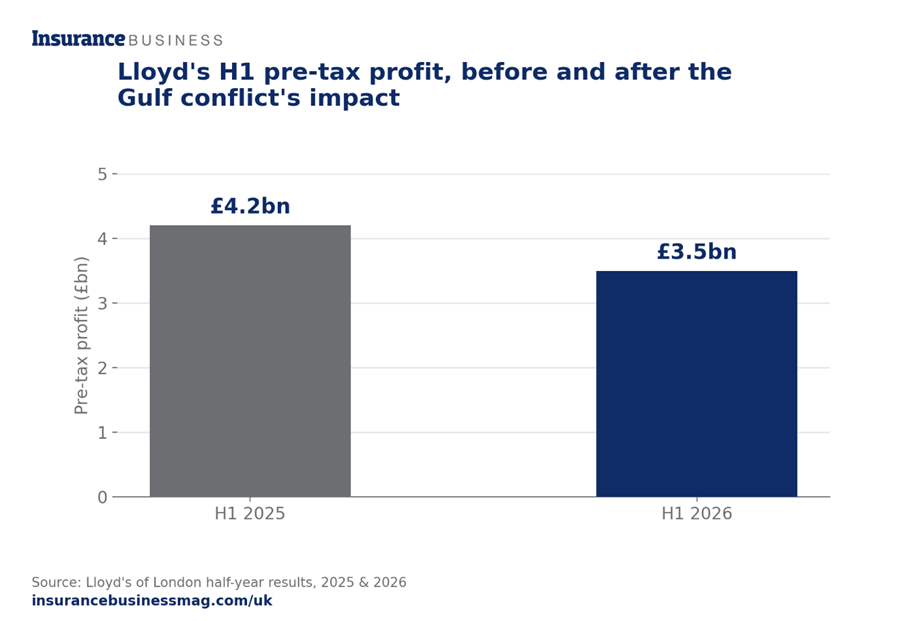
Rate rises this steep tend to invite a familiar accusation, that insurers are profiting from the crisis. Lange's figures, echoed by Lloyd's own half-year numbers, tell a totally different story. Lloyd's disclosed the scale of the conflict's impact for the first time in its half-year results: £1.4bn, or about $1.9bn, in losses tied to the Middle East conflict, concentrated in marine, energy and political violence lines. Chief executive Patrick Tiernan said the exposures seen so far didn't look like a capital event for the market. Pre-tax profit still fell 16.8% to £3.5bn for the half.
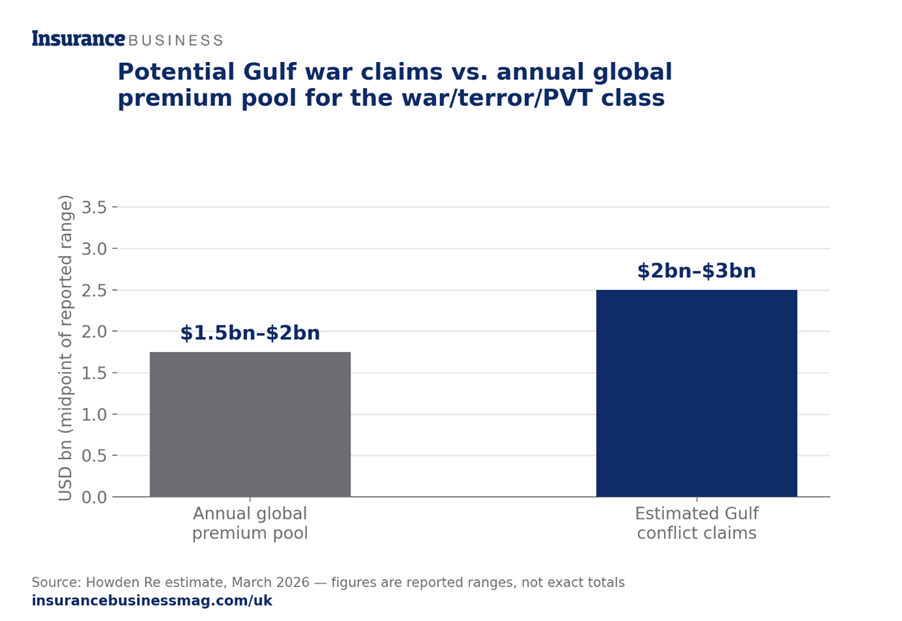
Broking analysis from Howden Re goes further. It puts total potential war, terror and political violence claims from the conflict at $2bn–$3bn against an estimated annual global premium pool for the class of just $1.5bn–$2bn. A single conflict, on that estimate, could cost the market more than a full year's income from the business it's meant to fund.
Read next: Lloyd's puts a number on the Iran conflict for the first time - and flags a tougher year ahead
What makes the Gulf numbers harder to square is that they're landing on a wider marine market that, by IUMI's own account, isn't hardening. Opening the Rotterdam conference, Denèfle described overall conditions as broadly stable but still predominantly soft, with much of the hull and cargo premium growth reported this year coming from currency movements - a weaker US dollar inflating figures reported in dollar terms rather than genuine rate increases. Offshore energy, he said, remains subdued.
His explanation for that mismatch is that war risk is rising, but so is competition from new capacity entering the market, alongside persistent inflationary pressure and continued uncertainty over trade and tariffs. Those forces are pulling in opposite directions at the same time, which is part of why a conflict big enough to eat a year's premium income for one class hasn't been enough to turn the broader market. Denèfle's own summary of where that leaves insurers was that our sector remains strong, agile and ready to adapt.
That backdrop matters for brokers placing business outside the war-risk niche as it suggests renewal conversations on the standard hull and cargo book are unlikely to toughen just because Gulf headlines are worsening.
Even the $2bn figure under discussion in Rotterdam probably understates where this ends up. Many marine war policies now carry a 12-month waiting period before "blocking and trapping" cover responds for vessels stuck in the Gulf, treating a ship as a total loss if it stays stranded for a year, even undamaged. Hostilities resumed in August after a ceasefire collapsed within weeks, and vessels remain stranded on both sides of the Strait. A meaningful share of this war's cost may not surface until well into 2027.
The Strait carries roughly a quarter of the world's seaborne oil trade and around a fifth of global LNG shipments, according to the International Energy Agency. A prolonged closure reaches well beyond marine underwriters into energy pricing and the wider political violence and terrorism market.
Denèfle flagged a related, longer-term shift which is that insurers will increasingly be asked to cover longer trade routes that exist specifically to avoid conflict zones, as shippers reroute around the Gulf rather than pay war-risk premiums to cross it. That's a different underwriting problem to the one dominating this week's headlines, and one likely to outlast the current conflict.
Read next: Hormuz war-risk rates face fresh pressure as Iran-US clashes resume
Throughout the conflict, one thing hasn't changed: the US government's attempt to solve it with its own insurance scheme hasn't got off the ground. President Trump ordered the US International Development Finance Corporation (DFC) on 3 March to set up political risk cover for Gulf shipping. Within days the agency unveiled a facility worth up to $40bn, naming Chubb as lead underwriting partner. Six months later, reporting has repeatedly found the scheme has placed zero dollars of actual coverage. Senator Jeanne Shaheen has pressed the DFC on how taxpayer money is protected and who ultimately benefits from a facility built to keep the Strait open.
That leaves the commercial market carrying this risk on its own, at prices the LMA maintains reflect genuine danger rather than any shortage of capacity even as the wider market Denèfle described stays soft around it.
Read next: US senator presses DFC on taxpayer risk in $20 billion maritime reinsurance proposal