For the best part of a decade, the London market has treated Brexit as weather rather than politics. It has built hubs in Brussels, Dublin and Luxembourg, shifted millions of policies across the Channel, rewritten its wordings and got on with business.
Last week the prime minister turned it back into politics.
At Labour's conference in Liverpool, Andy Burnham said Britain could not plot a course through the rest of the century until it settled its relationship with Europe. He then laid out a menu: stay as we are, form a customs union, rejoin the single market or, as he put it, "go all the way" and rejoin the bloc.
In a BBC interview the next day he went further, opening the door to rejoining after the next general election, and confirmed that the long-delayed UK-EU summit will take place before the end of the year. That is where he has promised to put his options on the table.
It is a sharp turn. Barely a fortnight earlier, as Insurance Business noted when looking at Canada's bid for associate EU membership, Burnham's government was still holding Labour's red lines: no single market, no customs union, no free movement.
The reaction across the Channel was warmer than anyone in Westminster expected. Emmanuel Macron, speaking alongside Spain's Pedro Sánchez, broke into English to say "welcome back". But the French president was just as quick to add that Britain could not cherry-pick the parts of membership it liked.
Michel Barnier, the EU's former Brexit negotiator, went further, warning that the single market is not à la carte and that the further Britain drifts from EU rules, the harder any return becomes. That warning matters more to insurers than to almost anyone, for reasons we will come to.
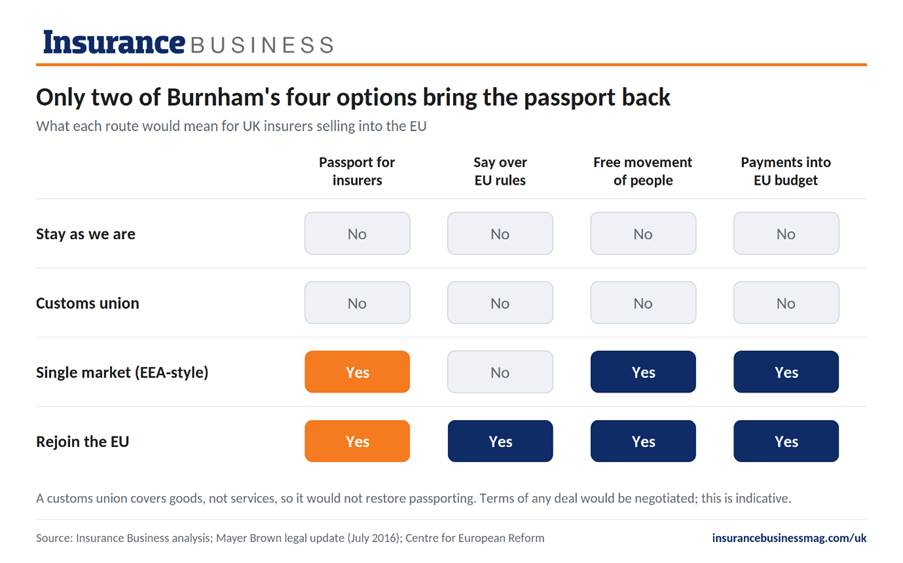
Burnham's menu treats the four choices as points on a scale. For financial services each point is uniquely different.
A customs union is about goods: tariffs, rules of origin and border checks. It would help carmakers and food exporters. It would do next to nothing for an insurer trying to write a risk in Lyon from an office in London, because it does not touch services.
Charles Grant, director of the Centre for European Reform, drew the same line this week: a customs union would mainly help manufacturing in the North and Midlands, while undoing the damage to the City would take the single market or full membership.
The single market is different. Lawyers advising the market made the point back in 2016 that only a Norway-style arrangement inside the European Economic Area would preserve the passport, the right to sell across the bloc on a single home licence. The price of that deal, however is the one Leave voters rejected: free movement, payments into the EU budget and rules written without a British vote.
Full membership would restore the passport and, crucially, a say over the rules. But it could also mean giving up the opt-outs Britain once had.
YouGov found in June that support for rejoining dropped to around a third of voters if it meant signing up to the euro and the Schengen area.
The economic case for a rethink has hardened over the last decade. A landmark paper co-written by Stanford's Nicholas Bloom and Bank of England economists estimated that by early 2025 Brexit had left UK GDP 6% to 8% smaller than it would otherwise have been, and it singled out finance and insurance as one of the most EU-exposed sectors. A Centre for European Reform report published in June put the fall in finance and insurance exports to the EU at a whopping 24%.
The structural bill was large too. By early 2019 the ABI estimated that UK insurers had moved around 29 million contracts and set up about 40 new hubs in the EU, each needing its own capital, board and compliance team.
Read next: Ten years on: what did Brexit actually cost the UK insurance industry?
But our industry hasn’t stood still over the last decade. Lloyd's set up its Brussels insurer, Beazley expanded in Dublin, and Hiscox and AIG chose Luxembourg. And the building has not stopped: London-based MNK Group's purchase of Danish insurer ETU Forsikring was approved by the Danish regulator in September, and Bridgehaven completed its deal for Dublin-based SureStone last December.
As we reported last month, UK broking groups are now buying their own EU insurers rather than renting EU paper from others. Clyde & Co's Marcella Hill described buying a licensed carrier as quicker than starting from scratch, but "not a light-touch move".
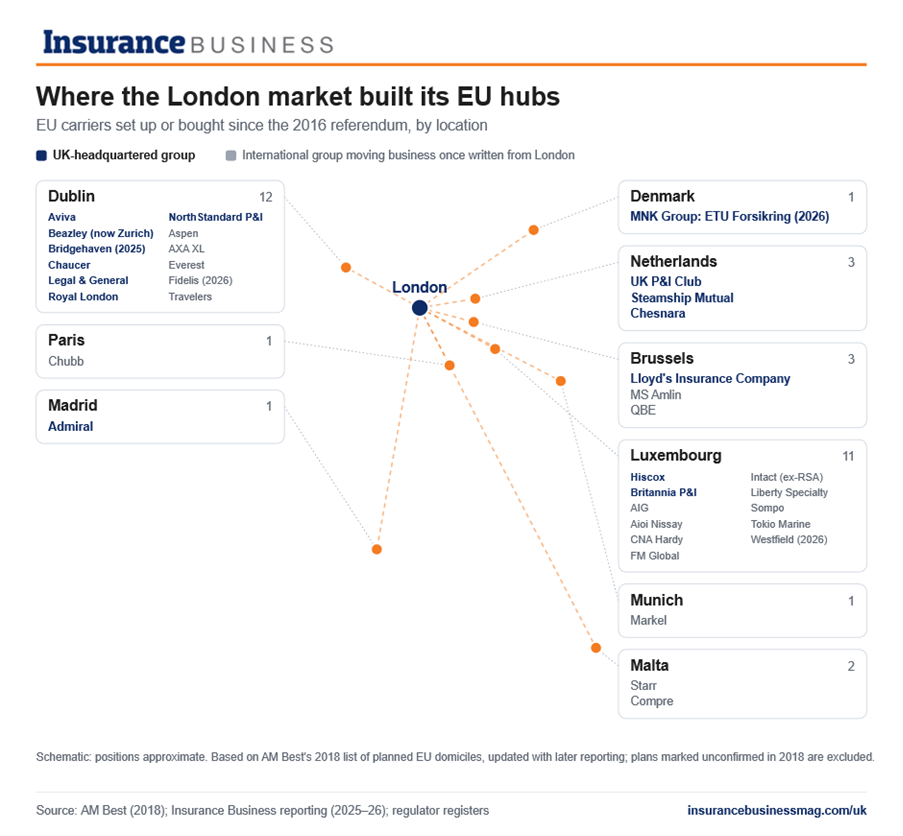
If the passport ever returned, those entities wouldn’t just vanish overnight. European clients have got used to dealing with local carriers, and regulators like to see real substance on the ground.
But the economics of running two capital bases, two boards and two rulebooks would look very different, and every board that signed off an EU hub will be asking how long it needs to keep paying for one.
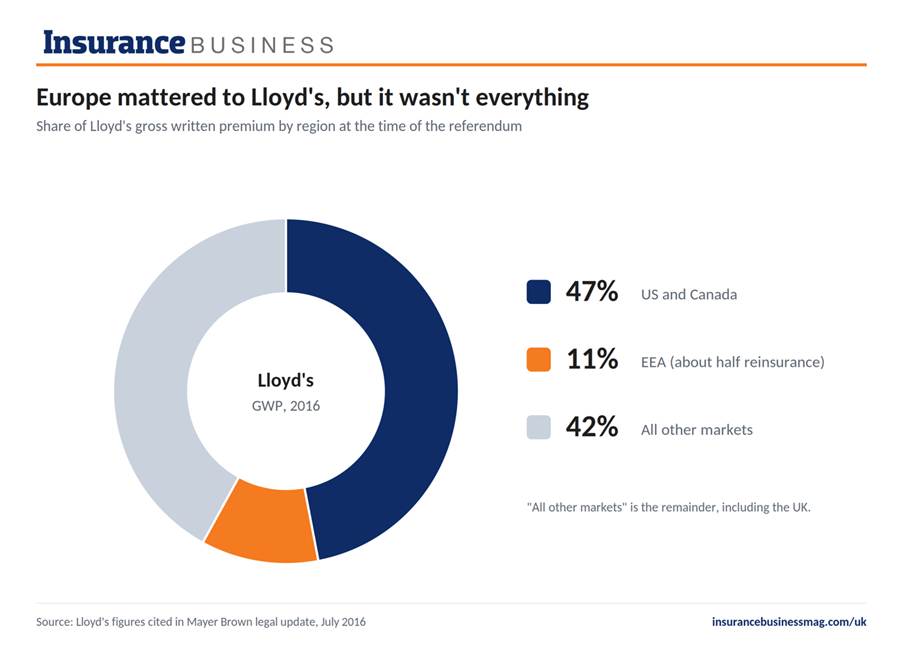
It is also worth keeping Europe in proportion. When Lloyd's ran the numbers after the referendum, the EEA accounted for around 11% of its gross written premium, almost half of it reinsurance, while the US and Canada together made up 47%.
Those figures are a decade old, and the market has grown a lot since: Lloyd's wrote £57.9bn of premium in 2025, and its then chief executive John Neal said in March 2025 that the Brussels subsidiary was delivering double-digit growth. Europe is a growing piece of the business, but for much of the specialty market it is still one piece among several.
Read next: Bridgehaven completes SureStone deal to launch EU hybrid carrier hub
Since leaving, the UK has been rewriting its prudential rules under Solvency UK, consulting on a domestic captive regime due in 2027 and preparing an Enhancing Financial Services Bill to simplify insurance regulation. Much of that was lobbied for by the industry itself.
Any serious move back towards the single market would almost certainly mean realigning with Solvency II and the wider EU rulebook, unwinding reforms that firms have only just started to price into their capital plans.
The industry's own ask has tended to be narrower: the Lloyd's Market Association has long pushed for equivalence or mutual recognition for insurance, and BIBA has set out its position on EU market access in its 2026 manifesto. Neither is the same thing as rejoining.
Sentiment is clearly moving. When Insurance Business asked its LinkedIn community this summer how they would vote in a fresh referendum, 58% said remain and 26% leave. YouGov's June polling found 57% of Britons now think leaving was wrong, against 30% who think it was right.
Read next: Brexit Bregret? Insurance professionals have their say
But the road back is a long one. EU capitals want to know that any British shift in policy would survive a change of government, and Reform UK, which is leading the polls, wants nothing of the sort.
Accession would need ratification in every member state; in France that means a three-fifths vote in parliament or a referendum, with a presidential election due next year in which Marine Le Pen has vowed to block further enlargement.
Burnham's next test comes in Berlin, where he is expected next week for his first talks with German chancellor Friedrich Merz. For insurers, the more telling signals will come later.