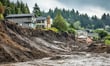
A landslip on the Isle of Skye has closed one of the island's main roads, leaving drivers facing a diversion of almost 40 miles and putting a spotlight on how property and business cover responds when the ground gives way.
The slip happened at Idrigill Bend on the A855, just north of Uig, at around 6pm on October 2, when earth fell away from the side of the road onto a local access road below. Traffic Scotland recorded the closure shortly after 6pm. No one was hurt, and the moment was caught on CCTV from a nearby house, according to media reports.
The A855 loops around the Trotternish peninsula in the north of the island. Highland Council said on Saturday the road would stay closed over the weekend while its roads team cleared the slipped material and assessed the repairs needed. Local councillor Chrissie Gillies has warned the closure could run into this week while detailed surveying continues.
The diversion runs via the Quiraing Road, the A855 Staffin Road and the A87, and can add up to an hour and 20 minutes to journeys. The council has postponed planned resurfacing on the Quiraing Road to keep it open as an alternative, but warned the route needs significant improvement and isn't suited to heavy traffic.
For homeowners, the position is relatively clear. The Association of British Insurers said landslip, along with subsidence and heave, is a standard feature of buildings insurance. Most policies apply an excess of around £1,000 for ground movement claims, and it can be higher where a property has a history of movement.
Cover usually extends to the home and its outbuildings. Garden walls, fences, gates, patios and driveways are generally covered only if the main building is damaged at the same time.
The harder questions are for businesses on the peninsula that rely on visitors and passing trade. Standard business interruption policies require physical loss or damage to trigger cover, as Insurance Business has noted in its analysis of losses that fall into the gaps between policy wordings. A business that is cut off, rather than damaged, has to look to its extensions.
Prevention of access extensions are designed for this kind of event. They typically cover losses when an authority closes or restricts access following a specific incident within a specified radius of the premises. These extensions come in two broad forms. Damage-based wordings require physical damage to property in the vicinity of the insured premises, which a landslip that has damaged the road itself may satisfy. Non-damage denial of access wordings respond to an authority closure even where there is no physical damage, but are less common and often carry tighter sub-limits. A council road closure after a landslip fits that pattern, but whether a claim succeeds depends on the radius set in the policy, whether the closure counts as a qualifying authority action, and any sub-limits and indemnity periods.
The Supreme Court's 2021 ruling in the FCA's business interruption test case widened how these clauses are read. It found that a total closure is not needed to trigger denial of access cover, and that a partial closure may be enough. As brokers noted when the industry reacted to the ruling, clauses that only provide localised cover were not broadened by the decision. That point is directly relevant to a single road closure on Skye.
In practice, a guesthouse or café whose customers face a long detour, rather than a locked door, may struggle to show that access has been prevented, as opposed to merely made harder.
Landslips are a familiar problem on Scotland's roads. The A83 at the Rest and Be Thankful in Argyll has been closed repeatedly after heavy rain triggered slips, including one that brought around 5,000 tonnes of mud and rock onto the road in 2020.
For brokers with rural and tourism clients in the Highlands, the Skye closure is a timely prompt to review prevention of access wordings ahead of winter: the radius that triggers cover, whether a road closure by a council counts, and how long the indemnity period runs.