
Ottawa is negotiating something that would have sounded far-fetched a decade ago. Canadian prime minister Mark Carney has spent months sounding out European leaders about a bespoke status for Canada that doesn't currently exist: "associate member" of the EU. The idea would let Canadian firms in energy, AI, defence and critical minerals move goods, services and possibly workers into the EU's single market with far less friction than today, without Canada ever joining the bloc outright.
It's a trade and geopolitics story on its face, but it lands in the UK at an odd moment, just as domestic polling suggests British appetite for a closer EU relationship is at its highest point since the 2016 referendum. For an industry that has spent nine years rebuilding its access to the European market from scratch, both stories are worth a closer look.
The plan, still being sketched out by technical working groups on both sides, would see Canada align with EU rules in a handful of strategic sectors rather than adopt the whole rulebook. Officials have discussed joint data centres and undersea cables linking the two economies, and even visa-free travel for Canadians in Europe. Finnish president Alexander Stubb has reportedly told Carney he'd rather see Canada tied to Europe's economy than America's – a striking comment given how integrated the two North American economies have become since Nafta.
Nothing is agreed yet. Ten EU member states still haven't ratified Canada's existing trade deal with the bloc, signed almost a decade ago, which says something about how long even a willing Brussels can take to finish paperwork.
New polling reported this weekend puts support for UK rejoining the EU at its highest sustained level since the referendum, with a majority now saying they'd vote to rejoin if asked tomorrow. Pollsters are quick to add a caveat: almost nobody who actually voted in 2016 has switched sides. The movement is generational – a decade's worth of new voters has entered the electorate, and they lean heavily towards closer EU ties.
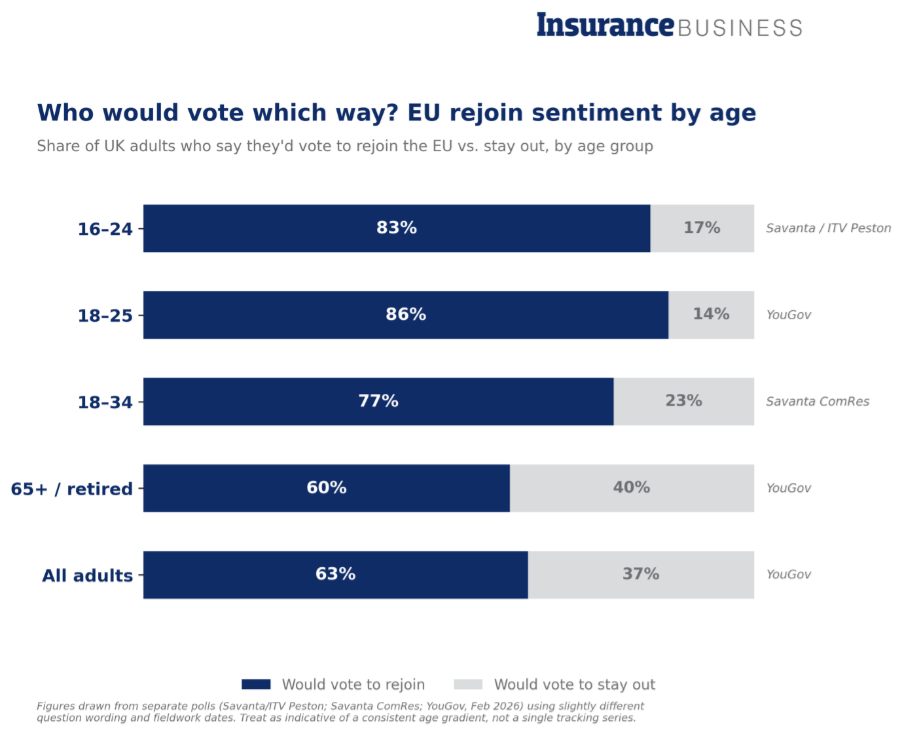
That doesn't put a second referendum anywhere near the table. Andy Burnham, who replaced Sir Keir Starmer as prime minister in July, has kept Labour's manifesto "red lines" in place: no return to the single market, the customs union or free movement of people, a position his own spokesperson has restated since he took office.
That's despite Burnham's own long-standing sympathy for closer EU ties, including past comments that he'd like to see the UK rejoin "in his lifetime" – a gap between personal instinct and government policy that's likely to be tested as his premiership goes on.
For now, what his government has actually agreed to with Brussels is narrower: an economic deal on food and agricultural trade, talks on a youth mobility scheme, and exploratory work on linking into the EU's electricity market. Financial services sit apart from most of that, though not entirely outside it.
According to the official parliamentary record, the Treasury told the House of Lords in March that financial services form part of ongoing UK-EU discussions on growth and competitiveness, with the two sides using a Joint EU-UK Financial Regulatory Forum to keep talking – a channel with no power to restore insurance passporting, but a live one nonetheless.
Read next: Solvency II: should it stay or should it go?
The industry didn't wait for any of this. When the UK left the single market, insurers based in London lost their passporting rights – the ability to sell policies directly into EU states without a local licence. LIIBA, the London & International Insurance Brokers' Association, said at the time that neither UK firms nor EU clients would be well served without some form of mutual market access.
The industry's response was to build. By the time the UK actually left in 2020, the ABI put the number of new EU hubs set up by UK insurers at around 40, with roughly 29 million policies transferred across to them, a figure also cited by the German Insurance Association, which tracked the same trend from the EU side. That construction project hasn't stopped. Fidelis has just moved its EU hub to Dublin, Westfield Specialty is opening a new carrier in Luxembourg, and Bridgehaven has just completed a deal to launch its own EU hybrid carrier hub. None of it replaces passporting on cost or simplicity, but it has kept most London Market business moving.
Motor insurance had its own, smaller version of the same problem. UK drivers needed a physical "Green Card" to prove valid cover when crossing into the EU from 2021, until the European Commission dropped the requirement later that year – a decision the ABI welcomed, particularly for drivers crossing the Irish border. Even the most basic mechanics of cross-border cover had to be rebuilt once the UK became a third country.
Set against that backdrop, three developments are worth watching if you run a UK insurance business.
Solvency UK. Freed from Solvency II, the UK has been rewriting its own prudential rulebook, with changes aimed at releasing capital tied up in insurer balance sheets for long-term investment, plus a new UK captive insurance regime due for consultation this summer ahead of a 2027 launch. Whether that divergence becomes a real edge for London over Frankfurt or Amsterdam, or just another rulebook for firms operating on both sides of the Channel to track, is still being tested.
The Enhancing Financial Services Bill. Announced in the King's Speech and due before Parliament in the 2026/27 session, this is the legislative vehicle for the government's "Leeds Reforms" and the FCA's plan to simplify insurance rules. BIBA, which represents over 1,700 broking firms and more than 130,000 people, has called the bill its top manifesto ask. Chief executive Graeme Trudgill said the announcement was "essential" and "extremely positive news" for the sector. A companion EU Partnership Bill is also expected, aimed at giving the government a legal mechanism to align with EU rules where it chooses to.
Continued EU expansion. The subsidiary-building that started as damage limitation in 2018 has become a genuine growth channel. Firms with an EU foothold already in place are better positioned to pick up business as continental clients consolidate their broking and underwriting relationships – a trend playing out across recent EU-facing deals in the London Market.
Carney's associate-member plan is really an attempt to find something between full membership and total separation – precisely the kind of arrangement Brussels insisted couldn't exist during the UK's own withdrawal talks, when EU negotiators ruled out any "cherry-picking" of single market benefits.
If the EU is now willing to build a new tier of membership for Canada, it raises an obvious question: could something similar eventually apply to financial services, rather than the current mix of national subsidiaries, equivalence gaps and forum meetings?
For now, that's a question for a future government, not a live policy option. The government has so far kept its reset narrow and sector-specific precisely to avoid reopening a single market argument that still divides the party.
For insurers and brokers, the more useful signals will keep coming from smaller, practical places: the pace of EU subsidiary licensing, how the Enhancing Financial Services Bill lands in Parliament, and whether the Joint EU-UK Financial Regulatory Forum produces anything beyond talk.
A younger, more pro-EU electorate is changing the politics. Whether that changes the terms UK insurers actually trade on is still an open question, and one this market has learned to keep working around rather than wait for an answer to.